White from Red
Base Wine & Blend
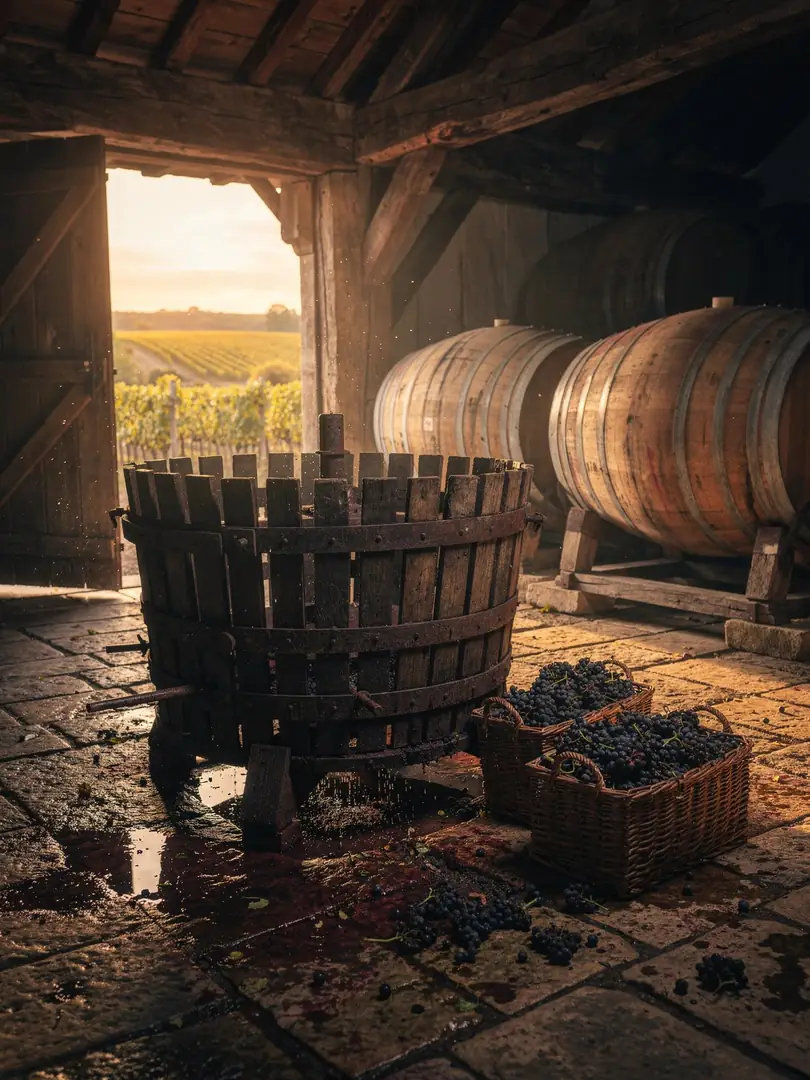
The juice of a Pinot Noir berry is pale; the color sits in the skin. Pressed whole and gently, the must stays almost colorless, yielding Blanc de Noirs, a white wine made from black grapes. In Champagne, grapes are hand-harvested so that intact bunches reach the press and the juice doesn't take on color.
Because so much Pinot Noir grows here, Blanc de Noirs is right at home on the Montagne. According to merchant sources, Hugues Godmé from Verzenay offers one entirely without dosage, and Krug crafts the Clos d'Ambonnay from a single parcel in Ambonnay, also pure Pinot Noir.
With rosé, there are two paths. For an assemblage rosé, a small amount of red wine is added to a white wine before the second fermentation—according to the trade press, around five to fifteen percent, depending on the house. For still wine this is banned under EU law, but for sparkling wine blends an exception applies, and the Champagne specification explicitly names the method.
The second path is called saignée, French for "bleeding." Red grapes sit briefly on their skins in the juice, then the colored must is drawn off and fermented into rosé. For its Cuvée Rosé, Laurent-Perrier relies on pure Pinot Noir with two to three days of skin contact, as Decanter reports, using grapes from Grand Cru villages such as Ambonnay and Bouzy.
You can taste the difference. Saignée rosé tends to be darker, more wine-like, and bolder in fruit, while an assemblage rosé is usually finer and paler. Neither method is better than the other—they simply aim for different styles. At this stage, winemaking is far from finished: the base wine is initially tart, hard, and without bubbles. It serves the cellar master as the raw material from which the final blend is later assembled.