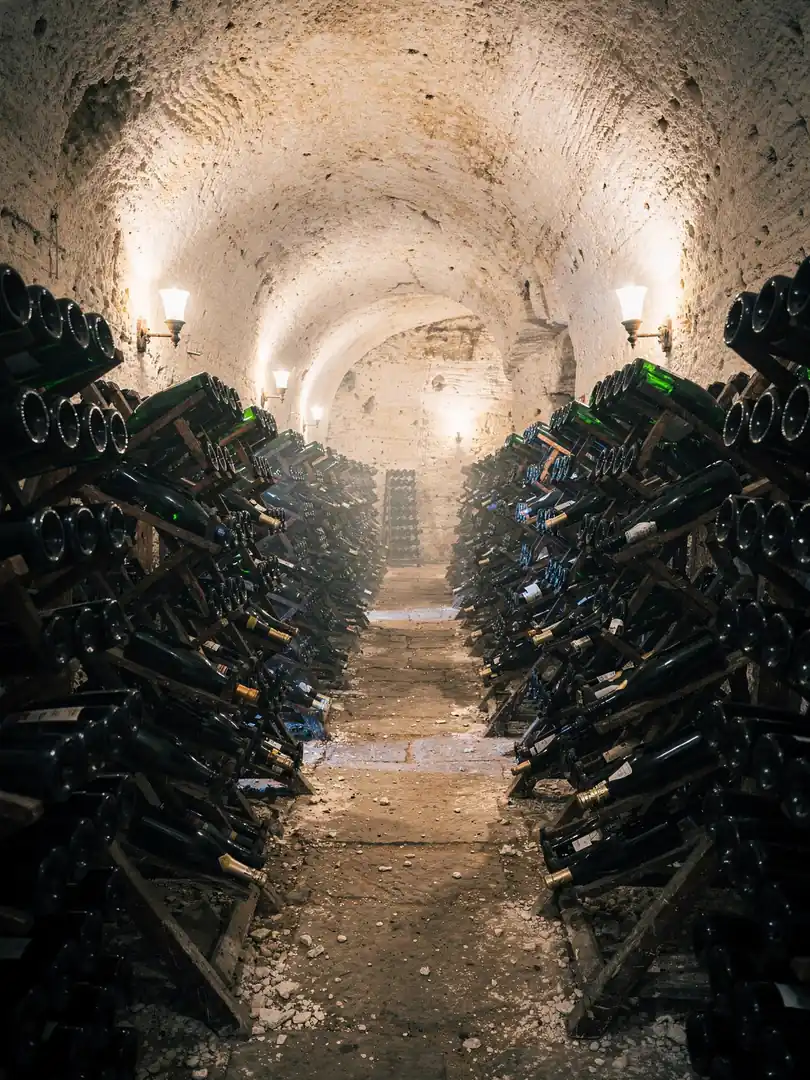
Bottle and Lees
The Second Fermentation
A Blanc de Noirs makes its entire journey in the same bottle that later sits on the shelf. The finished base wine receives the liqueur de tirage, a mixture of sugar and yeast, is sealed with a crown cap, and begins fermenting a second time in the bottle. This method is called classic bottle fermentation.
In Champagne, this bottling step, the tirage, may begin no earlier than January 1 following the harvest. Rule of thumb: about 24 grams of sugar per liter generate roughly six bars of pressure. That's more than twice the pressure in a car tire, which is why the bottles are so thick-walled.
The sugar may raise the blend's alcohol by no more than 1.5 percent by volume. The carbon dioxide stays trapped in the bottle and dissolves into the wine until someone opens it. With the tirage begins the period in which the wine develops its fine mousse and brioche aromas. How long this lasts is governed by law, which is the subject of the next stage.
There's no transferring here. The transvasement method, in which bottles are emptied under pressure into a tank and rebottled, is permitted in Champagne only for small formats under 37.5 centiliters and large ones over 1.5 liters. A standard bottle of Blanc de Noirs from Verzenay or Bouzy stays in its bottle from fermentation all the way to the glass.
There's no tank method or ancestral method here. To understand the Montagne, remember just one path: bottle, lees, chalk cellar, and plenty of patience until the cellar master retrieves the bottles for disgorgement.
Champagne Blanc de Noirs BrutBottle fermentation · Pinot Noir, Meunier
- Time on lees
- 15–36 Months
- Sugar
- 0–12 g/l
- Alcohol
- 12–12.5 % vol
Red fruit, cherry, and brioche, powerful body, taut acidity.