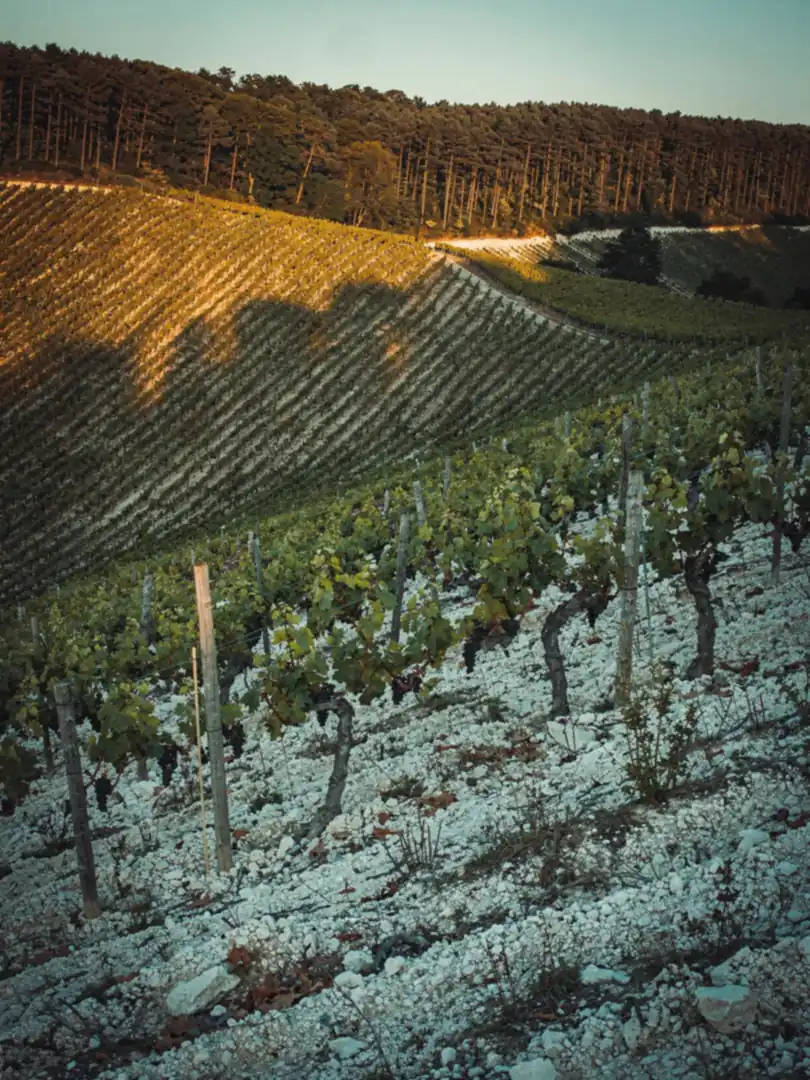
Chalk, North, South
Soil & Climate
Chalk lies beneath the vines of the Montagne, yet the slopes face two different directions, and this shapes the wine. Verzy and Verzenay sit on north-facing slopes, while Bouzy and Ambonnay look south. According to the trade press, the wines from the south show riper, more generous red fruit, while those from the north are leaner, more acid-driven, and tauter.
Champagne lies at the cool edge of viticulture. Pinot Noir ripens late here and in some years accumulates little sugar, while retaining its acidity. That acidity is exactly what a sparkling wine needs when it spends years on the lees and is finally rounded off with a dosage.
Above the vines begins the forest that gives the ridge its dark canopy. Near Verzy grow the Faux de Verzy, twisted, gnarled beech trees that are now protected. Above Verzenay stands a restored windmill amid the vineyards, offering a view of the village's lighthouse.
Beneath the hill lies the wine's second landscape. In Mailly, the winegrowers dug their chalk cellars by hand between 1929 and 1965; according to the house, they now stretch across seven levels and roughly one kilometer. There, the temperature hardly changes, and the bottles rest quietly on their lees.
According to the house, Mailly counts 35 named single vineyard parcels, or lieux-dits, across about 70 hectares, most of them north-facing. Legally, the individual site doesn't count—the classification applies to the whole commune. Yet Krug's Clos d'Ambonnay shows that a single parcel can still carry its own wine: 0.68 hectares, enclosed by a wall, planted only with Pinot Noir.