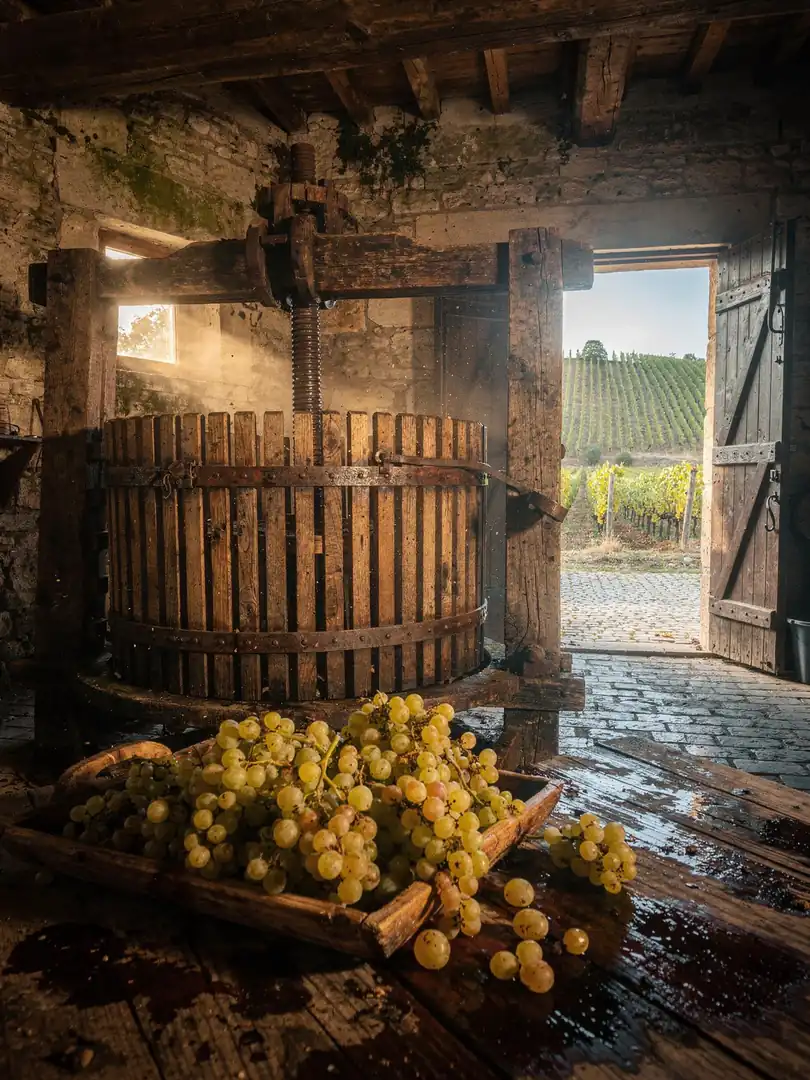
Pressing and Blending
Base Wine & Cuvée
Before the bottle comes the base wine, a still wine that doesn't yet sparkle. In Champagne, it is hand-harvested, as machine harvesting is forbidden. The grapes go into the press whole, otherwise the skins of the red varieties would color the juice.
The rule for the yield is precise. From 4,000 kilograms of grapes, no more than 2,550 liters of must may be pressed. That's 102 liters per 160 kilograms. About 1.2 kilograms of grapes go into a single bottle.
The first 2,050 liters are called the cuvée, the finest fractions with the most acidity. The next 500 liters are called the taille and are more robust. Whatever comes from the grapes beyond that, the rebêches, goes to the distillery. Many houses use mainly the cuvée.
Then comes the blending, the assemblage. The cellar master tastes wines from many villages and grape varieties and adds reserve wines from earlier years. These keep the house style stable, even when a cool or hot year makes the grapes turn out differently. This is how every house in Reims, whether Mumm or Lanson, gets its own signature, recognizable year after year.
A vintage Champagne comes from a single year. Houses may bottle at most 80 percent of their annual volume this way, so that reserves remain. Non-vintage is therefore the standard case, not a shortcoming. A Champagne is only called Blanc de Blancs if made solely from white grapes, and Blanc de Noirs if made solely from red grapes. Rosé can be made by blending white and red wine before bottling.