Harvest and Blending
Base Wine & Blend
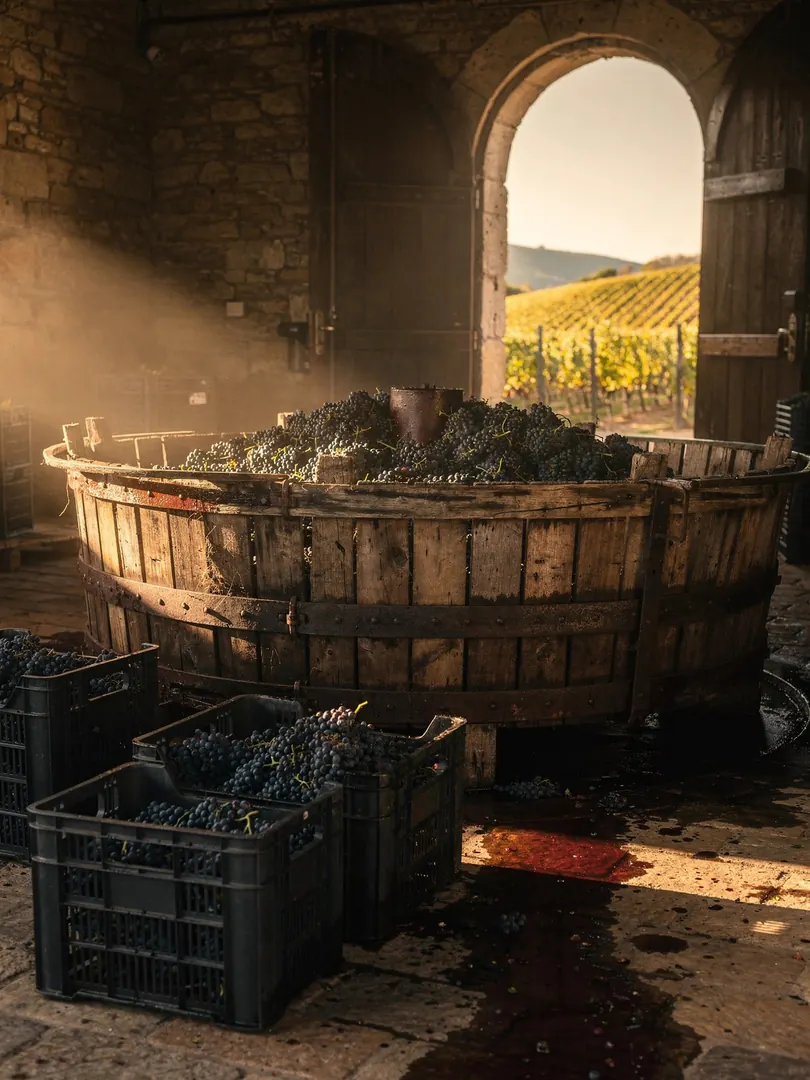
Harvest in the Marne Valley begins early, usually in September, and it is done by hand: hand-picking is mandatory in Champagne. The grapes go whole into the press so that the juice stays pale, even though the berries are dark.
Pressing follows strict rules. From 4,000 kilograms of grapes, only 2,550 liters of must may be drawn off: first 2,050 liters of cuvée, the finest portion, then 500 liters of taille, the remainder with more tannin. Whatever is left after that goes to the distillery.
The must must then settle, a process called débourbage. Billecart-Salmon is seen as a pioneer of cold settling: the must is chilled heavily so that the sediment sinks and the wine ferments more cleanly.
Next comes the first fermentation into the still base wine, known as vin clair. Whether the malic acid is subsequently converted into softer lactic acid is a decision each house makes for itself.
Then begins the art of the assemblage. A cellar master blends wines from different villages, varieties and vintages into a house style. Meunier from the valley contributes fruit, Pinot Noir from Aÿ weight, Chardonnay freshness.
Wines from older vintages, the reserve wines, ensure that a non-vintage Champagne tastes consistent year after year. A vintage Champagne, by contrast, comes from grapes of a single year and may make up no more than 80 percent of a producer's annual volume, so that some reserve remains. A rosé in Champagne is often made by adding red wine to white wine before the second fermentation; this is permitted for sparkling wine but banned for still wine within the EU.