Bubbling in the Cellar
The Second Fermentation
Base wine becomes Champagne once it ferments a second time, inside the bottle. In Champagne this is not a stylistic choice but a rule: the second fermentation may only take place in glass bottles. This is exactly where the difference from tank fermentation lies, since much sparkling wine is made in pressurized tanks.
For this bottling step, called tirage, the wine receives a mixture of sugar and yeast, the liqueur de tirage. Around 24 grams of sugar per liter is the benchmark; the law allows this to add no more than 1.5 percent alcohol by volume. Bottling may begin no earlier than 1 January after the harvest.
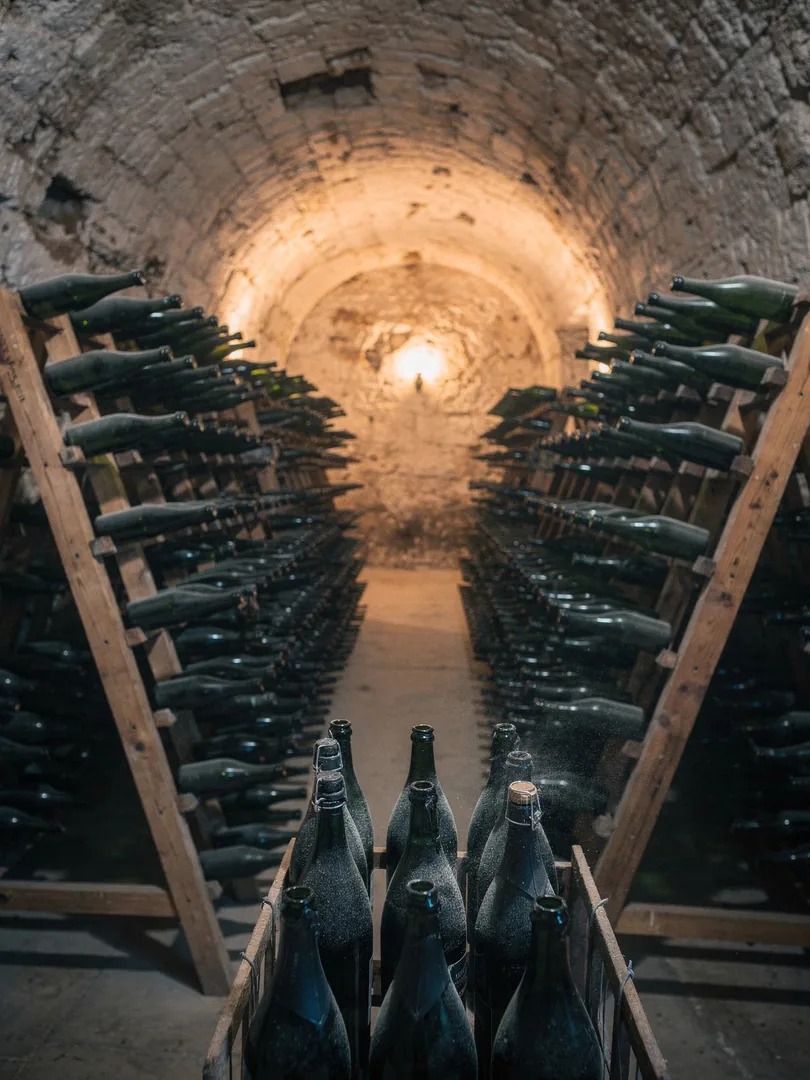
The bottle is sealed with a crown cap, often fitted with a small plastic cup inside, the bidule, which later collects the yeast sediment. The cellar team then lays the bottles down to rest, at Billecart-Salmon, Bollinger, Deutz and Jacquesson alike, as well as at small growers across the valley.
In the cellar, the prise de mousse, the bubbling, begins. The yeast consumes the sugar, producing alcohol and carbon dioxide, and because the bottle is sealed, the gas cannot escape. This builds up a pressure of around six bar, more than double that of a car tire.
The result can hardly ever be transferred to another vessel. Champagne is sold in the same bottle in which it fermented. Only very small formats under 37.5 centiliters and very large ones over 150 centiliters may be transvased, meaning emptied under pressure into a tank and rebottled.
On the label of a sparkling wine from another region, the term méthode champenoise therefore never appears, since it is reserved for Champagne alone. There, the permitted terms are traditional bottle fermentation or méthode traditionnelle, provided the bottle rested on its lees for at least nine months and was disgorged.
Champagne Brut, Meunier-ledBottle fermentation · Meunier, Pinot Noir, Chardonnay
- Time on lees
- 15–36 Months
- Sugar
- 0–12 g/l
- Alcohol
- 12–12.5 % vol
Red apple, pear and brioche, soft acidity, approachable young.