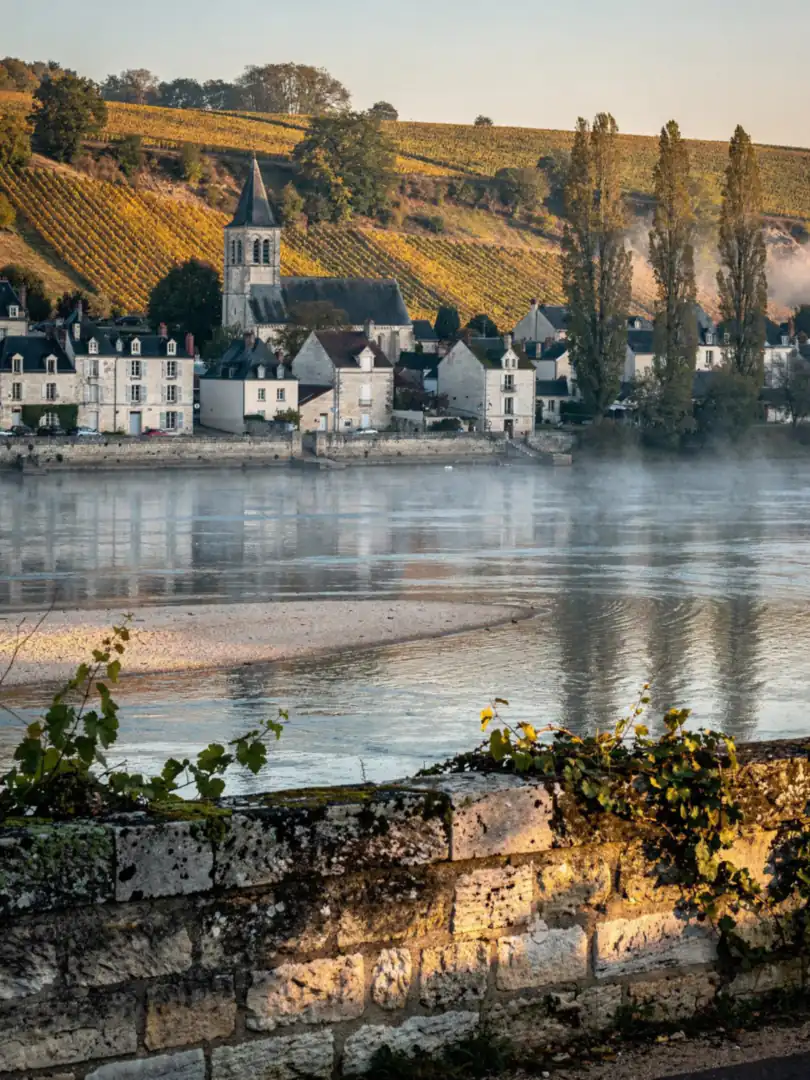
Chenin by the river
Region & History
Vouvray is generally regarded as still-wine country, yet according to local winemakers roughly half the harvest ends up as Vouvray mousseux or Vouvray pétillant. The mousseux is a true sparkling wine, while the pétillant is its gentler sister with less pressure. Both are made from Chenin, grown on the slopes east of Tours. The label reads Vouvray as the origin, and the word mousseux or pétillant tells you how vigorous the fizz actually is.
According to legend, Saint Martin planted the region's first vines in 372 at the Marmoutier Abbey on the outskirts of Tours. What's better documented is the later trade: in the 16th and 17th centuries, Dutch merchants gave a boost to winegrowing around Tours. The Loire was the trade route of the time, carrying the barrels downstream to the sea.
The Vouvray appellation was established by decree on 8 December 1936. The winegrowing village of Montlouis-sur-Loire, on the river's south bank, followed on 6 December 1938, breaking away as its own appellation from Vouvray. Both areas lie within the Indre-et-Loire département. Since then, two appellations have shared the same grape, and both make sparkling wine, each in its own way.
The house of Marc Brédif, founded in 1893 according to its own records, is credited as a pioneer of Vouvray sparkling wine and ages its bottles in caves dug straight out of the tuffeau. Domaine Huet also ranks among the appellation's classic names.
Today, around 160 estates farm roughly 2,250 hectares in Vouvray, while Montlouis counts some 40 estates on just under 400 hectares. That's modest compared to Champagne, which is why much of the work here remains handmade. In the late 2000s, Montlouis also added the Pétillant Originel to its rulebook - a Pét-Nat with an official name of its own.
The Loire's still wine has its own story told elsewhere; here it's only about what sparkles in the glass.