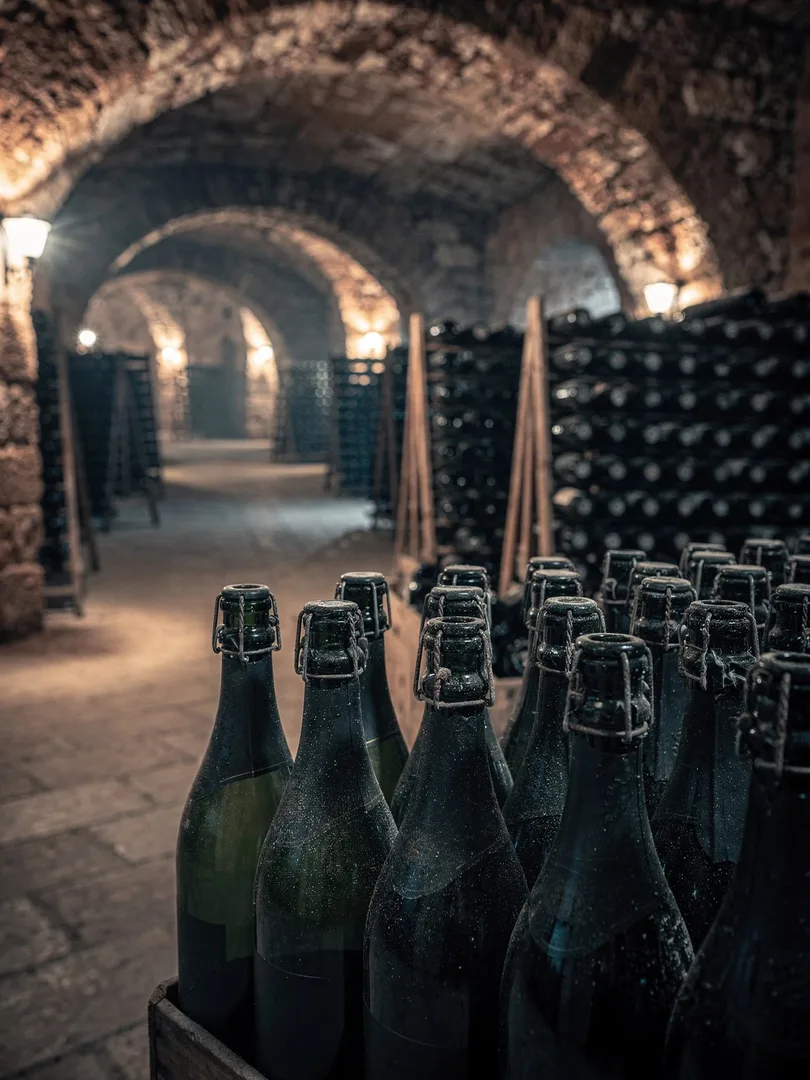
Thirty months of patience
Lees Aging & Dosage
Thirty months of lees aging are required for a vintage-dated wine, while the Riserva ages at least 36 months. By comparison, a non-vintage Champagne only needs 12 months on the lees; only vintage Champagne reaches 36 months from tirage.
During this time, essential processes take place in the dark. The spent yeast breaks down—a process called autolysis—releasing proteins and other compounds into the wine. This creates the aromas associated with aged sparkling wine: brioche, toasted hazelnut, almond. The longer the aging, the creamier the perlage becomes.
Afterward, the yeast must be removed. The bottles are riddled—traditionally by hand on a riddling rack, today often in gyropalettes—until the sediment collects in the neck of the bottle. During disgorgement, the neck is frozen in an ice bath, and the plug of yeast shoots out when opened, carried by the bottle's own pressure. The bottle is then usually left to rest a little longer so the dosage and wine can integrate.
Now comes the dosage, more precisely the liqueur d'expédition: a mixture of wine and sugar fills the lost volume and sets the sugar level. Brut means under 12 grams of sugar per liter, Extra Brut 0 to 6 grams, Pas Dosé under 3 grams and with no added sugar at all.
Particularly dry styles are common in Alta Langa. Contratto bottles its Blanc de Blancs as Pas Dosé, as does Fontanafredda with its Vigna Gatinera Riserva. Enrico Serafino offers a Zero Sboccatura Tardiva, where the bottle stays on the lees especially long before disgorgement. How sweet a wine tastes depends less on sugar content than on its interplay with acidity.