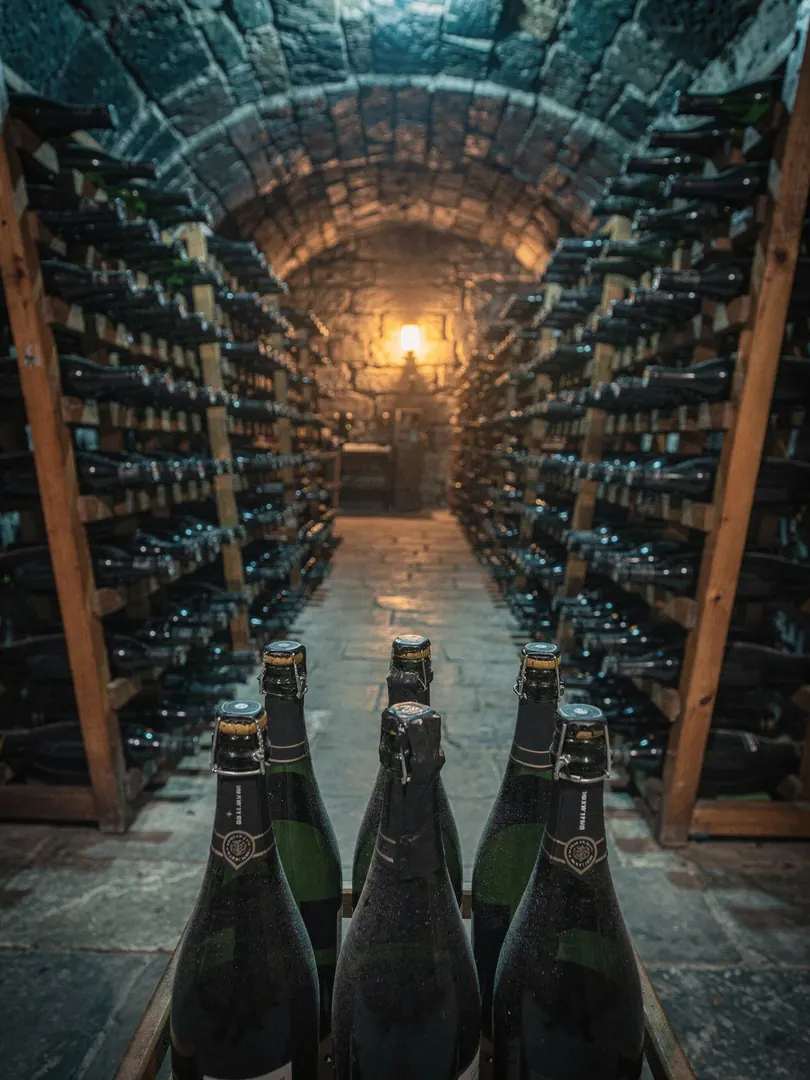
Lees and Pressure
The Second Fermentation
How is Trentodoc made? Exclusively through bottle fermentation using the classic method, in which the wine undergoes its second fermentation in the very bottle it will later be sold in. Tank fermentation, the method behind much Prosecco, is excluded here.
The process begins with the tirage, bottling the finished blended wine into thick-walled bottles. The liqueur de tirage is added, a mixture of sugar, yeast, and a clarifying agent. A crown cap then seals the bottle, which is stacked horizontally.
Now the yeast gets to work. It converts the sugar in the liqueur de tirage into alcohol and carbon dioxide, and because the bottle is sealed, the gas cannot escape. It dissolves into the wine until a pressure of several bar builds up—by law, a minimum of three and a half bar is required.
This second fermentation takes several weeks and proceeds slowly in the cool cellars of the province of Trento. In the process, a fine sediment of dead yeast cells forms. It's precisely this sediment that later gives the wine depth as it rests in the bottle for months.
Why do the bottles lie on their sides? An upright bottle would let the yeast clump at the bottom with little contact to the wine. Lying down, the sediment spreads across a large surface area. There's also a safety factor: thick bottles and a secure crown cap can withstand pressure that an ordinary wine bottle could not.
Anyone who dismisses this process as merely technical overlooks how much craft is involved. Too much sugar in the liqueur de tirage can cause bottles to burst; too little yields too little pressure; and the wrong yeast strain leaves the wine cloudy or stalls fermentation. Cellar masters therefore test in the lab beforehand and check every batch. The profile below shows how three types of Trentodoc differ. What unites them is the method; what sets them apart is mainly the time spent on the lees.
Trentodoc BrutBottle fermentation · Chardonnay, Pinot Noir, Pinot Bianco, Meunier
- Time on lees
- 15–24 Months
- Sugar
- 0–12 g/l
- Alcohol
- 11.5–12.5 % vol
Fresh, citrus and green apple, fine mousse, crisp mountain acidity.