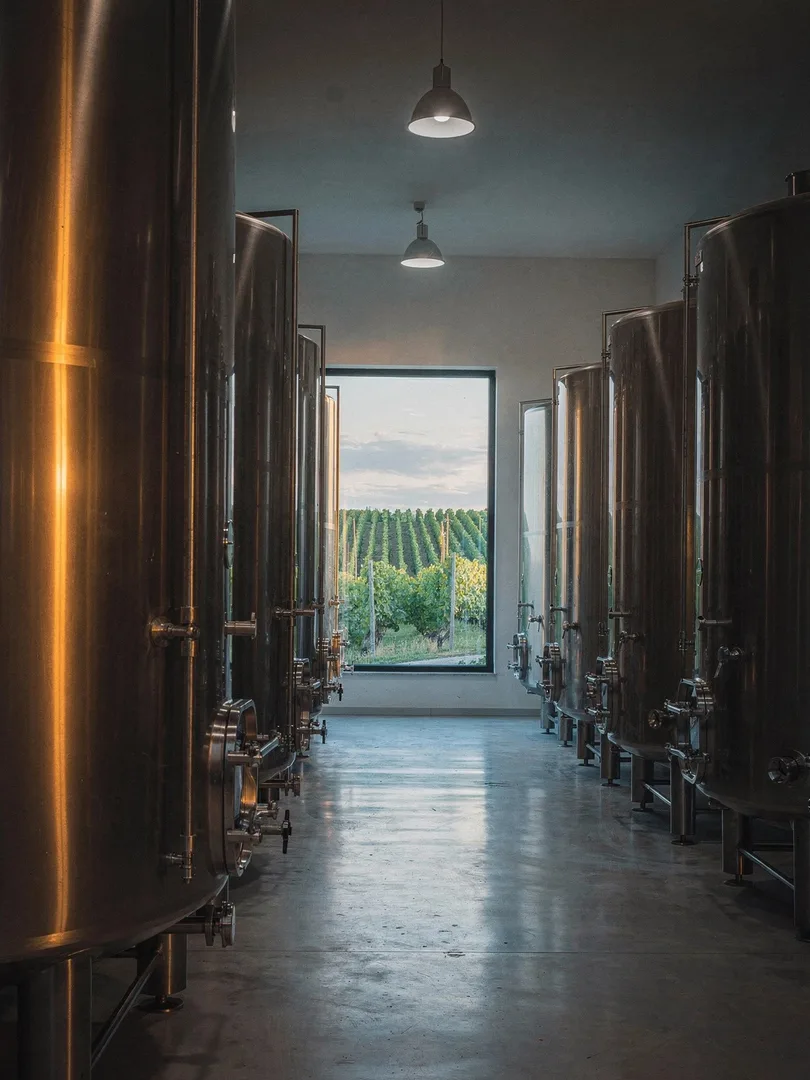
Aged in Tank
The Second Fermentation
Prosecco is made almost exclusively in tank. The base wine goes into a pressure-resistant stainless steel vessel, the autoclave, where it receives sugar and yeast, and the second fermentation takes place there. The resulting carbon dioxide cannot escape and dissolves into the wine. Tank fermentation traces back to Martinotti (1895) and Charmat (1907), which is why both names refer to the same principle.
The advantage lies in speed and aroma. A tank holds many thousands of liters, fermentation takes weeks rather than months, and the wine stays close to the grape, without the bread-crust and almond notes of long lees contact. For a Glera that's defined by apple, pear, and blossom aromas, this is the right technique.
Once the desired pressure is reached, the cellar master chills the tank sharply. The yeast stops working, the wine is filtered, and bottled under counter-pressure so the carbon dioxide doesn't escape. A Spumante must carry at least 3.5 bar at 20 degrees Celsius—about three-and-a-half times atmospheric pressure.
How long this takes depends on the house, ranging from a few weeks to several months. In Friuli, cooperatives like La Delizia in Casarsa della Delizia bottle such tank wines just as family estates around Prata di Pordenone do. The style is similar everywhere; only the volume varies greatly.
A bottle from the tank therefore has no sediment, is never riddled, and needs no disgorgement. This keeps production costs low and the character very consistent, though the bubbles are usually coarser and fade faster than in a wine aged in bottle.
Prosecco DOC Spumante BrutTank fermentation · Glera (minimum 85%), other permitted varieties
- Time on lees
- 1–6 Months
- Sugar
- 6–12 g/l
- Alcohol
- 11–11.5 % vol
Apple, pear, and acacia, a slender body, lively bubbles, and crisp acidity.