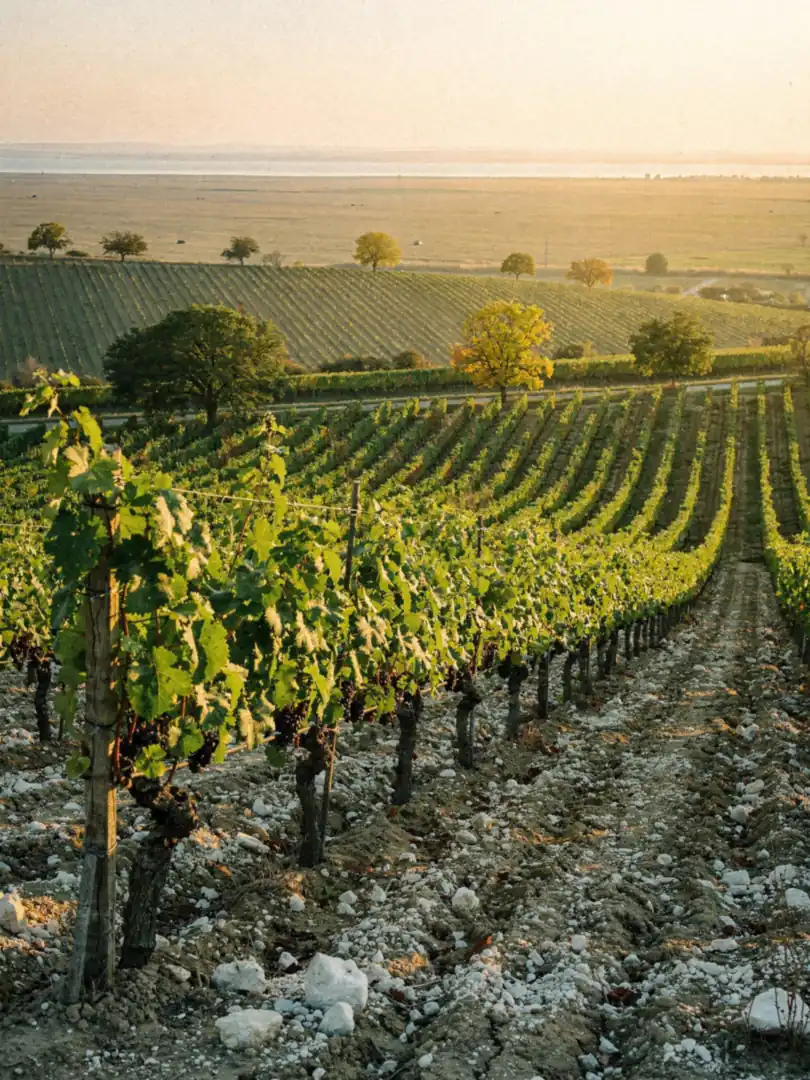
Pannonian Warmth
Soil & Climate
How can a region this warm produce a fresh, crisp sparkling wine? Burgenland sits within a Pannonian climate marked by early spring, hot and mostly dry summers, and mild autumns—a gift for still wine. Sparkling wine, however, needs acidity and lean fruit, which can only be achieved by picking the grapes considerably earlier than for still wine.
The soils shift from sand, gravel, and loam to black earth, and on to limestone-rich loam, marl, and primary rock. The province holds roughly 13,000 hectares of vines. The flat Neusiedlersee wine region accounts for about 7,650 hectares along the lake's north and east shores, while the Neusiedlersee-Hügelland on the west shore covers around 3,575 hectares.
Both areas supply different base wines for Sekt. In the lowlands, Welschriesling and Zweigelt dominate; on the hills to the west of the lake, Blaufränkisch, Weißburgunder, and Chardonnay take the lead. For those wanting a tightly defined origin, the Große Reserve tier even allows naming a single village, provided at least 85 percent of the grapes come from there.
Lake Neusiedl is best known for the sweet wines it helps produce by encouraging noble rot. Sparkling wine needs no such rot—just healthy grapes and the right timing. Early picking brings crisp, acid-rich fruit into the press house before the sun pushes sugar levels too high.
Unlike in Champagne, there are no chalk cellars here. The bottles rest in ordinary wine cellars, where the temperature must stay constant for months so the yeast works evenly and the Sekt ages consistently from bottle to bottle.