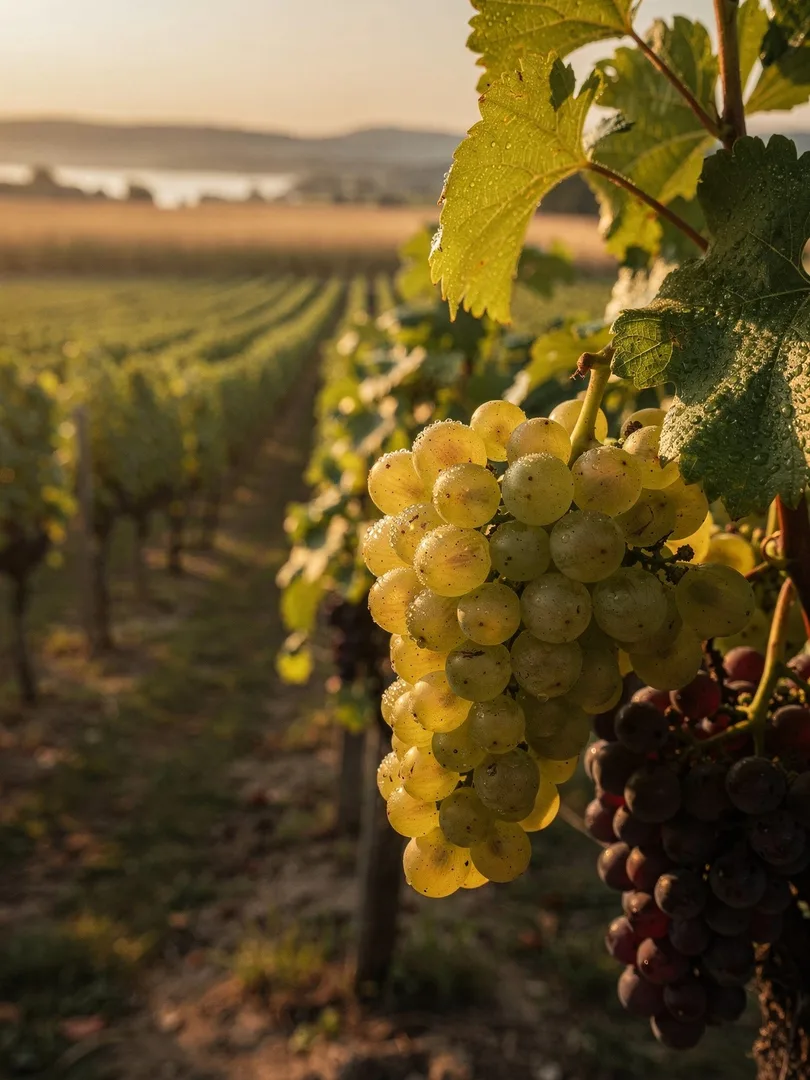
Welschriesling and Reds
Base Wine & Blend
Is Welschriesling the same as Riesling? No, the two are unrelated, despite what the name suggests. Welschriesling brings high acidity and a restrained fruit character reminiscent of green apples. In the Neusiedlersee region, it's the most important grape variety alongside Zweigelt.
For sparkling wine, this restraint is an advantage: the acidity carries well through long lees aging, and the understated fruit leaves room for yeast-derived aromas to shine. Varietal Welschriesling is therefore a natural choice for Burgenland's base wines, especially where the goal is a young, fresh-drinking Sekt.
Then there are the Pinot varieties, which thrive in the Neusiedlersee-Hügelland. Weißburgunder and Chardonnay contribute body and delicate fruit, while Pinot Noir provides the color for rosé. Szigeti in Gols bottles not only Pinot-based Sekt but also a Traminer Brut and a Pinot Noir rosé—variety is clearly part of the house style.
The truly Burgenland signature, though, lies in the red native varieties. Zweigelt, St. Laurent, and Blaufränkisch all appear in rosé Sekts here, and this is no mere novelty. A rosé from Schlumberger lists Zweigelt, Pinot Noir, and St. Laurent from Burgenland; Weingut Esterházy bottles a Sekt from Blaufränkisch, including a rosé version; and Erich Sattler makes a rosé from St. Laurent.
For Sekt g.U., Austria's approved quality wine grape varieties are permitted, with the province serving as the unit of origin. So opening a Burgenland Sekt made from Blaufränkisch isn't an oddity—it's a textbook example of exactly what the regulations allow.