Loess and Primary Rock
Soil & Climate
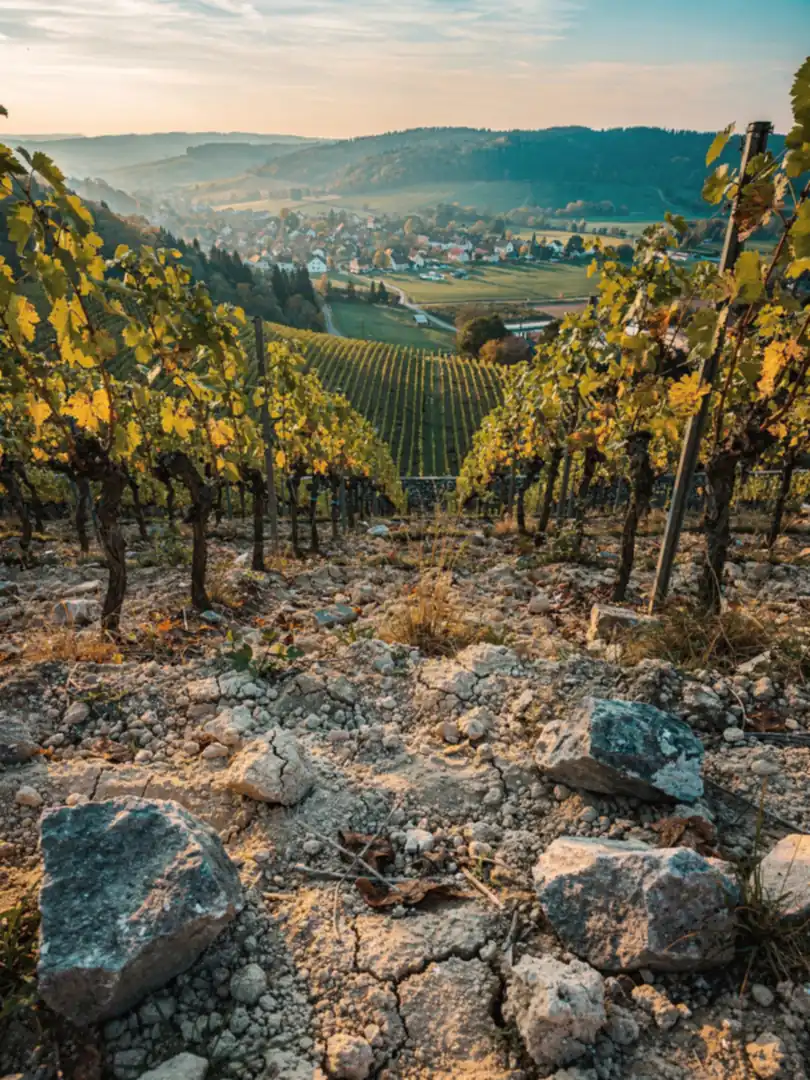
The Kamptal around Langenlois covers nearly 3,900 hectares of vines, and the soil changes over short distances. Loess, gravel, and primary rock lie side by side, and the regional specification traces these soil formations all the way back to the Permian period, around 270 million years ago. Each combination gives a base wine a different character.
For sparkling wine, what matters most is what the climate makes of it. Warm, Pannonian air drifts in from the east, while cool evening winds flow into the vineyards from the Waldviertel. With 550 to 600 millimeters of rainfall and an annual average of a good 9 degrees, the grapes ripen with plenty of freshness. It's exactly this acidity that a base wine needs for extended time on the lees later on.
In the Weinviertel, Austria's largest wine region, loess shapes the landscape. Around Poysdorf there are about 1,400 hectares of vines, according to the wine town, and Welschriesling and Grüner Veltliner for sparkling wine grow on this loess. Roughly 2,000 hours of sunshine a year are enough for ripening, without the climate burning off the acidity.
The landscape of the Weinviertel is defined by Kellergassen, rows of press houses behind which cellars burrow into the loess. Here, as everywhere, the rule for sparkling wine holds: the yeast works slowest and finest at a steady, cool temperature.
With Große Reserve, the soil also makes its way into the glass through pressing. The yield may amount to no more than half the weight of the grapes, while for Reserve it's up to 60 percent. Taking so little must from the berries means capturing only the finest juice and leaving behind the harshness from skins and seeds.