Bottle or Tank
The Secondary Fermentation
In Austria, the tier determines how the secondary fermentation may take place. For Reserve and Große Reserve, the ordinance mandates the traditional bottle fermentation. Only Klassik may use any method, including tank fermentation. The claim that Austrian Sekt g.U. is always bottle-fermented is therefore not accurate.
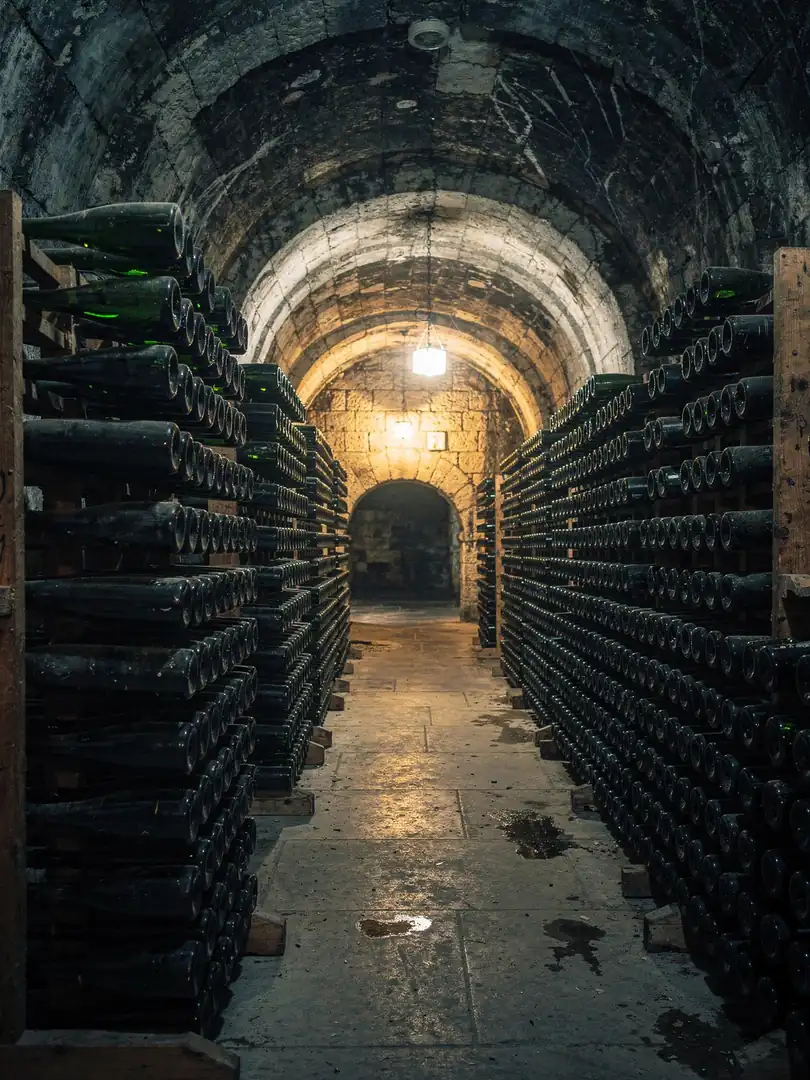
In bottle fermentation, a mixture of sugar and yeast — the tirage — is added to the base wine. The bottle is sealed, and fermentation generates carbon dioxide inside that cannot escape. This creates a pressure of at least 3.5 bar, roughly the pressure in a car tire. The same bottle remains in use until the end, even through disgorgement.
The stainless steel tank handles secondary fermentation under pressure. This is faster and cheaper, since the Sekt doesn't need to be riddled and disgorged bottle by bottle but is processed as a whole batch instead. The Sekt is then filtered and bottled. Klassik still requires a minimum nine months of lees aging.
An intermediate method is the transfer process (transvasage). The Sekt ferments in the bottle, but is then emptied under pressure into a tank, filtered, and rebottled. It's labeled under the term "bottle fermentation," but it is not the traditional bottle fermentation.
Outside the pyramid, there's the ancestral method (méthode ancestrale). Here, the single fermentation is completed in the bottle without any sugar addition. Kattus offers such a Pét-Nat made from Welschriesling called Nepomuk. This isn't a separate legal category, and the pressure in the bottle isn't fixed either, so such wines can be classified as either Perlwein (semi-sparkling) or sparkling wine.
Sekt g.U. KlassikTank fermentation · Welschriesling, Grüner Veltliner, Pinot varieties
- Time on lees
- 9–12 Months
- Sugar
- 0–12 g/l
- Alcohol
- 11–12.5 % vol
Fresh and fruity, green apple and citrus, at least nine months on the lees.