At Least Nine Months
Lees Aging & Dosage
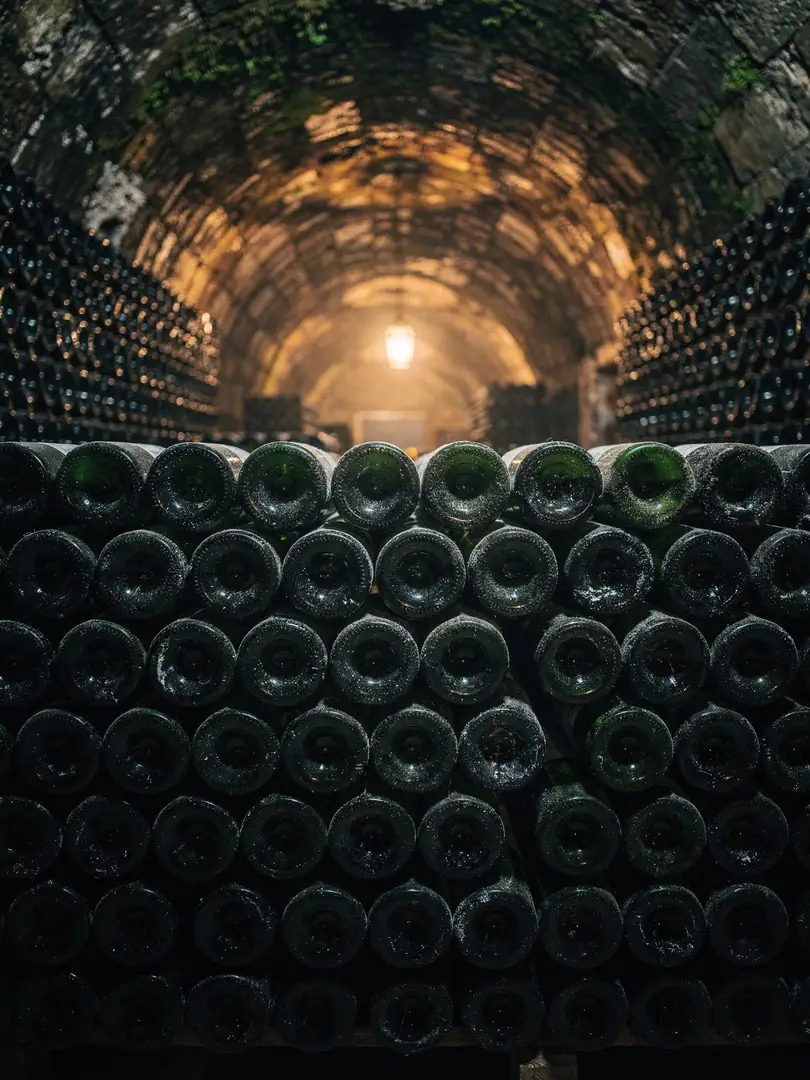
After fermentation comes the waiting. The appellation requires Espumante to rest in-house for at least nine months after bottling before it can be sold. Many producers let it rest even longer, and bottles labeled Reserva or Grande Reserva in particular are made for extended aging.
During this time, the dead yeast cells slowly break down and release compounds into the wine, a process known as yeast autolysis. It brings aromas of brioche, bread crust, and nuts, and makes the wine creamier. Baga's austere structure in particular rounds out through this process without losing its freshness.
Eventually, the yeast has to come out. The bottles are gradually tilted and rotated, by hand on riddling racks or with a gyropalette, until the sediment collects in the neck. During disgorgement, the plug of yeast shoots out under the pressure of the carbon dioxide; the bottle is then topped up and sealed with cork and wire cage.
What's used to top up the bottle determines its sweetness. In Portuguese, "bruto natural" is what's called Brut Nature elsewhere: under 3 grams of sugar per liter, with no sugar added after fermentation. "Bruto" corresponds to Brut, under 12 grams. "Meio seco" sits well above that and corresponds to off-dry.
In Bairrada, Bruto Natural is especially popular because Baga's high acidity holds up well without added sugar. Aliança, for instance, bottles its Reserva wines as Brut Nature, and Sidónio de Sousa also offers a Bairrada Espumante Bruto Natural. Those who prefer something softer can reach for a Bruto or Meio seco.