Classic, in the Bottle
The Second Fermentation
For Bairrada's Espumante, the appellation sets a clear path: it must undergo classic bottle fermentation, not tank fermentation. The finished base wine receives a mixture of sugar and yeast, the tirage, is bottled into thick-walled bottles, and sealed with a crown cap. That's where the real sparkling wine journey begins.
Inside the sealed bottle, the second fermentation kicks in. The yeast consumes the sugar and converts it into alcohol and carbon dioxide. With nowhere to escape, the gas dissolves into the wine and builds up pressure. Quality sparkling wine must reach at least 3.5 bar, and classically made sparkling wines often go well beyond that. That's why the glass of the bottle is so thick.
It's important to distinguish between two similar-sounding terms. With simple bottle fermentation, the yeast may be removed by transfer: the bottle is emptied under pressure into a tank, the wine is filtered and rebottled, known as the transfer method. With classic bottle fermentation, the wine stays in the very same bottle until the yeast is removed. Bairrada requires this second method for its Espumante.
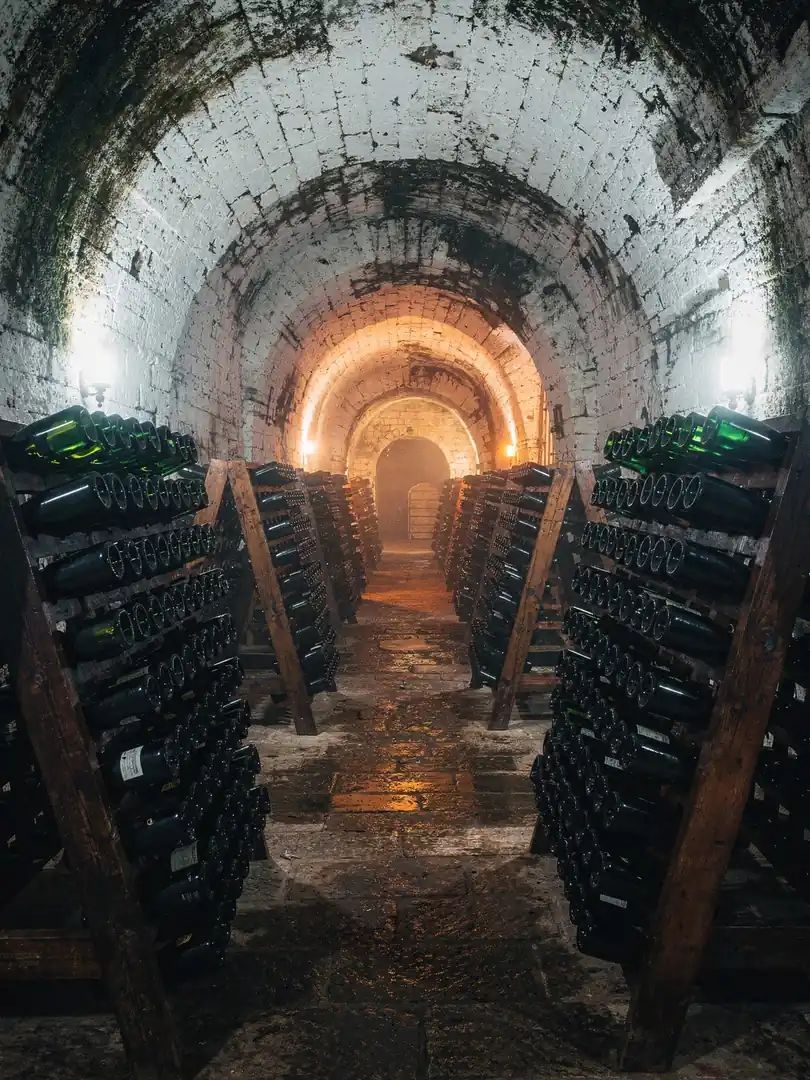
During fermentation, the bottles lie horizontally in the cellars, stacked or held in wire racks. In the vaults of Anadia's old houses, it takes weeks for the sugar to be used up. Afterward, the wine is sparkling for the first time, but still cloudy with yeast.
The fact sheet presents three regional styles side by side: the Blanc de Noirs made from Baga, the white cuvée, and the red Espumante.
Bairrada Baga Bruto NaturalBottle fermentation · Baga (pressed white)
- Time on lees
- 9–24 Months
- Sugar
- 0–3 g/l
- Alcohol
- 11.5–12.5 % vol
A white sparkling wine made from a red grape: taut acidity, apple, bread crust, and a fine touch of tannin.