Picking Early, Blending
Base Wine & Cuvée
In Távora-Varosa, the base wine is a distinct, still-unsparkling wine that only fizzes later. It is harvested early, when the grapes have high acidity and low sugar, and so tastes tart and lean—almost too sour to drink on its own. That's exactly what sparkling wine needs. Before harvest, growers measure sugar and acidity and pick before acidity drops too far.
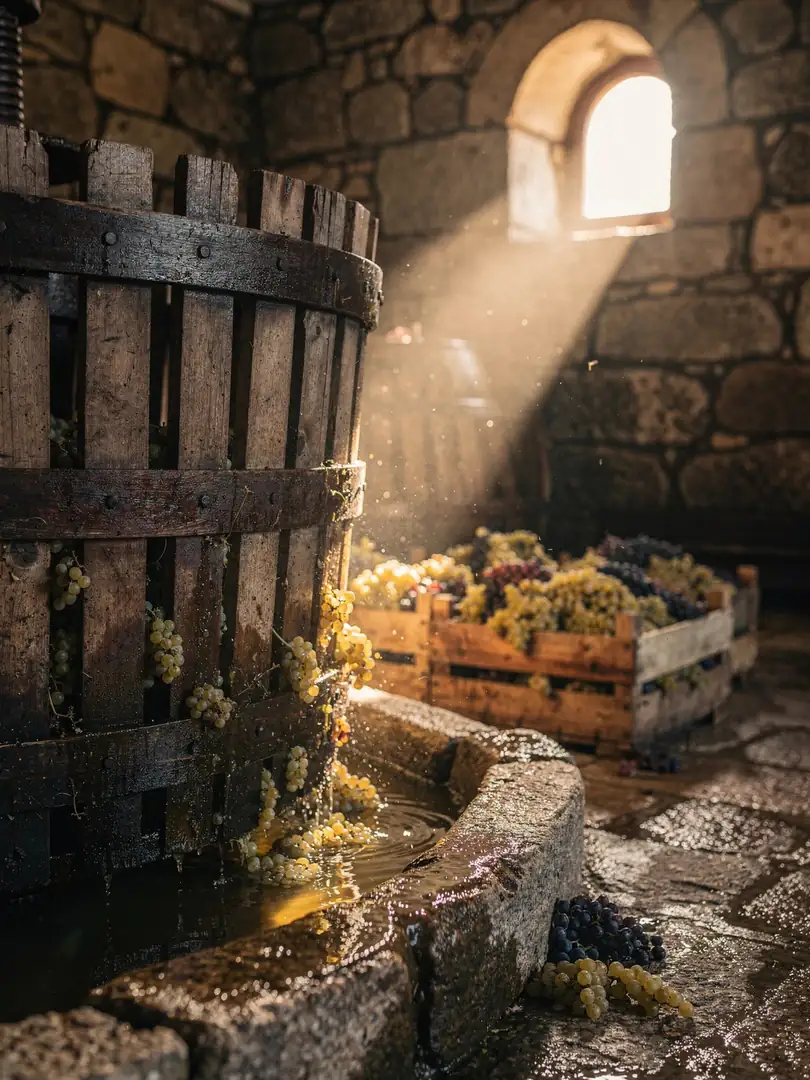
Pressing is done gently. The grapes go whole into the press so the juice stays pale, and only the first, finest portion of the pressing—the cuvée—goes into the sparkling wine. The rest, the taille, is more robust and tannic. This matters especially for Pinot Noir, since otherwise color from the skins would bleed into the juice.
Next comes the assemblage, the blending. The cellar master blends wines from different varieties, vineyard sites, and altitudes into the cuvée. Reserve wines from earlier years may also be added so a house's style tastes consistent year after year.
From here there are two paths. A non-vintage wine is a blend of several harvests. A vintage wine comes from a single year and reflects that year's weather. Raposeira, for instance, produces a Super Reserva Blanc de Noirs from the 2017 vintage—from a single harvest.
Blanc de Blancs means white wine made from white grapes—in Távora-Varosa, from white varieties such as Chardonnay. Blanc de Noirs is white wine made from red grapes, here from Pinot Noir. Raposeira bottles both styles as Super Reserva.
The rosé also needs some explanation. For sparkling wine, it's permitted to make rosé by blending white and red wine, while for still wine this is banned in the EU. A pink Espumante, then, can be a blend of both wines.