Bottle, Never Tank
The Second Fermentation
With Cava there's no choice: the second fermentation happens in the bottle, following the traditional method. The D.O.'s rules don't allow tank fermentation as with Prosecco, nor do they permit the transfer method or the ancestral method. This holds true in Requena just as it does in the Ebro Valley and in Almendralejo.
The winemaker fills the finished base wine into bottles along with a mixture of sugar and yeast, the liqueur de tirage, and seals them with a crown cap. The yeast converts the sugar into alcohol and carbon dioxide. Since the bottle is sealed, the gas can't escape and dissolves into the wine instead. This is how the pressure builds: at 20 degrees Celsius, a Cava must reach at least 3.5 bar.
The liqueur de tirage may raise the alcohol content of the cuvée by no more than 1.5 percent by volume. A base wine at ten percent thus becomes a Cava at eleven to a little over eleven and a half. The cooler the bottles are kept during this process, the slower the fermentation runs, and the finer the bubbles turn out.
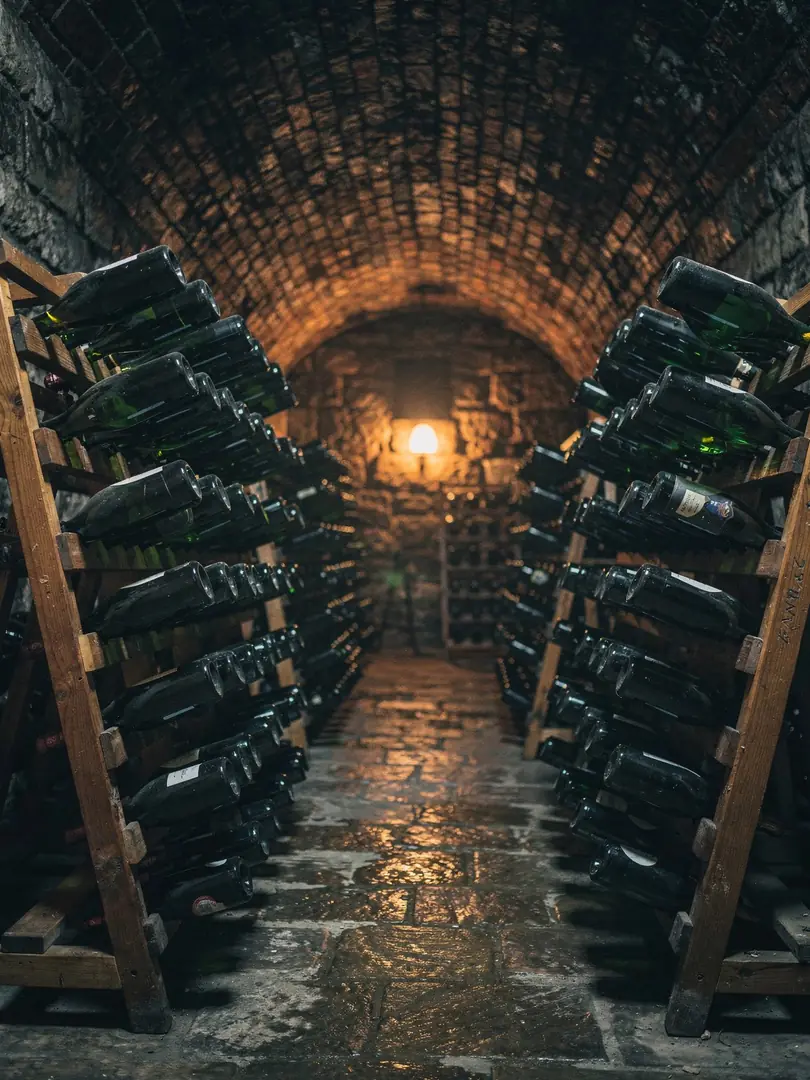
This pressure is considerable, exceeding that of a car tire. That's why the bottles are made of thick glass and built round and heavy. The fermentation itself takes a few weeks. Afterward, the wine remains in the bottle, now resting quietly on the sediment of spent yeast, and this period later counts as lees aging.
The fact that some base wines from the Ebro Valley or Extremadura become Cava elsewhere doesn't change the rule for the bottle. Anyone who writes "traditional bottle fermentation" on the label must keep the wine, from the point of the cuvée onward, resting uninterrupted on the lees at the same winery for at least nine months, before disgorging it.
Cava de Guarda Brut (Requena)Bottle fermentation · Macabeo, Chardonnay, Pinot Noir
- Time on lees
- 9–15 Months
- Sugar
- 0–12 g/l
- Alcohol
- 11.5–12 % vol
Green apple, citrus and white blossom, lively acidity, lean.