Early, Tart, Pale
Base Wine & Blend
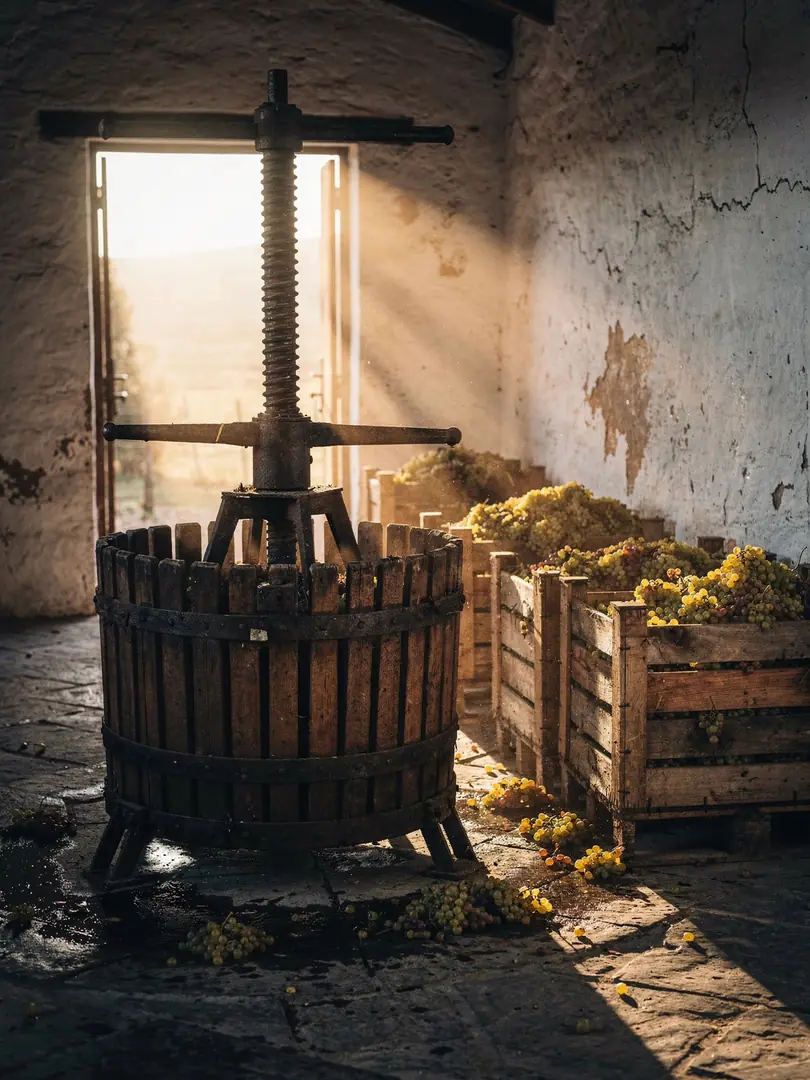
With a Cap Classique, the most important decision comes before fermentation even starts: when to pick. At the Cape, that happens from January onward, while the berries are still tart and low in sugar. Quality-focused producers harvest by hand, so the berries reach the press intact.
Gentleness is the watchword at the press. Whole clusters are pressed softly so the juice stays pale and draws little tannin from the skins. The first fractions, known in Champagne as the cuvée, are considered the finest. The later fractions, the taille, are fuller and coarser.
Each variety, and often each individual vineyard, is then fermented separately into a dry, acid-driven still wine, the base wine. Only once fermentation is complete does the cellar master build the assemblage: Chardonnay for citrus, Pinot Noir for body, plus reserve wines from earlier vintages if needed.
Graham Beck's range in Robertson shows what this looks like in practice. The non-vintage line, with Brut, Brut Rosé and the sweet Bliss Demi Sec, blends different vintages into a consistent house style. The vintage range, with Blanc de Blancs, Brut Zero and Brut Rosé, comes from a single year instead, while the prestige range features the Cuvée Clive.
A vintage Cap Classique bears the signature of a single year, while a non-vintage bears the signature of a house. To achieve this, good cellars hold back reserve wines so the Brut tastes the same as the year before, even after a difficult summer.
Pieter Ferreira, known to everyone simply as "Bubbles," joined Graham Beck as cellar master in 1990. Blanc de Blancs means white sparkling wine made from white grapes, Blanc de Noirs white sparkling wine made from red grapes; both styles emerge from the same base wine work, with only the variety changing.