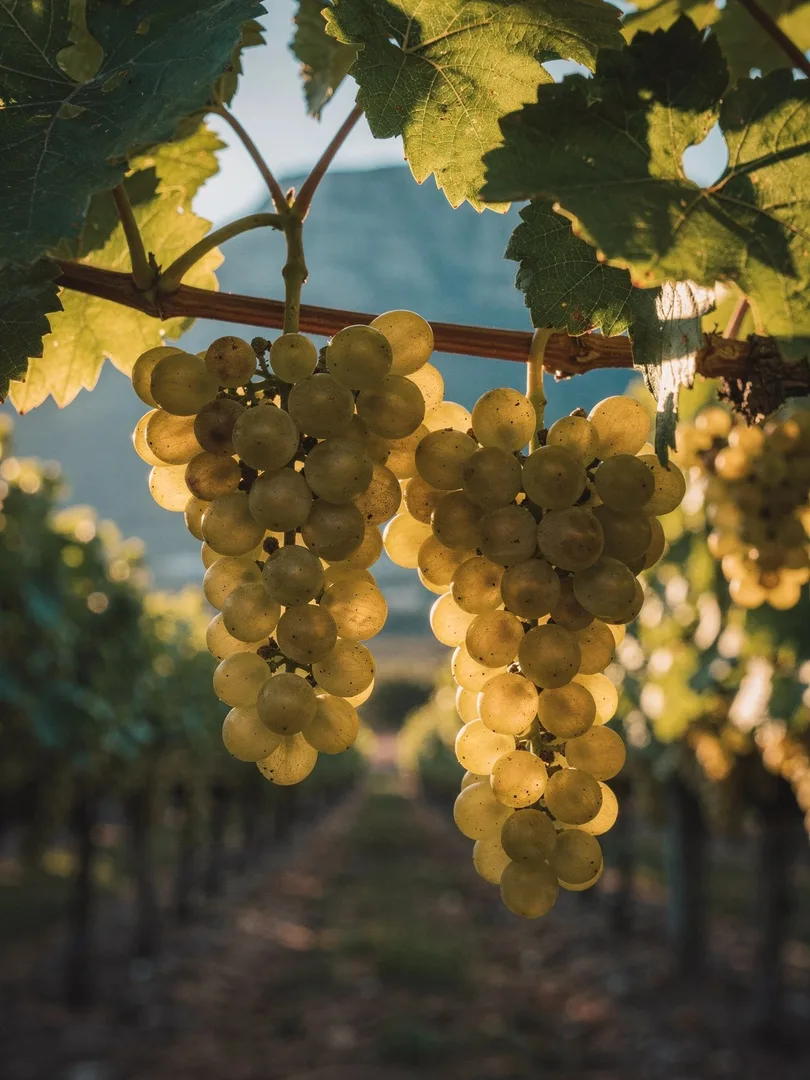
From Chenin to Chardonnay
Grape Varieties
Chenin Blanc, not Chardonnay, stood at the origin of Cap Classique. Frans Malan crafted his first Kaapse Vonkel in 1971 from this variety, long known at the Cape as Steen, rounded out with a touch of Clairette Blanche.
That remained the case until 1987. Then Johan Malan, Frans Malan's son, switched the cuvée to Pinot Noir and Chardonnay, the two principal grapes of Champagne. Chenin Blanc has grown at the Cape for centuries and is among the country's most widely planted varieties, so a sparkling wine built from it made perfect sense.
By law, the choice of grape is open. According to the trade press, there's no restriction to specific varieties; the association recommends Chardonnay, Pinot Noir and Pinot Meunier. Meunier is a red grape that lends a sparkling wine fruitiness and early approachability.
On Robertson's limestone soils, Chardonnay and Pinot Noir are considered especially well suited. Chardonnay brings citrus and tautness, Pinot Noir brings body and depth. Chardonnay alone produces a Blanc de Blancs, meaning "white from whites."
Pinot Noir is a red grape, yet its juice is pale. The color sits in the skins, and if the grapes are pressed early, a white sparkling wine results. If a little color bleeds from the skins into the juice, the wine turns pink; Graham Beck offers a Brut Rosé across two of its ranges.
All three varieties share one trait: picked early, they retain plenty of acidity and little alcohol, which is the prerequisite for a long rest on the lees. To understand Cap Classique, it helps to focus less on the grape alone and more on the moment it was harvested.