Houses and conglomerates
The great Champagne houses: history and ownership
Champagne houses are cellars that buy grapes from many growers, blend them into their cuvées and sell them under their own name. The oldest Champagne house dedicated solely to Champagne is Ruinart, founded in 1729 in Reims. Today many of the big brands belong to the LVMH conglomerate, while others have remained in family hands for generations.
What is a Champagne house?
In French, a Champagne house is called a Maison. This refers to an operation that may own some vines of its own, but buys most of its grapes from growers. Figures from the Comité Champagne, the region's trade body, show the divide clearly: around 16,200 growers farm about 90 percent of the vineyard area. The roughly 370 houses, by contrast, ship more than two-thirds of all bottles. In Champagne, vineyard and cellar are therefore often in different hands.
A house's real craft is the assemblage, the blending of many base wines from different villages, grape varieties and years. A large house processes grapes from dozens of villages and so can hit a recognizable style every year. This sets it apart from a German sparkling wine producer, which may source its base wine from anywhere in Europe. A Champagne house, however, must draw every grape from the protected Champagne appellation, the legally defined growing region.
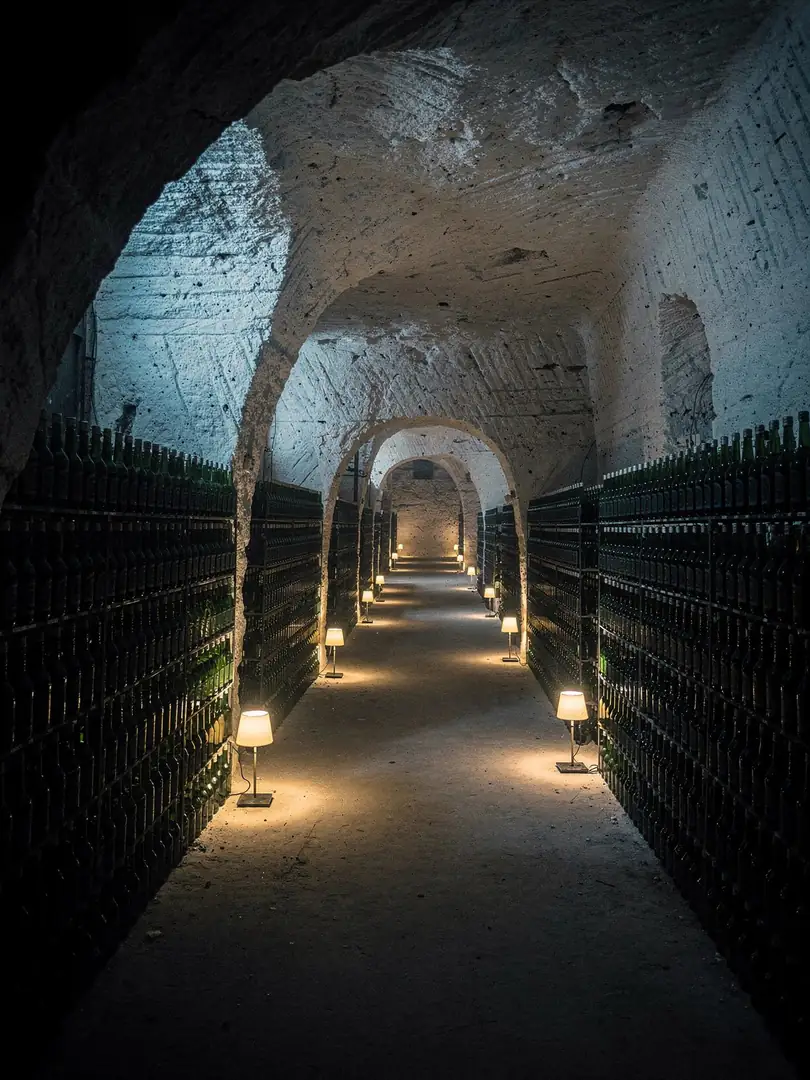
The power of the houses becomes visible underground. In Reims and Épernay, miles of cellars run through the chalk, where millions of bottles age at a steady, cool temperature. Ruinart has used its chalk pits, the crayères, since 1768; they have been a protected historic monument since 1931. Such cellars are costly to maintain and tie up a great deal of capital, since every bottle must rest there for at least 15 months before it can be sold. A small grower can hardly build up such a reserve, but a large house depends on it.
When were the well-known Champagne houses founded?
The starting signal came with an edict issued by Louis XV in 1728, which permitted the transport of wine in bottles. Before that, wine traveled in casks, and a sparkling wine would never have survived the journey. As early as 1 September 1729, Ruinart was founded in Reims, regarded as the oldest house to produce Champagne exclusively. Gosset claims 1584, though as a wine house and by its own account. Taittinger traces its roots back to 1734, though the house has only borne the name Taittinger since 1932.
The 18th century brought Moët in Épernay in 1743, Lanson in 1760, Veuve Clicquot in 1772, and the house later known as Louis Roederer in 1776, originally called Dubois Père & Fils. The 19th century brought a second wave: Perrier-Jouët in 1811, Laurent-Perrier in 1812, Billecart-Salmon in 1818, Mumm in 1827, Bollinger in 1829, Krug in 1843, Pol Roger in 1849 and Pommery in 1858. Strikingly many founders came from Germany, from cities such as Mainz, Cologne or Ellwangen. Their story is told in more detail in the themed journey on the history of sparkling wine.
Who owns the Champagne houses today?
The largest owner is the luxury conglomerate LVMH. It owns Moët & Chandon, with its flagship brand Dom Pérignon, Veuve Clicquot since 1986/87, and Krug since January 1999; before that, Krug belonged to Rémy Cointreau. For the consumer, a conglomerate changes little on the label, but a great deal in terms of reach and marketing: these brands appear in bars, airports and supermarkets worldwide.
Alongside these are houses that emphasize their independence. Louis Roederer belongs to the Rouzaud family, and Bollinger and Pol Roger are likewise family-owned. Taittinger is a special case: in 2005 the house was sold to the American Starwood group, before the family bought it back on 31 May 2006 together with the bank Crédit Agricole Nord-Est. Mid-sized groups bundle several brands together. The Laurent-Perrier group, for instance, includes Salon, Delamotte and De Castellane, while Lanson has been part of Lanson-BCC since 2006.
What does the house name reveal about the Champagne?
A well-known name guarantees no particular vineyard. It stands for a style the house has cultivated over decades: more powerful and Pinot Noir-driven, or leaner and Chardonnay-driven, with more or less oak, more or less age. Anyone who knows this style has a rough idea of what will be in the glass. The name says little, however, about the origin of individual grapes, since a house buys from hundreds of growers depending on the harvest.
A small code on the label reveals more. The letters NM indicate a trading house, RM a grower who produces the wine themselves, and CM a cooperative. What lies behind these codes is explained in the next stop on this journey. For now, a simple rule of thumb will do: a house sells a reliable style, while a grower tends to show the signature of their village. Neither is inherently better or worse.