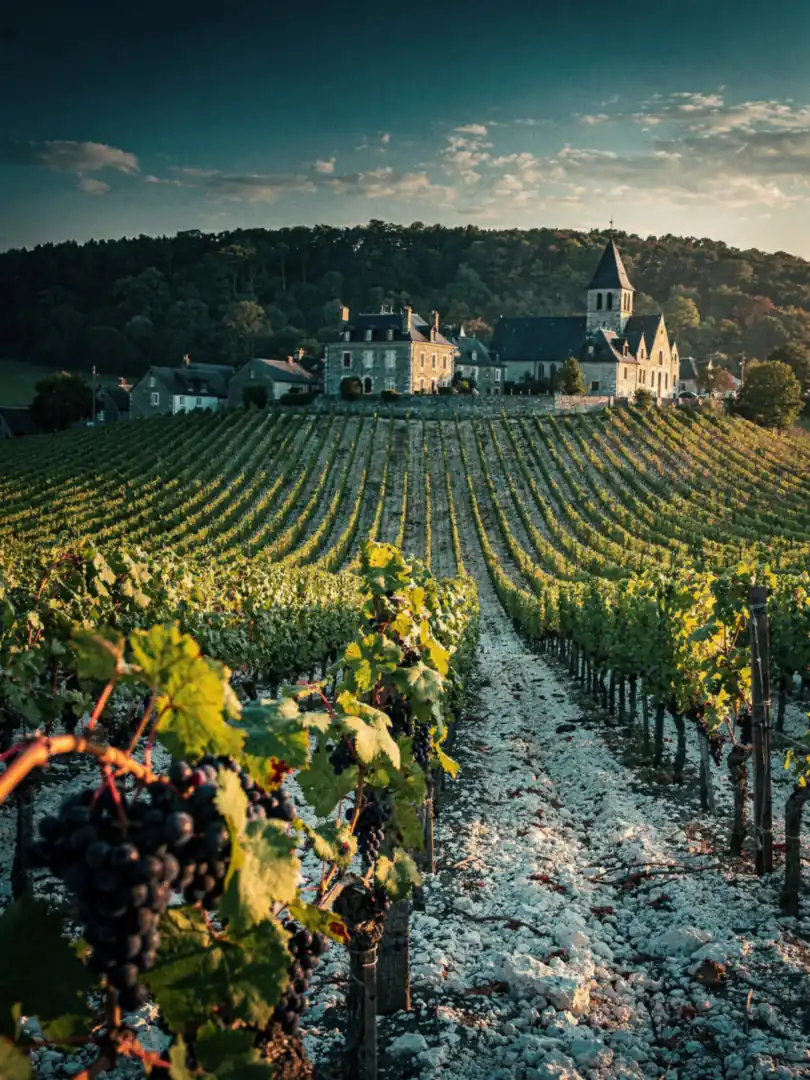
The Villages
Grand Cru and Premier Cru in Champagne
In Champagne, Grand Cru and Premier Cru do not refer to individual vineyard sites, but to entire villages: 17 villages may put Grand Cru on the label, and 42 more may use Premier Cru. The remaining villages, out of 319 crus in the appellation, carry neither designation. The term thus reveals the origin of the grapes, not a particular note in the glass.
What does Grand Cru mean for Champagne?
In Burgundy, a Grand Cru is a precisely delineated vineyard, sometimes just a few hectares in size. In Champagne, the classification applies to an entire village's territory. A Champagne may be called Grand Cru if all its grapes come from one or more of the 17 Grand Cru villages. All of them lie in the Marne department; not a single one is found in the southern part of the region, the Aube.
Most Grand Crus are found in the Montagne de Reims: Ambonnay, Beaumont-sur-Vesle, Bouzy, Louvois, Mailly-Champagne, Puisieulx, Sillery, Verzenay and Verzy. Pinot Noir dominates here. The Côte des Blancs, south of Épernay, contributes Avize, Chouilly, Cramant, Le Mesnil-sur-Oger, Oger and Oiry, strongholds of Chardonnay grown on chalk. On the Marne lie Ay and Tours-sur-Marne. Anyone who knows this list can often tell from the village name alone which grape variety is likely to set the tone.
Where does the classification come from? The Échelle des crus
Behind these terms lies an old pricing scale, the Échelle des crus. Each village was given a percentage value, which determined what growers were paid for their grapes. A Grand Cru village stood at 100 percent and received the full benchmark price. Premier Cru villages ranged between 90 and 99 percent, with all others falling below that, down to as low as 80 percent.
The old village pricing scale was abolished in the late 2000s, and growers and houses have negotiated freely ever since. The terms Grand Cru and Premier Cru remained, and today appear in the appellation's specifications, the Cahier des charges. They thus describe a historical rating of entire villages, not a regular assessment of the wines.
Premier Cru: 42 villages, each with its own character
The Premier Cru list is longer and more varied. It includes Hautvillers with its famous abbey, Cumières, Dizy and Mareuil-sur-Ay on the Marne, Vertus at the southern end of the Côte des Blancs, as well as Rilly-la-Montagne, Ludes and Chigny-lès-Roses in the Montagne de Reims. Even Bezannes, on the outskirts of Reims, is included. Older books and some websites list 43 or 44 villages. The current specifications list 42.
One detail surprises many people: grapes from Grand Cru villages may also be used in a Premier Cru wine. A Premier Cru Champagne can therefore contain Grand Cru grapes, though the reverse is not allowed. If Grand Cru appears on the label, every grape comes from one of the 17 villages. If no designation appears at all, the wine may still contain Grand Cru fruit, since many houses blend it with grapes from other villages.
Is Grand Cru Champagne always better?
The classification is a useful indicator, but no guarantee. A village contains better and weaker parcels alike, south-facing slopes as well as flat plots down in the valley. A village's reputation is an average. On top of that, work in the vineyard and cellar often matters more than the address. A carefully made Champagne from an unclassified village can outshine a carelessly made Grand Cru.
A good example is the Côte des Bar in the Aube. It has not a single classified village, yet it produces Pinot Noir that many houses prize highly. Even top prestige cuvées sometimes forgo the designation, because they deliberately blend grapes from several classifications. Anyone buying Champagne for its origin should therefore read the village name as well, not just the two words in front of it.
A glance at the map helps here. Champagne covers around 34,200 hectares, spread across 319 villages, which the specifications call crus. Only 59 of these carry a classification; all the rest are simply labeled Champagne. This implies no flaw. It simply shows that the pricing scale dates back more than a century and ranked villages by the reputation their grapes held at the time, not by any modern measurement of soil, climate or wine quality.