The Art of Assemblage
Reserve Wines and House Style: Why Non-Vintage Brut Always Tastes the Same
Non-vintage Brut tastes similar year after year because houses blend young wine from the latest harvest with reserve wines from older vintages. These reserves compensate for weak harvests and keep the house style consistent. The cellar master reassembles the blend from dozens of base wines after every harvest.
What are reserve wines in Champagne?
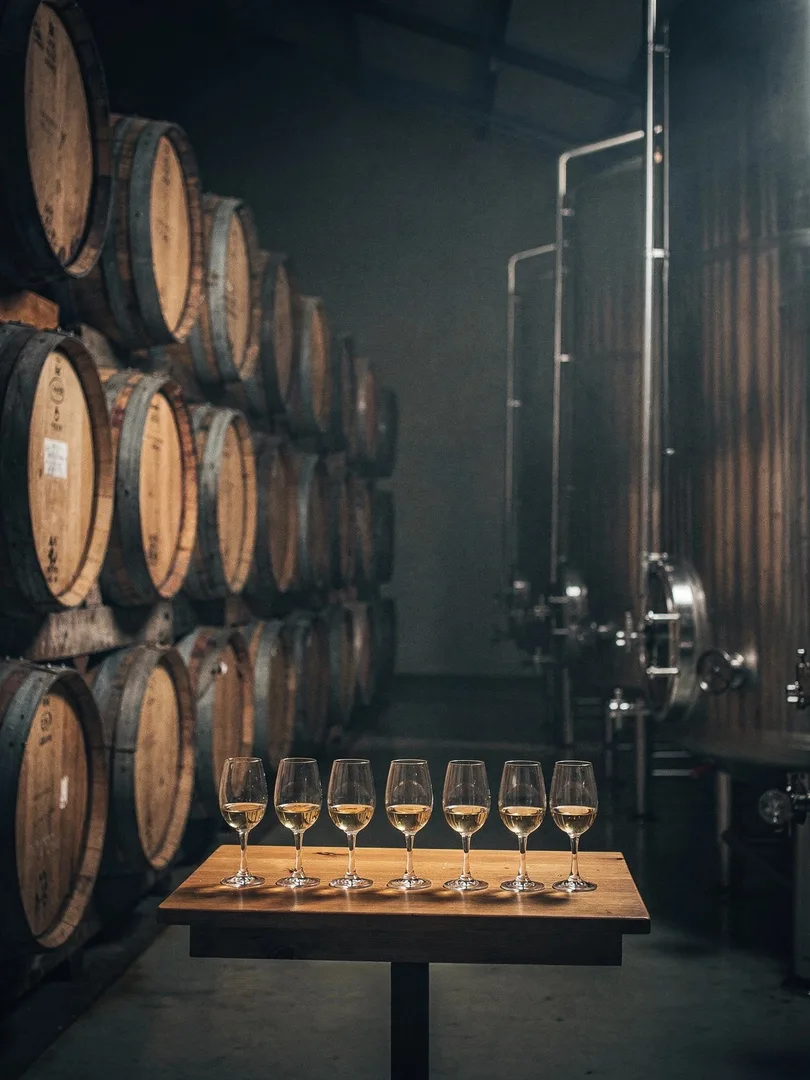
After the harvest, the musts first ferment into still wines, the base wines. Part of this is not used immediately but set aside, often for many years. These reserve wines are stored, depending on the house, in stainless steel tanks, large wooden casks or bottles. They serve, in a sense, as a cellar's memory: a cellar master can draw on the character of earlier years whenever the new harvest turns out too thin, too acidic or too lush.
Appellation rules help ensure this reserve never runs dry. A producer may sell at most 80 percent of its annual volume as vintage Champagne. Champagne also maintains a collectively managed reserve: in abundant years, growers may set aside quantities above the authorized yield as a blocked reserve. These wines receive their designation of origin only once the industry releases them, for instance after frost or hail damage. The marketable yield is set anew each year by the Comité Champagne—for the 2025 harvest, it was set at 9,000 kilograms of grapes per hectare.
How does a Champagne house's style come together?
The real work begins in winter after the harvest. The cellar master and team taste samples from every tank and cask, sorted by village, grape variety and year. A large house may have well over a hundred individual wines in front of them. From these, they assemble a blend that comes as close as possible to the style of previous years. The assemblage must be finalized before tirage, and tirage is permitted no earlier than January 1st following the harvest.
Every house has its own preferences here. Some favor a high proportion of Pinot Noir for power, others lean on Chardonnay for freshness, and still others rely on a generous share of aged reserve wine for depth. How much reserve wine goes into the blend varies considerably from house to house and year to year. The final touch comes from the dosage, the small sugar solution added after disgorgement. It balances the acidity and rounds out the style; details on this are covered in the feature on sweetness and dosage.
Does the label reveal how old the wines in a Brut are?
For a long time, it revealed nothing. A non-vintage Brut looked the same on the shelf year after year, even though the blend inside kept changing. Increasingly, though, producers are offering more transparency. In 2000, Jacquesson abandoned the classic non-vintage Brut and has since numbered every cuvée according to its cellar records; number 728 was based on the 2000 harvest. Krug has numbered its Grande Cuvée as an Edition since 2016.
Other houses and many growers print the base year on the back label—the vintage from which most of the wine originates—or the disgorgement date. Anyone comparing two bottles of the same brand with different information on them often tastes just how much a single extra year on the lees, or after disgorgement, can make. Exactly what the disgorgement date reveals is explained in the feature on aging and storage.
Does non-vintage Brut really taste the same every year?
Similar, but never identical. The goal is recognizability, not copying. A trained palate will notice differences between two bottlings, for instance when a particularly ripe vintage forms the base. Climate change reinforces this: warmer years bring riper grapes with less acidity, and some houses adjust harvest timing, varietal proportions, or dosage to maintain their style. The reserve wine is the most important tool here.
Tank fermentation for Prosecco works quite differently. There, the focus is on the freshness of the young Glera grape, and the wine typically leaves the winery after just a few months. With Champagne, by contrast, the goal is for customers to recognize a brand over decades. That explains why the houses hold so much wine in their cellars. The reserve isn't surplus—it's the foundation of their style.