What drives the price
Why is Champagne so expensive?
Champagne costs more than most sparkling wines because nearly every step is more labor-intensive: hand-harvesting on limited land, strictly capped juice yields, at least 15 months of aging, and cellars full of bottles that can't yet be sold. Add to that the value of the brands and worldwide demand.
Expensive grapes from limited land
The Champagne appellation is legally defined. Around 34,200 hectares of vines lie within it, and new vineyards outside the boundary can't produce Champagne, no matter how good the soil is. The Comité Champagne sets the allowable yield per hectare anew each year; for the 2025 harvest, it was 9,000 kilograms of marketable yield. This keeps supply tight and grape prices high.
The boundaries are old. The law of May 6, 1919 established the region, followed by recognition as an Appellation d'Origine Contrôlée in 1936. Since then, the area has grown only within narrow limits, while demand has risen worldwide. A vineyard in Champagne is therefore a costly asset, and that's reflected in every kilogram of grapes.
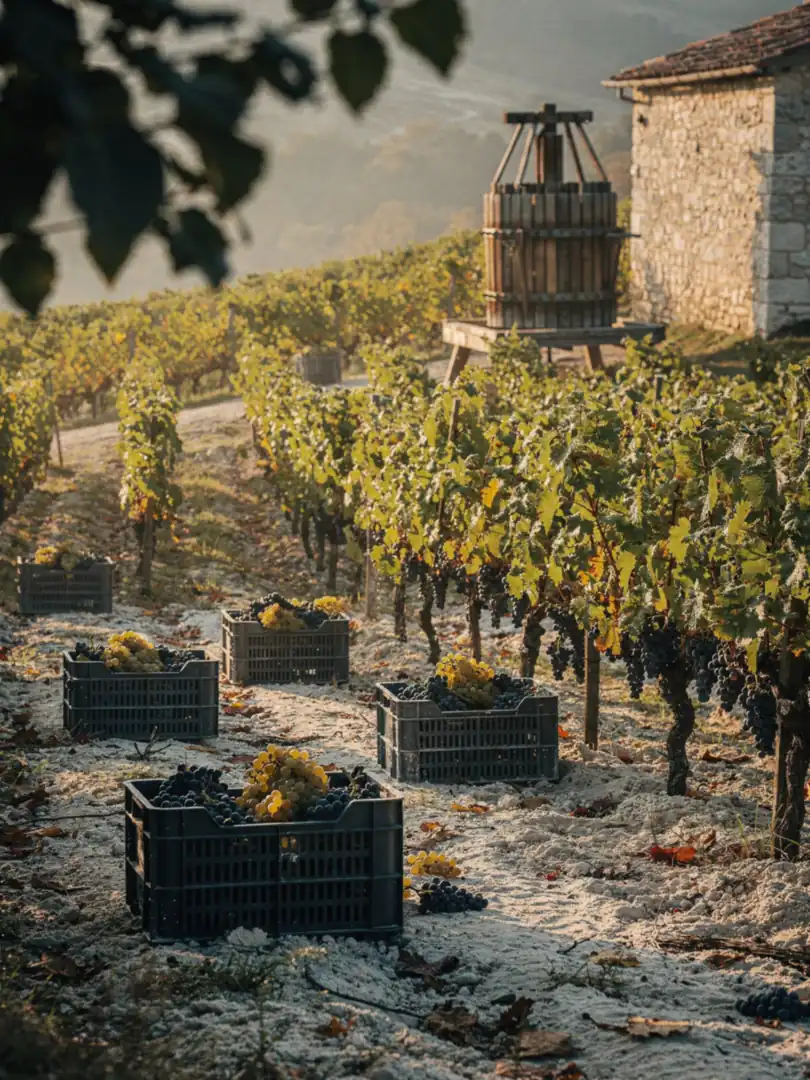
Harvesting is done by hand. The grapes must reach the press whole and undamaged so the juice stays clear and red varieties don't release color. Thousands of harvest workers toil in the vineyards each year for just a few weeks to make this possible. Roughly 1.2 kilograms of grapes are needed for one bottle of Champagne. For a mass-market sparkling wine made from machine-harvested grapes, these costs are considerably lower.
Little juice from many grapes
Pressing is also strictly regulated. From 4,000 kilograms of grapes—one pressing load—no more than 2,550 liters of must may be extracted. Of this, 2,050 liters count as the cuvée, the finest first juice, and 500 liters as the taille, which is somewhat stronger and less refined. Whatever comes from the grapes after that goes to the distillery. Houses that make their top cuvées solely from the cuvée juice are deliberately forgoing part of the permitted yield.
By comparison: EU law allows a maximum of 100 liters of must from 150 kilograms of grapes for Crémant, which works out to about 2,667 liters per 4,000 kilograms. The gap is smaller than one might think, but it adds up across many millions of bottles. For details on how pressing and base wine production work, see the feature on Champagne production.
Why cellar time costs so much
A non-vintage Champagne may not be sold until at least 15 months after bottling for the second fermentation, with a minimum of 12 months on the lees. A vintage Champagne requires 36 months, and many houses voluntarily let their wines age far longer. During this time, grapes, labor, and bottles are long since paid for, yet generate no revenue. According to Comité Champagne, cellars hold reserves equivalent to nearly four years of shipments, more than a billion bottles.
Then there's the traditional bottle fermentation itself. Each bottle is filled, riddled, disgorged, dosed, and corked individually. Machines have sped up many steps, but the effort remains greater than with tank fermentation. A quality sparkling wine made in a pressure tank can be finished after six months of production, and with a stirring device, just 30 days of contact with the lees suffice. A Prosecco DOC can therefore reach the market in a fraction of the time.
One cost factor, incidentally, doesn't explain the gap: the German sparkling wine tax. It's based on volume and is the same for every bottle, whether it contains Champagne or budget sparkling wine. For an expensive bottle, it barely registers, but for a cheap one, it weighs much more heavily.
Brand, reputation, and demand
The rest is market economics. According to Comité Champagne, Champagne accounts for about 9 percent of the sparkling wine consumed worldwide by volume, but roughly 35 percent by value. A large part of the price, then, pays for what customers associate with the name: celebration, tradition, reliability. The big houses invest heavily in advertising, sports sponsorship, and visibility in bars and restaurants.
Whether the premium is worth it ultimately comes down to the palate. Well-made Crémant, Cava de Guarda Superior, or grower Sekt from traditional bottle fermentation use similar methods and often cost significantly less. What makes Champagne unmistakable is its origin, chalky soil, and long cellar aging. Whether that makes it always better than Sekt is examined in the themed journey on health and myths.