Large Bottles
Champagne for weddings and birthdays: bottle sizes and quantities
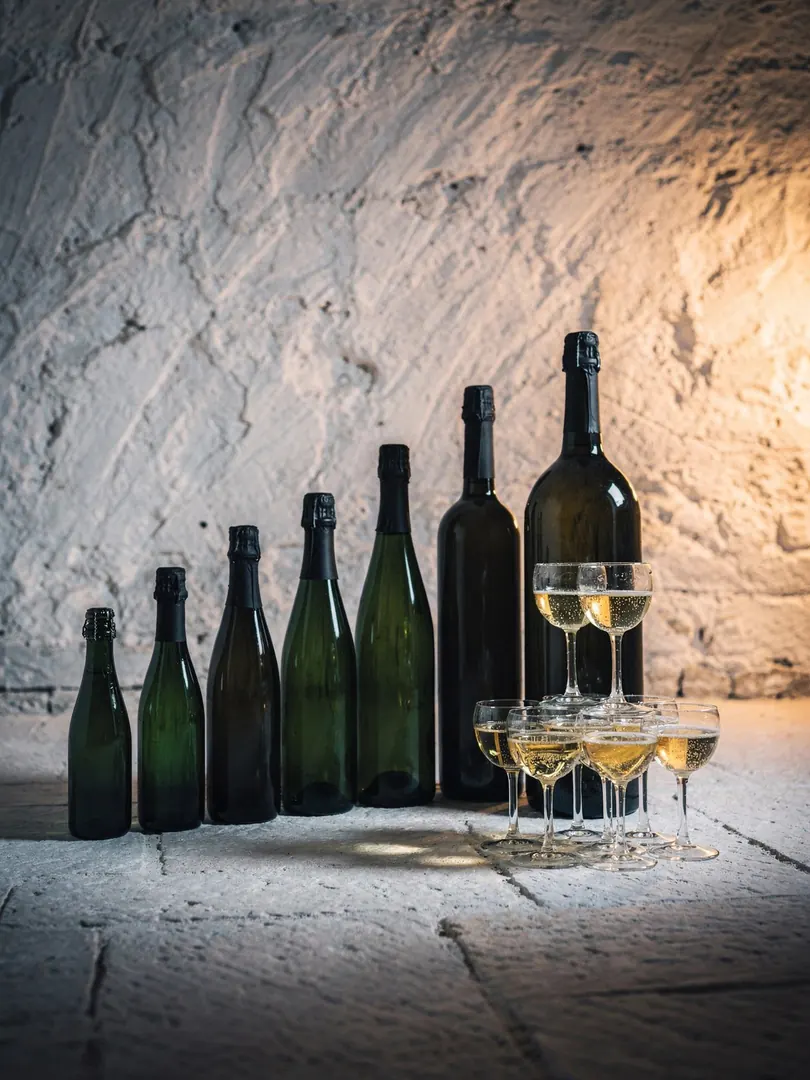
Champagne comes in sizes ranging from the Quart at 0.2 liters, through the standard bottle at 0.75 and the Magnum at 1.5, up to the Melchizedec at 30 liters. For a wedding, plan on one to two glasses per guest for the reception and one more for the toast, figuring six to seven glasses per bottle.
What bottle sizes exist for Champagne?
The Comité Champagne, the region's trade association, lists a long series of formats in its fact sheet. The smallest is the Quart at 20 centiliters, usually called Piccolo in Germany. Next come the half bottle at 37.5 centiliters and the standard bottle at 75. Starting with the Magnum at 1.5 liters, the bottles carry names: Jéroboam at 3 liters, Réhoboam at 4.5, Mathusalem at 6, Salmanazar at 9, Balthazar at 12, and Nabuchodonosor at 15 liters.
Beyond that come Salomon at 18, Souverain at 26.25, Primat at 27, and Melchizedec, also called Midas, at 30 liters. According to the Comité, a Midas holds around 240 flutes. Most of the names come from kings and figures from the Bible and its world, such as Jeroboam, Methuselah, or Nebuchadnezzar. Who introduced this naming convention is not reliably documented. The names are also used for other wines, though the volumes may differ there.
Why Magnum? What the large bottle can do
Among connoisseurs, the Magnum is the most beloved size. It holds as much as two standard bottles, yet has a neck of similar width, meaning a similarly sized pocket of air beneath the cork. In relation to the volume of wine, less oxygen reaches it. Many cellar masters say Champagne therefore ages more slowly and evenly in a Magnum. Reliable comparative studies on this, however, are rare.
In Champagne, bottle size also has a legal dimension. Champagne must be sold in the bottle in which it underwent its second fermentation. This applies to formats from 37.5 centiliters up to 1.5 liters. Smaller bottles like the Quart, and larger ones from the Jéroboam upward, may be transferred after fermentation. A Magnum has spent its entire life in the same bottle; with a Nabuchodonosor, that's not guaranteed.
How much sparkling wine do you need for a wedding?
A wedding usually calls for sparkling wine at two moments: the reception after the ceremony and the toast, often when cutting the cake. For the reception, plan on one to two glasses per guest, and one more for the toast. At 0.1 liters per glass, a standard bottle yields six to seven glasses. For eighty guests at one and a half glasses each, you'll need roughly eighteen to twenty bottles for the reception and about twelve for the toast.
These figures are rules of thumb. A hot summer day, a long photo session, or guests who enjoy their sparkling wine will push the quantity higher. When ordering, it's worth asking whether unopened bottles can be returned. For the toast with the cake, a Demi-Sec pairs better than a Brut, since sweet cake can make a dry wine taste sour. For guests avoiding alcohol, alcohol-free sparkling wine should be on hand so everyone can join the toast. Some guests may prefer water or juice at the reception, and that's worth factoring into the count too.
Champagne tower and vintage wine: special moments
A Champagne tower is a pyramid built from shallow coupes. You pour at the top until the wine cascades down from level to level. This calls for coupes rather than flutes, a sturdy table, and a steady hand. A good deal of carbonation is lost in the overflow, along with some spilled wine. A fresh, uncomplicated sparkling wine from a Magnum suits this better than a prestigious vintage.
For a milestone birthday or anniversary, a vintage wine from the birth or wedding year makes a fitting choice. A vintage Champagne ages at least 36 months from tirage, and many houses let it rest considerably longer. Anyone wanting to set aside a wine for a child's 18th birthday should buy the vintage as soon as it's released and store it cool, dark, and undisturbed. Whether the wine still brings joy decades later depends above all on where it's been stored.