Two world wars
Champagne at war: Reims under fire, chalk cellars as refuge
Both world wars hit Champagne hard. In the First World War, Reims sat near the front for nearly four years, with people living and even schooling children in the chalk cellars. In the Second World War, the German occupation demanded enormous quantities of Champagne, and the industry founded its joint Comité in 1941, which still exists today.
Reims, 1914 to 1918: a Champagne city on the front line
In September 1914, the war reached Champagne, and Reims then lay near the front for almost four years. The city was shelled on 1,051 days. According to the city's history, around 800 residents died, and of 13,806 buildings, 8,625 were completely destroyed. The cathedral, where French kings had been crowned, was also badly hit.
The population fell drastically. In early 1914, around 115,000 people lived in Reims; by the end of the year, only about 60,000 remained. After the evacuation in February 1918, only around 1,500 stayed behind. Despite this, grapes were still harvested and pressed in Champagne, often under fire, with women, children, and the elderly working the vineyards while the men were at the front. German houses such as Mumm were seized at the outbreak of war.
Life in the Chalk Cellars of Reims
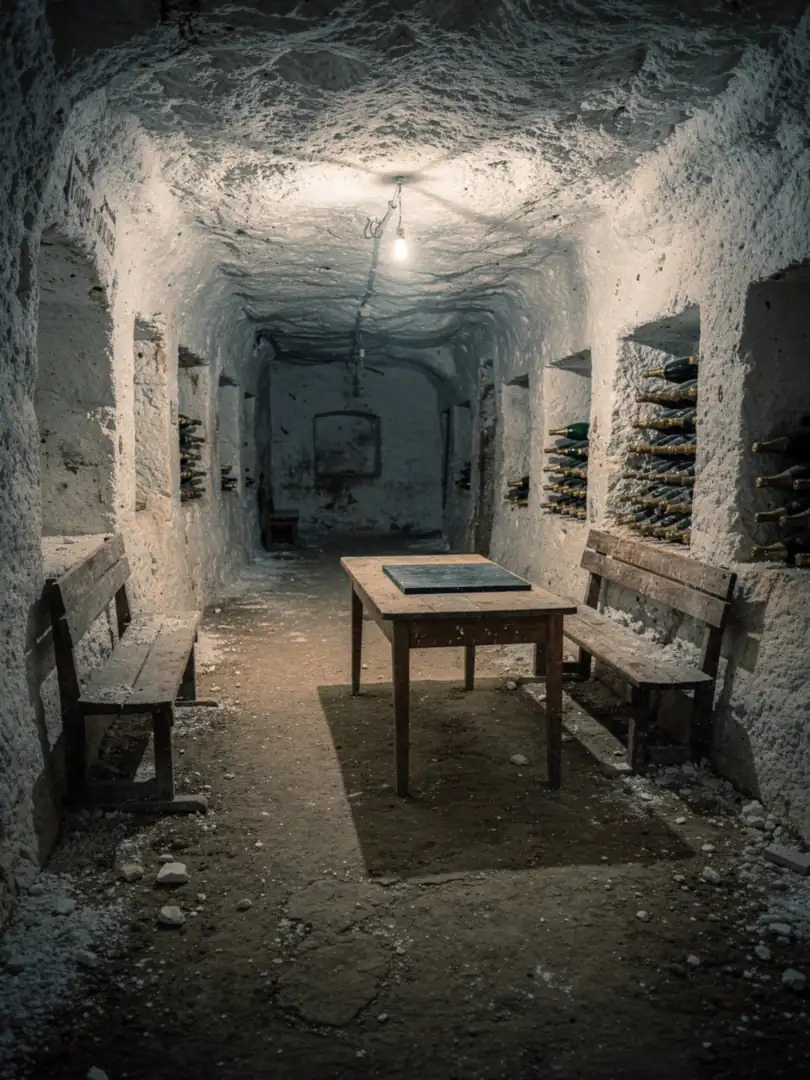
What protects Champagne now protected people. Beneath Reims lie miles of tunnels and pits carved into the chalk, known as the crayères, where millions of bottles normally age. They are cool, stable, and deep enough to withstand shelling. Many families moved into these cellars. There was a field hospital down there, church services, and even births.
Even schooling continued underground. In December 1915, of the city's 1,600 schoolchildren, 400 were being taught in cellar schools, some less than a mile and a half from the German lines. The Champagne houses kept working in the same tunnels as best they could. Anyone visiting a cellar in Reims today often walks through passages that, in those years, served as home, school, and shelter all at once.
The Wine Führer: Champagne Under German Occupation
After France's defeat in June 1940, the German occupation appointed wine-buying officers, often called Weinführer, in the major wine regions. In Champagne, that man was Otto Klaebisch. His job was to procure Champagne for the Wehrmacht, government offices, and the state leadership. The quantities demanded were enormous, with reports citing up to 400,000 bottles a week, at prices dictated by the occupiers.
The houses tried to resist without openly defying the occupiers. According to reports, weaker wines were handed over to the occupying forces, while good vintages disappeared behind hastily built walls. More important was an organizational step. On April 12, 1941, Robert-Jean de Vogüé of Moët & Chandon and Maurice Doyard founded the Comité Interprofessionnel du Vin de Champagne, known as the CIVC. It was the first trade association of its kind in French winemaking.
1941: How the Comité Champagne Came to Be
The Comité united growers and houses that often had conflicting interests. In dealings with the occupiers, Champagne could now speak with one voice. De Vogüé became its most prominent representative, and he paid a price for it. In November 1943, the Gestapo arrested him, and he was sentenced to death, though the sentence was never carried out. He was held in captivity at Ziegenhain in Hesse and was liberated in May 1945.
The Comité survived the war and today operates as the Comité Champagne, the region's trade association. It protects the name Champagne worldwide, helps determine the annual harvest yield, and publishes sales figures. Protection of the name goes back further still. As early as 1843, there were already joint legal actions, followed by a law defining the region's boundaries in 1919 and the protected designation of origin, AOC, in 1936. Out of the hardships of the occupation emerged the organization that still enforces this protection today.