Widows as Heads of the House
The Widow Clicquot and the Women of Champagne
Barbe-Nicole Clicquot, née Ponsardin, took over her husband's champagne house as a widow in 1805 and shaped it for decades. Under her, the first known vintage champagne emerged in 1810, the riddling rack in 1816, and in 1818 the first known rosé made from a blend of white and red wine.
Why Did Widows Run the Champagne Houses?
The word Veuve, widow, still appears on some of the most famous labels in Champagne today. Behind this lies a legal reason. Under the French civil code of 1804, the Code civil, a married woman could barely sign contracts or run a business without her husband. As a widow, however, she was legally independent. Anyone who lost her husband could therefore suddenly run a company, something that had been denied to her as a wife.
Barbe-Nicole Ponsardin had married into the Clicquot family, whose house had been founded in Reims by Philippe Clicquot in 1772. Her husband François died in 1805, when she was in her late twenties. Rather than selling the business, she ran it herself and built it over the following decades into one of the great brands. The house has since been known as Veuve Clicquot Ponsardin and today belongs to the LVMH group.
Riddling Rack 1816: How Champagne Became Clear
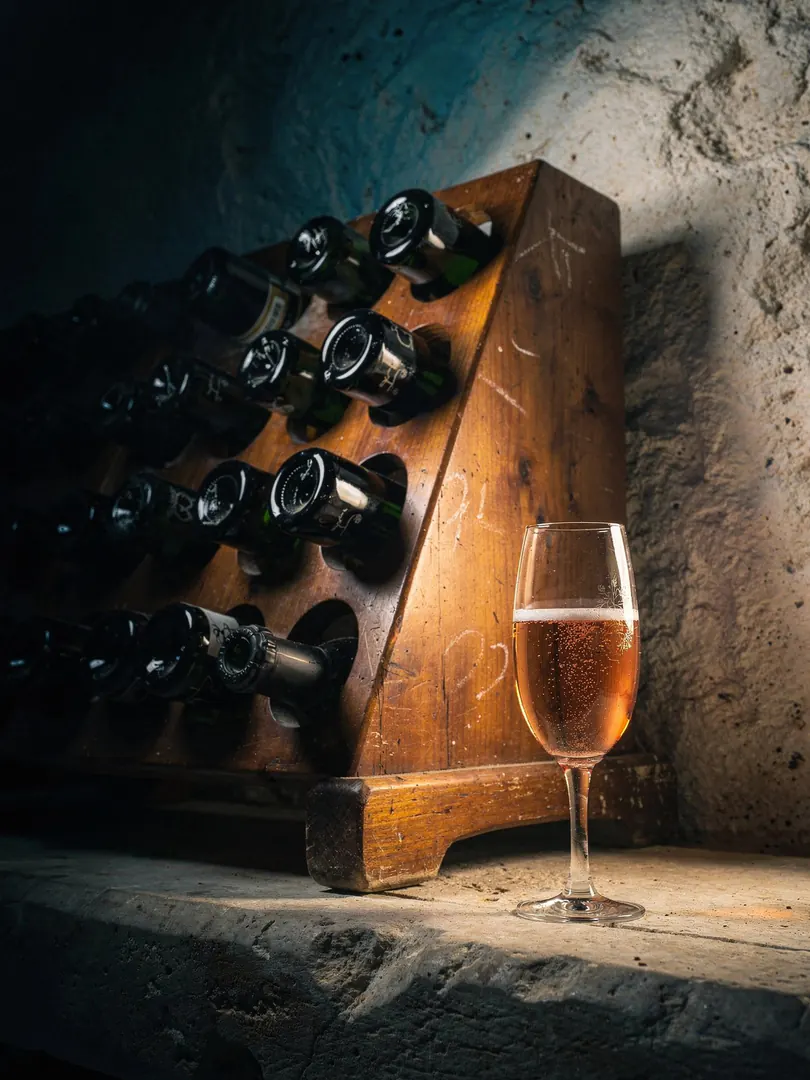
The biggest problem with early champagne was the yeast. After the second fermentation, it remains as cloudy sediment in the bottle. For a long time, the wine was therefore decanted or poured cloudy, and either way it cost carbonation. In 1816, the house of Clicquot, together with its cellar master Antoine Müller, found a solution. It was a slanted wooden board with holes, in which bottles were placed upside down.
The bottles were turned slightly each day and gradually tilted steeper. This gradually moved the yeast into the neck of the bottle. This process is called riddling, French remuage. At the end, the bottle was briefly opened, the pressure forced out the plug of yeast, and the wine remained clear. This removal process is called disgorgement. The principle still applies today, even though most houses now leave the riddling to machines, the so-called gyropalettes.
First Vintage Champagne and First Rosé Champagne
Vintage champagne also traces back to this house. The first known champagne made from a single harvest year is a wine from Veuve Clicquot from 1810. This was a deliberate decision against the usual blending of multiple years. A vintage shows the character of a particular harvest, while a blend evens out fluctuations. Both approaches exist side by side to this day, each with its own rules for minimum aging.
In 1818 came the first known rosé, created by blending white wine with a little red wine. This is called assemblage rosé. For still wine, this method is banned within the EU, but for sparkling wine cuvées it is permitted, and in Champagne it remains the standard approach to this day. Alongside it there is saignée rosé, whose color comes from brief contact with red skins. The claim that Ruinart sold rosé as early as 1764 is only known second-hand.
Louise Pommery, Lily Bollinger and Other Women at the Helm
Barbe-Nicole Clicquot was not the only one. Louise Pommery lost her husband Alexandre in 1858, shortly after the founding of the house Pommery & Greno in Reims. She continued running it and oriented it strongly toward the English market, which demanded drier wines. Her Pommery Nature from 1874 is considered by many accounts to be the first champagne in the Brut style, meaning notably drier than the sweet wines common at the time. It is confirmed that taste shifted toward dry during this period.
In the 20th century, Lily Bollinger took over the house of Bollinger in Aÿ after her husband Jacques died in 1941. She led it through the German occupation and for decades afterward. Her path resembles that of the Widow Clicquot more than a century earlier. Today, many women lead houses, estates, and cellars in Champagne without a death being necessary for that. The word Veuve on the label is a reminder of a time when the law dictated otherwise.