Removing the Lees
Riddling and Disgorgement: How the Lees Leave the Bottle
During riddling, the bottle is turned and tilted increasingly upright over days or weeks, until the lees deposit settles in the neck. During disgorgement, the bottle neck is frozen in brine at around minus 20 degrees Celsius, the crown cap is opened, and the pressure shoots the frozen yeast plug out. Dosage and corking follow afterward.
Why Does Sparkling Wine Need to Be Riddled?
After lees aging, the sediment sits as a streak along the bottle wall. If the bottle were opened now, the wine would be cloudy. So the lees need to end up somewhere that can be removed with a single motion: in the neck of the bottle, right beneath the crown cap. This is achieved through gravity and patience. The bottle is gradually moved from horizontal to upside down, being turned repeatedly along the way so that even stubborn deposits release from the glass. The French call this work remuage.
Riddling aids in the tirage dosage make the deposit heavier and less sticky, so it slides more easily. Even so, not every batch of lees moves equally well. Some deposits cling to the glass, requiring more passes or a firmer jolt. Experienced riddlers can read the progress by the appearance inside the bottle: as long as streaks still cling to the glass, the job isn't finished. Only once the wine above is perfectly clear can the bottle move on.
Riddling Rack or Gyropalette?
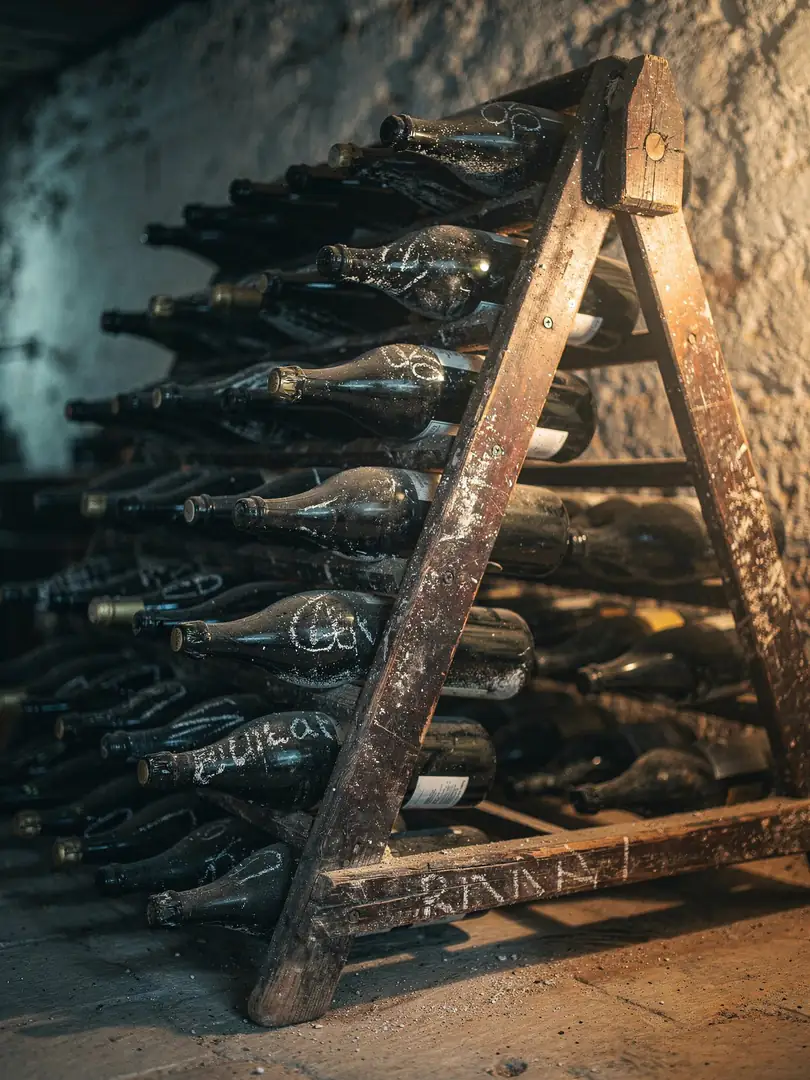
The classic tool is the riddling rack, two wooden boards leaned against each other at an angle, each pierced with holes into which the bottles are inserted neck-first. A riddler grips each bottle by the base, gives it a short twist, and tilts it a bit steeper. Over several weeks, the bottle gradually works its way up to vertical. Skilled hands can process many thousands of bottles a day. The Journey through History tells how the rack came to be in Champagne.
Today, gyropalettes handle this work in most wineries. These are machines that tilt and rotate an entire cage full of bottles according to a fixed program, even at night and on weekends. They take days rather than weeks and work with great consistency. Many houses now riddle only large formats or individual prestige cuvées by hand. The method of riddling is considered irrelevant to flavor; what matters is that the sediment fully reaches the neck.
What does disgorgement mean in sparkling wine?
Once the sediment sits in the neck, disgorgement follows—removing the yeast plug. The bottles travel neck-down through a brine bath at around minus 20 degrees Celsius. The first few centimeters of the neck, along with the yeast, freeze into a small, solid plug. The bottle is then set upright and the crown cap removed. The internal pressure shoots the frozen plug and the bidule out, leaving the wine clear behind. In large wineries, this runs on conveyor belts handling thousands of bottles per hour.
In the past, this was done without cold, known in French as à la volée. The cellar worker would open the bottle with the neck tilted downward, let the sediment shoot out along with a splash of wine, and immediately right the bottle again. This required great skill and cost more wine. Some producers still use this method for special bottlings. Many producers print the disgorgement date on the back label; it helps gauge how long the wine has aged without yeast since then.
Dosage and corking after disgorgement
Some wine is lost during disgorgement. The gap is filled by the dosage liqueur, known in French as liqueur d'expédition, a mixture of sugar and wine, sometimes with a touch of wine distillate. Its amount determines the sweetness level, from Brut Nature to Doux. If no sugar is added and the sugar content stays below 3 grams per liter, the label may read Brut Nature, Pas Dosé, or Dosage Zéro. The dosage liqueur may raise the alcohol content by no more than 0.5% ABV. The Journey into Sweetness and Dosage describes exactly how the sweetness levels work.
The cork goes in right after. It's compressed and driven halfway into the neck, with the rest expanding above to form the familiar mushroom shape. A metal cap, the plaque, and a wire cage, the agraffe (muselet), hold it in place against the pressure. The bottle is then given a brief shake to distribute the dosage evenly. Many houses then let the wine rest for several weeks or months so the dosage and wine can integrate before it goes to market.