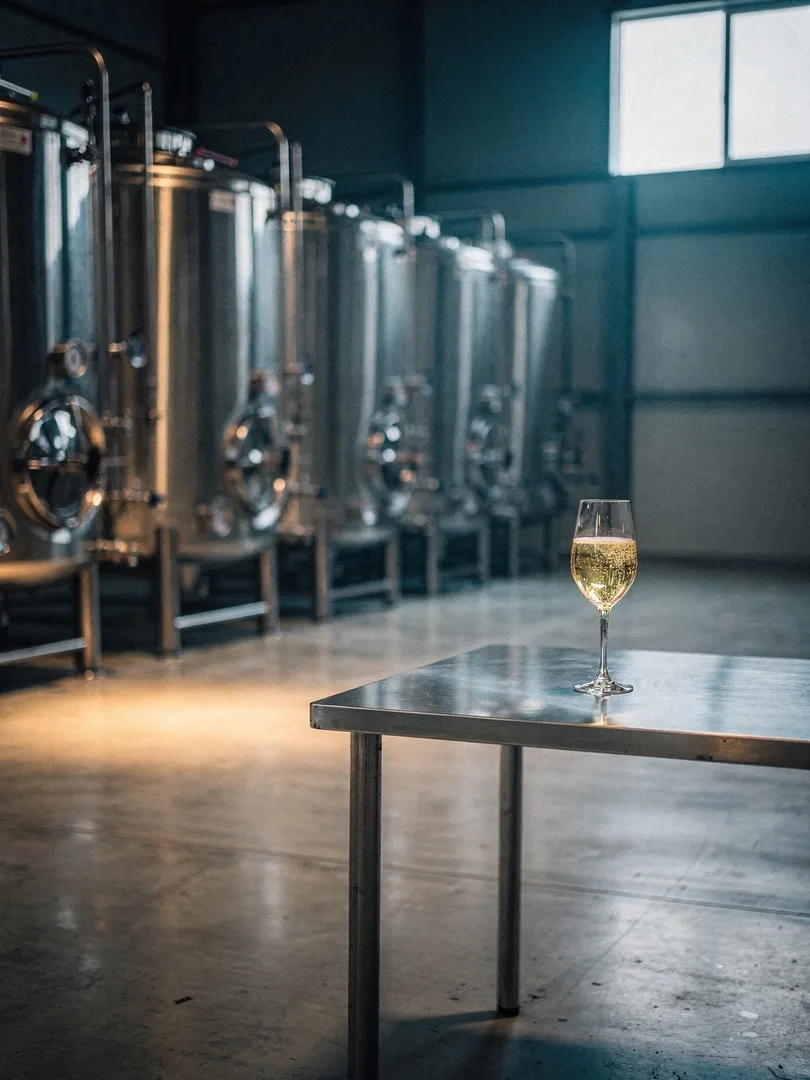
Fermentation in a pressure tank
Tank fermentation: the Charmat and Martinotti methods
With tank fermentation, the second fermentation takes place in a large pressure tank rather than in the bottle. Federico Martinotti had the method patented in 1895, and Eugène Charmat refined it in 1907. It saves time and manual labor while preserving fruit aromas; Prosecco and many branded sparkling wines are made this way.
Who invented tank fermentation?
It's often said that the Frenchman Eugène Charmat invented the method. But the first patent was actually filed back in 1895 by Federico Martinotti in Asti. Charmat improved the technique and had it patented in 1907. That's why Italians speak of the Metodo Martinotti, while the French and Germans usually refer to the Charmat method. Both mean the same thing: the second fermentation doesn't happen in thousands of individual bottles, but together in one sealed stainless steel vessel.
EU law calls this vessel a cuvée tank, while in the cellar it's known as a pressure tank or autoclave. It can withstand several bars of excess pressure and can be cooled or warmed as needed. This gives the cellar master full control over the fermentation at all times. Legally, the tank is treated the same as the bottle when it comes to carbonation: here too, it comes entirely from fermentation. A sparkling wine made in a tank therefore qualifies as a quality sparkling wine just as much as one fermented in the bottle, provided it meets the other requirements.
How does tank fermentation work step by step?
The cuvée goes into the pressure tank along with sugar and yeast. It ferments there at a controlled temperature until the desired pressure is reached. If the wine is meant to stay sweeter, the cellar master stops fermentation by chilling it as soon as enough residual sugar remains in the wine. The wine then spends some time on the lees. A stirring mechanism can repeatedly stir up the yeast in the tank, bringing it into contact with far more wine than would be possible at the bottom of a bottle lying on its side.
The wine is then chilled and filtered until clear. Bottling takes place under counter-pressure: the bottles are first pressurized with gas to match the tank's pressure, so the carbonation stays in the wine during transfer. The dosage is typically added to the wine before bottling. Riddling and disgorgement are skipped entirely, and the bottle is clean from the very start. This saves the most labor-intensive steps of bottle fermentation.
How long does tank fermentation take for sparkling wine?
Even in the tank, some patience is still required. For quality sparkling wine—which in Germany means every Sekt—EU law requires a minimum production period of six months from the start of the second fermentation. Fermentation and lees contact together must last at least 90 days, or just 30 days in tanks equipped with a stirring mechanism. By comparison, bottle fermentation requires nine months of production time.
For aromatic quality sparkling wines like Asti, one month is enough. The Prosecco DOC specification also lists the wine under this aromatic category; which one a producer uses doesn't appear on the label. Some producers take the opposite approach, leaving the wine on the lees in the tank for many months—called Charmat lungo in Italy, meaning long Charmat. The wine gains a bit of creaminess and yeasty character this way, without losing its fruit character.
Is tank fermentation inferior to bottle fermentation?
It pursues a different goal. Bottle fermentation seeks out the flavors of yeast—bread, brioche, and nuts—along with long aging. Tank fermentation preserves the fruit character of the grape: pear, apple, blossom, and in Muscat, the grape's own aroma. For an aromatic variety like Glera or Moscato, years of lees aging would actually be a loss, since the yeasty notes would mask the aroma. Some winemakers deliberately choose the tank method even for Riesling, to clearly showcase its freshness.
The practical difference comes down to volume and effort. A pressure tank holds tens of thousands of liters, eliminating the need to work on each individual bottle. That's why the big branded sparkling wines are mostly made in tanks, as is the vast majority of Prosecco. If you want to know how a sparkling wine was made, check the label: if there's no mention of bottle fermentation, it was very likely made in a tank. That alone, however, says nothing about the quality of the base wine.