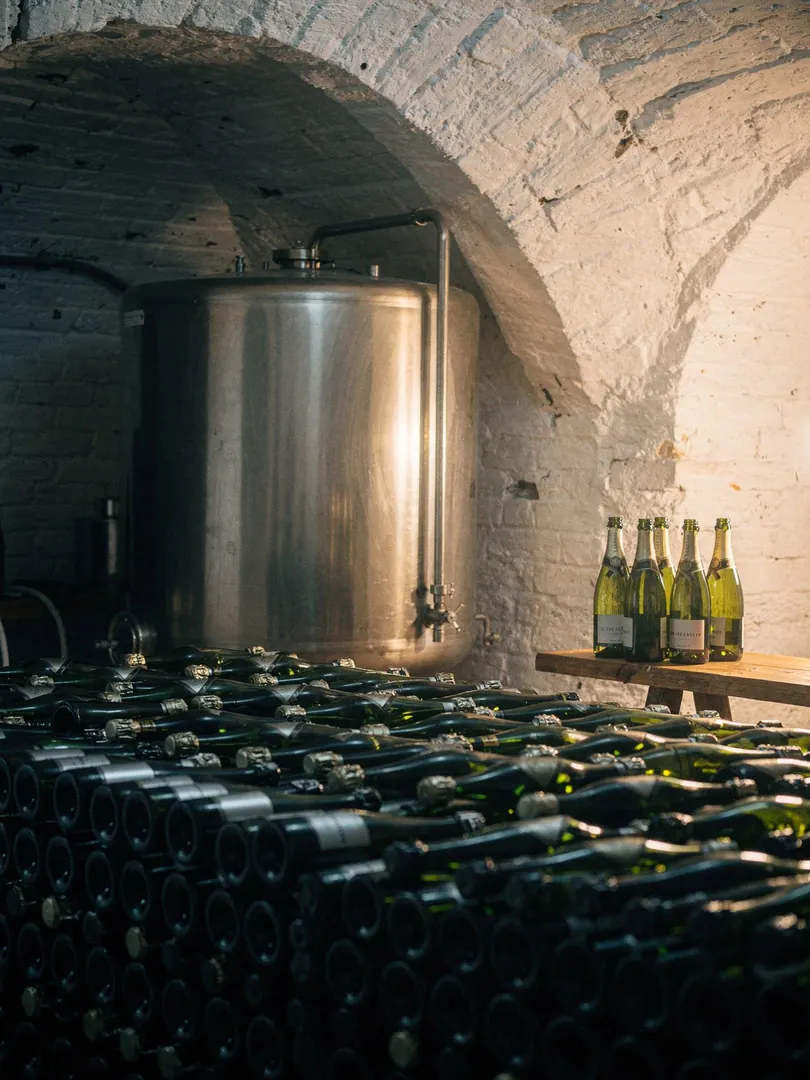
Transferring under pressure
The transfer method: bottle fermentation without riddling
With the transfer method, the sparkling wine ferments in the bottle but is then emptied under pressure into a tank, filtered, and bottled into new bottles. Riddling and disgorgement are skipped entirely. The label may say "bottle fermented," but not "traditional bottle fermentation."
How does the transfer method work?
It starts the same way as the traditional method. The cuvée receives the tirage dosage, is bottled, sealed with a crown cap, and ferments lying down in the cellar. Here too, pressure builds up inside each individual bottle, and the wine spends some time afterward resting on the lees. Only at the end do the paths diverge. Instead of riddling and disgorging each bottle, a machine opens the bottles under counter-pressure and empties them into a chilled pressure tank.
The wine from many thousands of bottles collects in the tank. There it's filtered to remove the yeast and given the dosage liqueur to achieve the desired sweetness level. It's then bottled under counter-pressure into new, clean bottles and corked. The name comes from the French transvaser, meaning to transfer. According to industry literature, the method has been widespread since the 1950s, especially among larger sparkling wine producers.
Can a transfer-method sparkling wine be labeled "bottle fermented"?
Yes, and this is exactly where confusion often arises. EU law permits the term "bottle fermented" if the second fermentation took place in a bottle, the production period lasted at least nine months, and fermentation plus lees contact totaled at least 90 days. Separation from the sediment may explicitly happen either by transfer or by disgorgement. "Transfer" here means decanting into another vessel.
The words "traditional" or "classic," on the other hand, are off-limits. These require that the wine rested on the sediment in the same producer's facility for at least nine months without interruption and was disgorged in its own original bottle. On the label, then, the entire difference hinges on a single word. If you only read "bottle fermented," you can't be sure the wine never left its fermentation bottle. The Journey into Law and Labeling covers the exact labeling rules.
Why do wineries use the transfer method?
The main reason is labor. Riddling and disgorgement are among the most labor-intensive steps of bottle fermentation. With the transfer method, these steps are eliminated, yet the wine still gains the lees-aging character that comes from the bottle. The tank also evens out small differences between individual bottles: in the end, the whole batch tastes consistent, which is desirable for large volumes. The filter also reliably catches any yeast residue that might otherwise remain in individual bottles after disgorgement.
Even Champagne makes use of transferring, though only for certain formats. Champagne in bottles ranging from 37.5 to 150 centiliters must be sold in the same bottle in which it fermented. Smaller bottles like the Piccolo, and large formats from the three-liter Jeroboam upward, may be transferred after fermentation. Riddling and disgorging tiny bottles individually would be disproportionately laborious, while very large ones are difficult to handle.
Can you taste the difference compared to the traditional method?
A transfer-method sparkling wine starts from the same foundation as one made traditionally: fermentation in the bottle and time on the lees. The tricky part is the transfer itself. Any movement under pressure carries the risk of losing some carbonation or picking up oxygen, which diminishes freshness. Wineries therefore work cold, under counter-pressure, and with protective gas.
How strongly the method shows in the glass depends on the winery's care and precision. Often, the base wine and the duration of lees aging matter more for flavor than this final step. A transfer-method sparkling wine with long aging can taste more complex than a traditionally fermented one that spent only the minimum time on the lees. For origin-based rules, though, the distinction remains crucial: Crémant, Cava, and estate-grown Winzersekt may not be made using the transfer method, and Champagne only in the formats mentioned above.