Lying Down or Standing Up
Storing Sparkling Wine: Standing Up or Lying Down?
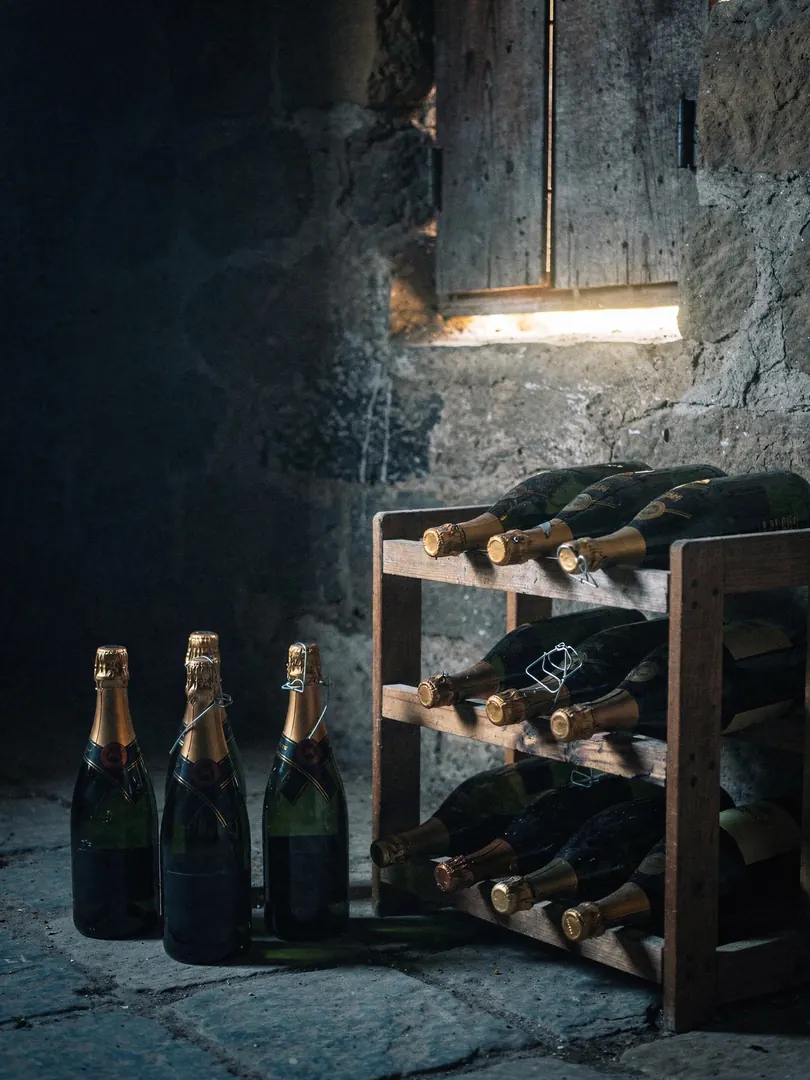
Sparkling wine and Champagne can be stored either standing up or lying down. The Comité Champagne sees no effect of position on quality. More important are darkness, a steady temperature between 10 and 15 °C, humidity of 60 to 80 percent, and a room free of foreign odors.
Why Is Sparkling Wine Stored Differently from Still Wine?
With still wine sealed under natural cork, the old rule applies: lay the bottle on its side so the cork stays moist and doesn't shrink. A dried-out cork lets air in, the wine oxidizes, meaning it reacts with oxygen and turns flat. With sparkling wine, things work a bit differently. Between the cork and the wine sits a small pocket of gas under pressure. According to the Comité Champagne, a Champagne bottle holds around 6 bar at 20 °C, while a quality sparkling wine like Sekt must have at least 3.5 bar.
This gas pocket is saturated with carbon dioxide and water vapor. That means the underside of the cork stays in moist air even in an upright bottle. The construction also plays a role: a sparkling wine cork is usually made of pressed cork granulate, with disks of natural cork at the base. It's compressed firmly and holds much more securely than a slender still-wine cork. That's why the Comité Champagne, the trade association of the Champagne region, states explicitly in its storage guidelines: lying down or standing up, it makes no difference to the quality of the wine.
Lying Down or Standing Up: What the 1996 Trial Revealed
Still, position isn't entirely without effect. French trade publications report on a study carried out by the Comité Champagne in 1996. It found that position made no difference to the risk of cork taint or off-flavors. However, bottles stored lying down appeared slightly more developed than those stored upright, meaning the wine tasted a touch more mature. One plausible explanation: where wine sits in constant contact with the cork, the exchange with outside air may proceed somewhat differently.
For everyday purposes, this leads to a simple rule. If you're buying sparkling wine to drink within the next few weeks or months, you can store it upright, just as it sits on the shelf. If you want to age Champagne for years, lying it down is the usual practice, as is customary in cellars and space-saving besides. If you'd rather preserve that fresh style for longer, standing it upright works too. Both approaches are sound from a technical standpoint; the other storage conditions matter more.
Light in the Wine Rack: Lightstruck Character
Light does far more damage. White wine, rosé, and Champagne all contain riboflavin, otherwise known as vitamin B2, along with the amino acid methionine. When blue or ultraviolet light hits the wine, this reaction breaks down the methionine into volatile sulfur compounds. The fault is known in French as goût de lumière, or "light taste." It smells of cooked cabbage, a damp dishcloth, or rotten eggs, and makes the wine taste bitter. Research from France shows that trained tasters can detect it in a glass of Champagne after just fifteen minutes of sun exposure.
Bottles made of clear or pale glass are especially vulnerable, which is why many rosé Champagnes and some prestige cuvées are wrapped in foil or packaged in cartons. Even dark green glass doesn't offer full protection over long periods. The Comité Champagne recommends storing bottles in the dark and displaying dummy bottles in shop windows instead. At home, this means: keep the carton closed, don't put bottles on a shelf by the window, and avoid placing them directly under fluorescent lighting.
The Right Spot: Temperature, Humidity, Stillness
The Comité's guidelines call for a temperature between 10 and 15 °C and humidity between 60 and 80 percent. More important than hitting an exact number is keeping it consistent. If temperature swings strongly between day and night or summer and winter, the wine expands and contracts repeatedly. This puts recurring strain on the cork, and the wine ages faster as a result. A wine fridge, a cool cellar, or a dark cupboard in the coolest room of the home all make good storage spots.
Unsuitable places include the kitchen next to the stove and dishwasher, the top of the refrigerator, and the attic. The storage area should also be free of strong odors, so keep it away from paint cans, heating oil, or onions, and air it out occasionally. After a long journey, the Comité recommends letting the bottles rest before opening. A Pét-Nat with yeast still in the bottle is best stood upright for a few days before opening, so the sediment settles at the bottom.