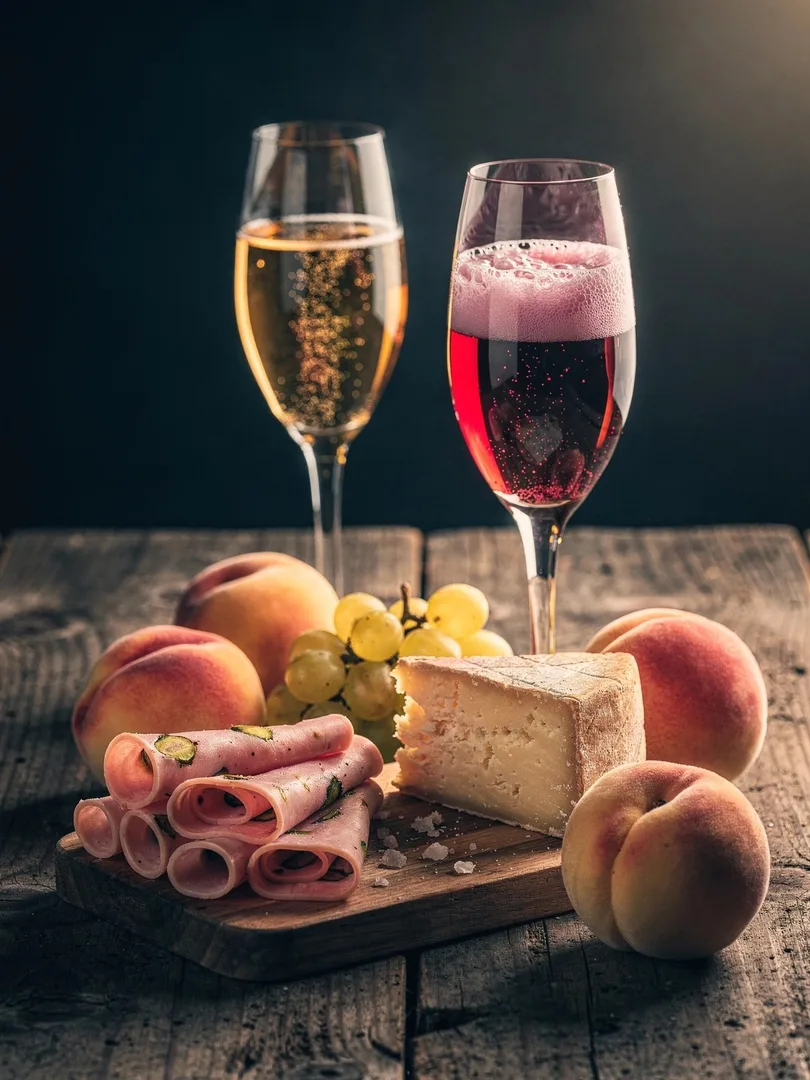
Red and Sweet
Lambrusco, Asti, Moscato d'Asti: Red and Sweet Sparkling Wines
Asti is a sweet sparkling wine made from Muscat that ferments only once: fermentation is halted while sugar remains in the must. Moscato d'Asti has a lighter fizz and only about 5.5 percent alcohol. Lambrusco is usually a red semi-sparkling wine from Emilia-Romagna, ranging from dry to sweet.
Asti Spumante: Why Is It Sweet?
With Sekt and Champagne, the wine ferments twice, and the sweetness only comes at the end through the dosage, a small amount of sugar solution. Asti takes a different path. The must from the Moscato bianco grape, the white Muscat, is stored cold and only fermented in a pressure tank when needed. The resulting carbon dioxide stays trapped in the tank. As soon as the pressure and alcohol levels are right, the winery stops fermentation through cooling—a process known as the Metodo Asti.
The unfermented sugar remains in the wine as natural sweetness. Legally, Asti is classified as an aromatic quality sparkling wine: it may not receive a dosage, fermentation may only be controlled through cold temperatures, and production can take as little as a month. The alcohol level is usually well below that of a Sekt. Asti has held DOCG status since 1993 and is made from 100 percent Moscato bianco; the zone was first delimited back in 1932.
Moscato d'Asti: How Does It Differ from Asti?
Made from the same grapes and the same region, Moscato d'Asti is nonetheless a different wine. Fermentation is halted even earlier, giving it only about 5.5 percent alcohol and a lighter fizz. This makes it a semi-sparkling wine, frizzante in Italian, rather than a full sparkling wine like Asti Spumante. It tastes sweet, but the acidity often makes it surprisingly light on the palate.
In the glass, both wines display the typical Muscat bouquet: peach, orange blossom, sage and fresh grapes. This is exactly why the production method is so specific. Extended lees aging or a dosage would mask this freshness. German Muscat Sekt shows similar aromatic notes too, but is usually made through second fermentation and can be produced dry.
For identifying them in the shop, two features are enough. Asti is sealed with a Champagne-style cork secured by a wire cage, since as a full sparkling wine it has at least 3 bar of pressure. Moscato d'Asti, as a semi-sparkling wine, stays below 2.5 bar and can be closed with a simpler stopper. Both belong to the same DOCG. Low alcohol, by the way, doesn't mean alcohol-free: even 5.5 percent is noticeably more than a non-alcoholic beer, and sweet wines tend to mask their alcohol content.
Lambrusco: Is Red Sparkling Wine Always Sweet?
Red and fizzy might sound sweet to many, but Lambrusco comes in every level of sweetness. It originates from Emilia-Romagna and the neighboring part of Lombardy and is made from a family of red grape varieties that all share the name Lambrusco. It's usually a semi-sparkling wine made in a pressure tank. The label uses secco for dry, amabile for off-dry and dolce for sweet—the same terms used for still wine.
The styles differ considerably. Lambrusco di Sorbara is pale, almost rosé, with lively acidity. Lambrusco Grasparossa di Castelvetro is dark, fuller-bodied and more tannic, while Lambrusco Salamino di Santa Croce falls somewhere in between. For the hearty cuisine of Modena—mortadella or Parmigiano—dry Lambrusco is considered the classic pairing, since its acidity and fizz balance out the richness.
With Lambrusco too, it pays to check the category. As a semi-sparkling wine, it has less pressure than a Sekt, its foam settles quickly in the glass, leaving a violet or pink-tinged rim. Simple mass-market versions are often sweet and soft, while the dry wines from the smaller appellations show sour cherry, violet and a tart freshness. It's served chilled, but a touch warmer than a white sparkling wine.
Red and Sweet in Other Sparkling Wines: Brachetto, Shiraz, Demi-Sec
Alongside Asti, Piedmont also produces Brachetto d'Acqui, a red, sweet and fragrant sparkling wine with notes of rose. In Australia, there's Sparkling Shiraz, a deep red sparkling wine that, in its finer versions, is made using the traditional method. Red, by contrast, is excluded from Champagne—the appellation only permits white and rosé.
Classic sparkling wines can also be sweet, though the sweetness arises differently there. With Champagne, Sekt or Cava, the dosage after the second fermentation determines the sugar level. The scale ranges from Brut Nature to mild, sweet styles with over 50 grams per liter—though the term "lieblich" (off-dry/medium-sweet) isn't used for sparkling wine. A Demi-Sec Champagne with 32 to 50 grams gets its sweetness from added sugar solution, whereas Asti's sweetness comes from the grape's own natural sugar.