The Old Houses
Kessler, Henkell, Rotkäppchen & Co.: Germany's Sekt Houses
Germany's oldest surviving Sekt house is Kessler in Esslingen am Neckar, founded on July 1, 1826. Henkell followed in 1832, Söhnlein in 1864, Rotkäppchen in 1856 (as Kloss & Foerster), and Schloss Wachenheim in 1888. A Sekt house typically buys in base wine and turns it into sparkling wine.
Which Is Germany's Oldest Sekt House?
Before returning to Württemberg, Georg Christian Kessler had worked at Veuve Clicquot in Reims. On July 1, 1826, he and Heinrich August Georgii founded the firm G. C. Kessler & Co. in Esslingen am Neckar. It's considered Germany's oldest Sekt house still in operation today. That qualifier matters, because Kessler wasn't entirely alone. In Naumburg an der Saale, the firm W. F. Bürger & Sohn had already tried its hand at sparkling wine in 1824, and a similar attempt began in Grünberg, Silesia, also in 1826. None of these early operations survive today.
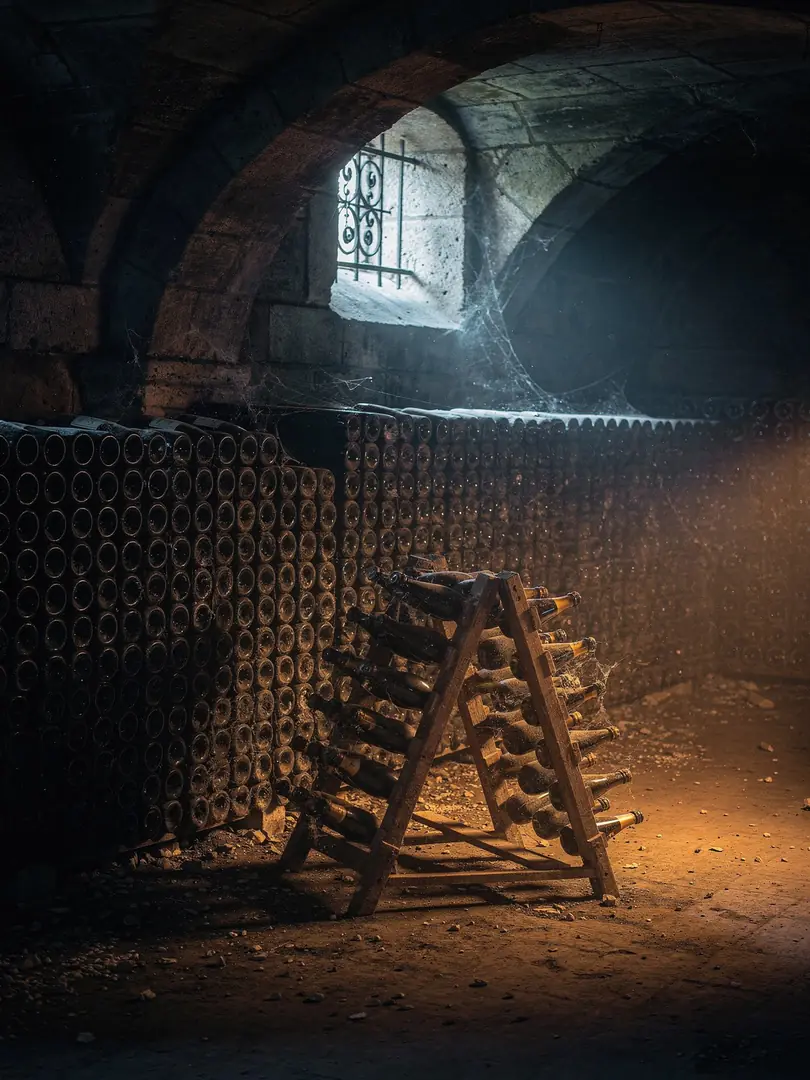
Kessler still ages its Sekt beneath the Speyrer Pfleghof in Esslingen's old town. The house weathered insolvency in 2004 and 2005, then relaunched with a new circle of shareholders. At around two million bottles a year, it's small today compared to the corporate groups that dominate the market. For the story of how Germans learned the craft in Champagne, see our journey through the history of sparkling wine.
Sekt Houses on the Rhine: Henkell, Söhnlein, Deinhard, Kupferberg
The 19th century saw the Rhine become the hub of German sparkling wine production. Here, wine merchants had capital, ports allowed for easy shipping, and base wine flowed in from the Rheingau, Rheinhessen, and the Mosel. Adam Henkell founded a wine merchant business in Mainz in 1832, which grew into the Sekt house Henkell. In 1894 it launched the brand Henkell Trocken, and in 1909 the company moved into its grand building in Wiesbaden-Biebrich, where it remains headquartered today.
Right next door in Wiesbaden-Schierstein, Johann Jacob Söhnlein founded the Rheingauer Schaumweinfabrik in July 1864. In 1877, Söhnlein struck a deal with the Prince von Metternich, owner of Schloss Johannisberg, which gave rise to the brand Fürst von Metternich. In Koblenz, the wine merchant Deinhard, founded in 1794, began making its own Sekt in 1843. In Mainz, the Kupferberg house got to work, while in Eltville in the Rheingau, the Matheus Müller house operated under the abbreviation MM, a brand name that lives on today.
Rotkäppchen, Geldermann, Schloss Wachenheim: Houses Beyond the Rhine
The best-known Sekt house in eastern Germany sits in Freyburg an der Unstrut. Founded in 1856 as Kloss & Foerster, its sparkling wine has carried the Rotkäppchen brand name since 1894. After reunification, this company grew into the country's largest Sekt group, which our next stop explores.
In the southwest, the Sekt house Geldermann is based in Breisach on the Kaiserstuhl. Its roots trace back to Aÿ in Champagne, where Peter-Joseph-Hubert Geldermann, originally from Aachen, co-founded the house Deutz & Geldermann with William Deutz in 1838. Geldermann works exclusively with traditional bottle fermentation. In the Palatinate, the Deutsche Schaumweinfabrik was founded in Wachenheim in 1888, known today as Schloss Wachenheim AG. It merged with the Trier-based Sekt house Faber in 1996 and now ranks among the largest sparkling wine producers in the world.
What's the Difference Between a Sekt House and a Sekt Estate?
A classic Sekt house often owns few or no vineyards of its own. It buys in base wine—the finished, still wine that becomes Sekt through secondary fermentation—and blends it into a cuvée, a mix designed to deliver a consistent house style. Its craft lies in blending, fermenting, and dialing in the right level of sweetness. Depending on the brand, the base wine may come from Germany or other EU countries; only the origin statement on the label reveals which.
A wine estate that makes Sekt takes the opposite path: it grows its own grapes, presses them, and turns its own wine into Sekt, often as Winzersekt labeled with grape variety and vintage. Since 1892, Sekt houses have been organized under the Association of German Sekt Producers (VDS), with Kessler as a founding member. Today, its members account for roughly 95 percent of domestic Sekt production.