Bottle or Tank
The Second Fermentation
A Pezsgő in Hungary can take one of two paths. The second fermentation happens either in the bottle or in a pressurized tank. It's this step that gives the still wine its carbon dioxide, since the gas stays trapped in the vessel and dissolves into the wine.
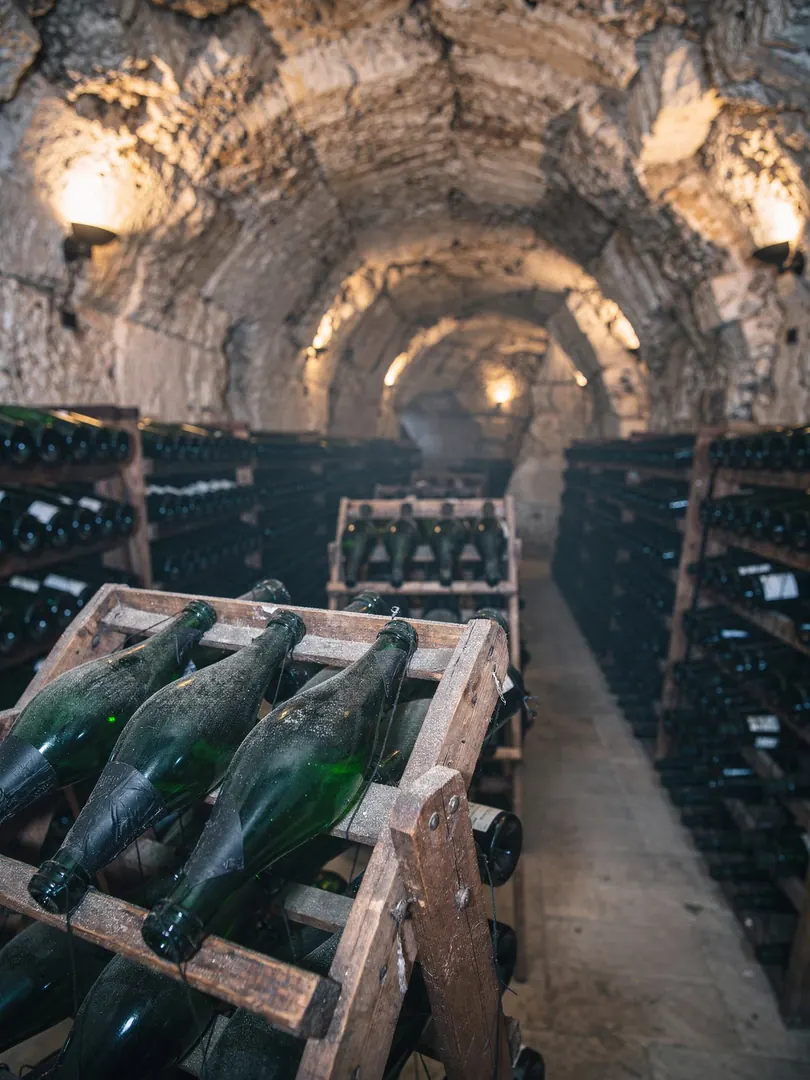
For bottle fermentation, the cellar master fills the cuvée into the bottle along with the liqueur de tirage, a mixture of sugar and yeast, then seals it with a crown cap. This filling step is called tirage. The yeast consumes the sugar, producing alcohol and carbon dioxide; the liqueur de tirage may raise the alcohol content by no more than 1.5 percent. Inside, the pressure rises to at least 3.5 bar, compared to around 6 bar for Champagne.
In 1882, József Törley copied every step he'd learned in Reims. According to the house, Törley Chardonnay Brut is still made this way today, meaning the wine leaves the bottle only when it's poured for drinking. It is never transferred into a tank.
With the tank method, the wine undergoes its second fermentation in a large pressurized tank. This process traces back to Federico Martinotti, who patented it in 1895, and Eugène Charmat, who refined it in 1907. It requires a minimum production time of six months and 90 days of lees contact, or 30 days with stirring.
The label doesn't always reveal which method was used. If a region such as Tokaj appears alongside "Pezsgő," the wine is bottle-fermented. "Classic bottle fermentation" requires at least nine months of uninterrupted lees aging at the same producer, plus disgorgement without any transfer to another vessel.
Törley Chardonnay BrutBottle fermentation · Chardonnay
- Time on lees
- 9–12 Months
- Sugar
- 0–12 g/l
- Alcohol
- 11–12 % vol
Dry, fresh, citrus and apple; Chardonnay from Etyek-Buda with a fine mousse.