Cool Hills
Soil & Climate
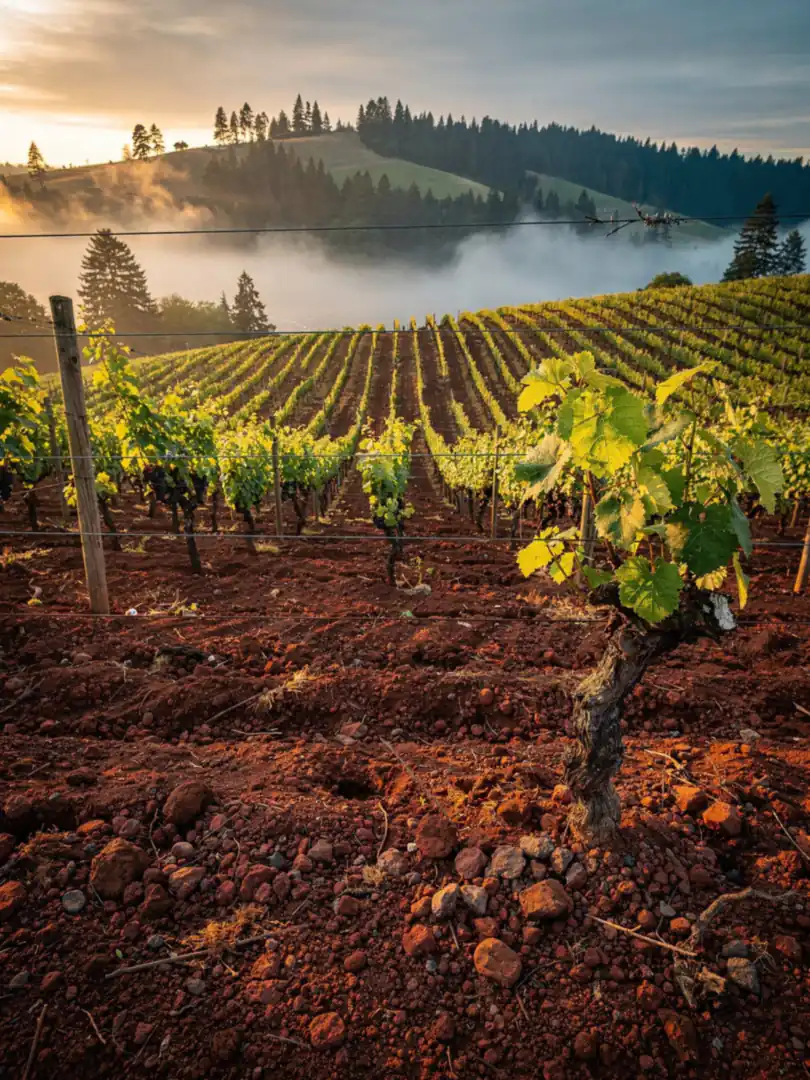
Cool nights and mornings make the Willamette Valley a place where sparkling wine thrives. The valley lies between the Coast Range and the Cascades; the grapes retain their acidity even when the days are sunny. For sparkling wine, they're picked early, at lower ripeness, so the wine stays fresh and crisp.
Three major soil types are distinguished in the valley: volcanic rock, deposits from an ancient sea, and loess, a fine wind-blown dust. Which type lies beneath the vines colors the wine of each sub-zone differently. This explains why two sparkling wines from the same valley can taste so different when their vines grow on different ground.
There's no chalk here as in Champagne. Argyle points out that the valley lacks the Kimmeridgian limestone, that Jurassic-era seabed also found beneath Chablis. Instead, there are spots where ancient seabed has been uplifted to the surface. Soter describes the subsoil of Mineral Springs Ranch near Yamhill-Carlton in similar terms, as ancient seabed.
In the hill country around Dundee, where Argyle is located, volcanic rock predominates; in the Yamhill-Carlton area to the west, marine deposits take over. Then there's autumn: toward the end of harvest, the Pacific often brings rain to the valley, another reason to pick grapes for sparkling wine early.
A very different case is found in New Mexico. There, Natalie and Laurent Gruet planted an experimental vineyard with Chardonnay and Pinot Noir near Engle, about ten miles from Truth or Consequences, after a visit in 1983. The family hails from Bethon in Champagne, where Gilbert Gruet founded his house in 1952; the winery in New Mexico has existed since 1984. Dry land, far from the sea: Champagne-style sparkling wine without a Champagne climate.