Two misconceptions at once
"Agave syrup is healthy, and there's plenty of agave to go around"
Agave syrup is marketed as a natural, healthy sugar alternative, and agave seems like an endlessly available raw material. Both fall short. This station separates syrup marketing from real growing times and genuine risks to wild populations.
What's actually in agave syrup?
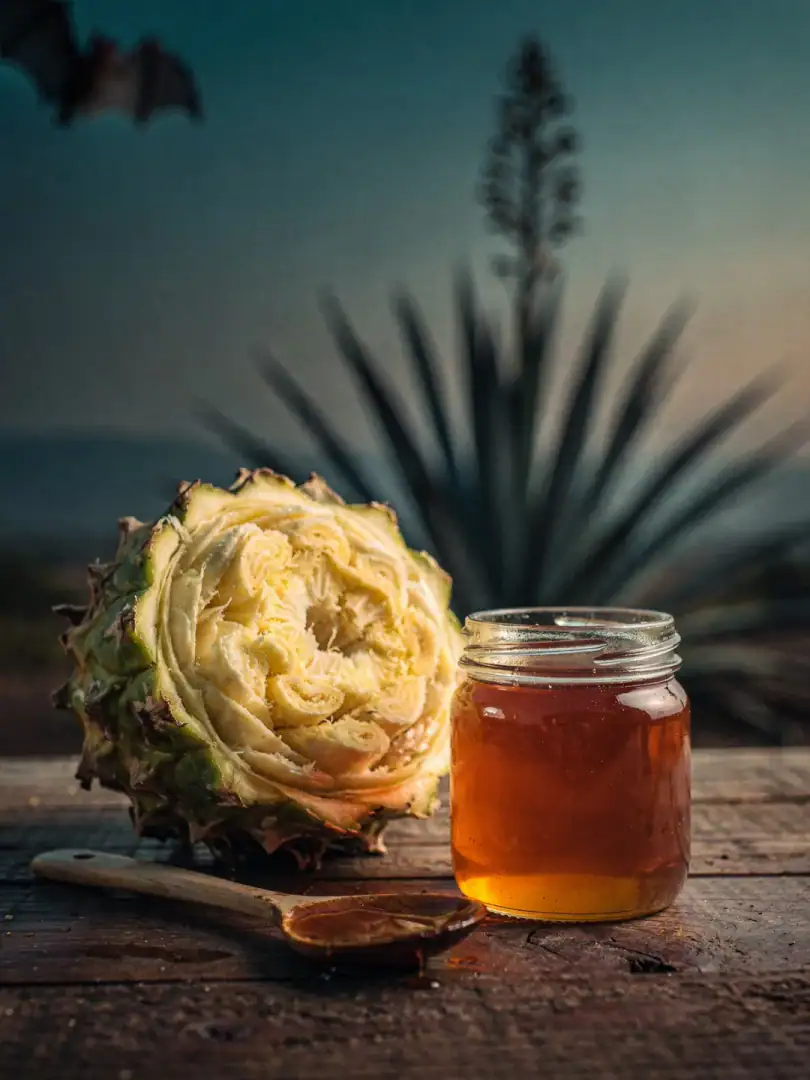
Agave syrup is usually extracted from the sap of Agave tequilana or related species, similar to the first step of tequila production, except that here the sap isn't fermented and distilled but heated and thickened instead. The syrup is often marketed as a natural, healthy alternative to table sugar. However, it consists largely of fructose, often considerably more than in ordinary sugar or honey, and it's processed industrially. So it isn't natural in the sense of unprocessed, even though the marketing suggests otherwise.
It gets even more confusing because some syrups are marketed for their low glycaemic index, which is purely down to the high fructose content and doesn't automatically mean the syrup is healthier overall than other sweeteners. A low glycaemic index only describes how quickly blood sugar rises after eating it, not its overall effect on the body.
Where does the syrup come from, and what does it have to do with tequila?
Syrup producers mostly use the same plant as the tequila industry, the cultivated Blue Weber agave, which is grown deliberately in fields like any other agricultural crop, with a growing time of six to eight years. In agricultural terms this agave is renewable, more demand can in principle be met with more farmland, even though the long growing time means supply can't be adjusted quickly. That explains the recurring shortages and price spikes in agave that the tequila industry has also been struggling with for years.
Because syrup and tequila draw on the same raw material, the two industries compete directly for the same agave fields in years when supply is tight. When demand for syrup rises sharply, as it recently did amid the trend toward plant-based sweeteners, tequila production feels the effect too, because farmers sell their harvest to whichever buyer pays more.
Is it true that there's enough agave for everyone?
That's only partly true for the cultivated Blue Weber agave, and not at all true for many wild agave species used mainly for mezcal. Mezcal may be made from numerous agave species, and a significant portion of these are not cultivated but wild-harvested. Some of these species take ten, fifteen, even over twenty years to mature. When demand for mezcal rises quickly, as it has internationally in recent years, local wild populations decline far faster than they can regrow.
Regionally, this overexploitation can go so far that entire populations of certain wild agave species noticeably decline in particular municipalities, which in turn hits small producers who traditionally depend on exactly those species. Some palenques are therefore now experimenting with cultivating species that were previously only wild-harvested, with mixed success.
What does this have to do with bats?
Commercial agaves are usually harvested shortly before they flower, because otherwise the plant channels its stored energy into flowering rather than into the piña, the usable heart. But it's precisely these flowers that the lesser long-nosed bat, Leptonycteris yerbabuenae, needs as the most important pollinator of night-blooming agaves. That's why the Bat Friendly initiative, run since 2016 by Mexico's UNAM university, certifies distilleries that let at least five percent of their agaves flower naturally, ensuring bats and wild populations get enough of a supply. So the misconception that agave is endlessly available overlooks both the long growth cycle and this ecological dependency.
Some mezcal producers and environmental initiatives are therefore running targeted replanting programmes for endangered wild agaves, often together with local communities. The success of such programmes depends heavily on whether enough plants are allowed to stand until they flower, rather than being harvested completely before flowering.