Sand, Caliche, Gravel
Soils
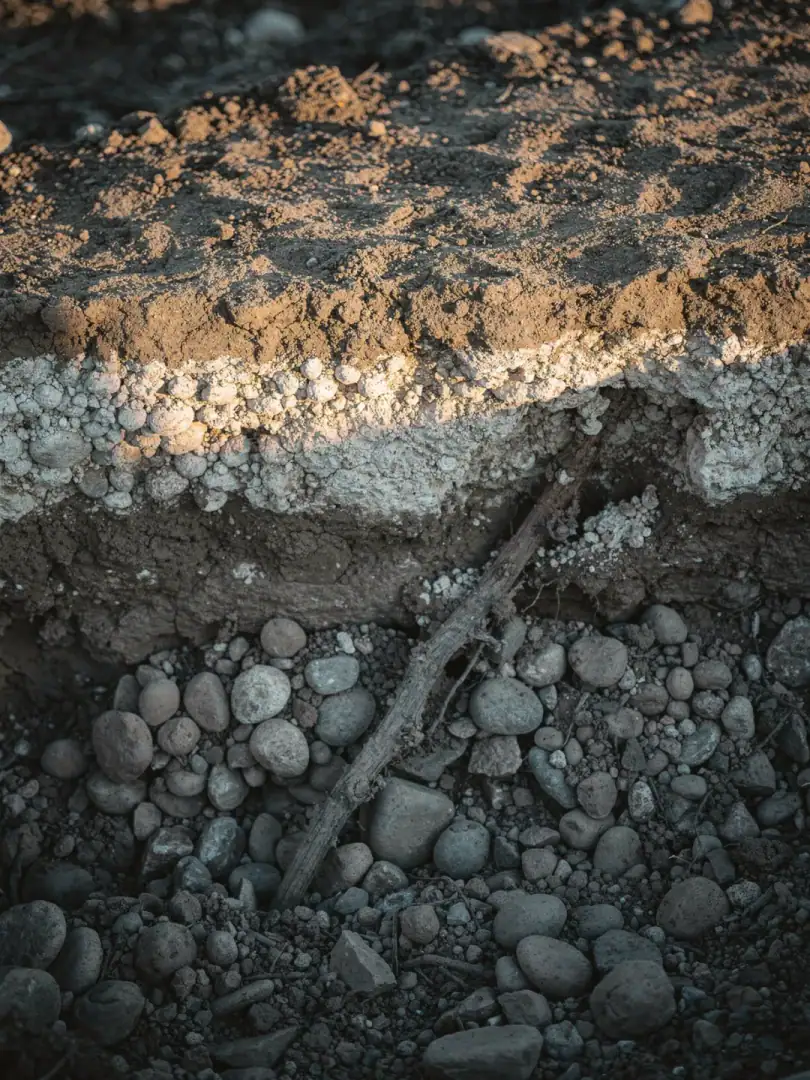
Dig a hole in a vineyard in the Valle de Uco. In the first twenty centimeters, you'll find only loose, pale sand, constantly reshuffled by wind and irrigation. Hardly a crumb of humus lies within. That's normal for a desert.
Below that, things get interesting. Over millennia, meltwater from the Andes has dissolved calcium and deposited it again, until it formed a pale, sometimes cement-hard crust — called caliche. It appears especially in Gualtallary and across much of the Valle de Uco, often twenty to fifty centimeters deep. Sometimes it lies as a thin vein, sometimes as a continuous slab.
For the vine's roots, this layer is an obstacle, and that's exactly what makes it valuable. The root must squeeze through cracks instead of spreading comfortably outward, and this effort curbs the yield per vine. Lower yield means more concentrated berries, and concentrated berries mean denser wines — the same equation as with lean rocky soils elsewhere, only with limestone instead of slate.
Beneath the caliche follows coarse, rounded gravel, deposited by glacial rivers that once flowed down from the Andes. Between the stones, hardly any fine soil remains, but water seeps through effortlessly. In particularly stony plots, this layer runs several meters deep, and any root that pushes down that far survives even a dry summer without additional irrigation.
One side effect of these sandy soils spared Mendoza a catastrophe that struck half of Europe. Phylloxera spreads quickly in dense clay, but barely at all in loose sand, because it can't dig stable tunnels to the roots there. As a result, numerous Malbec vines in Mendoza survived on their own roots, without being grafted onto American rootstock. A fact that some bodegas still take pride in to this day.
Loose, pale desert sand, constantly redistributed by wind and irrigation. Little organic matter, but plenty of light and warmth right at the surface.
The root: Only the finest roots live here. Between waterings, this layer dries out almost completely.