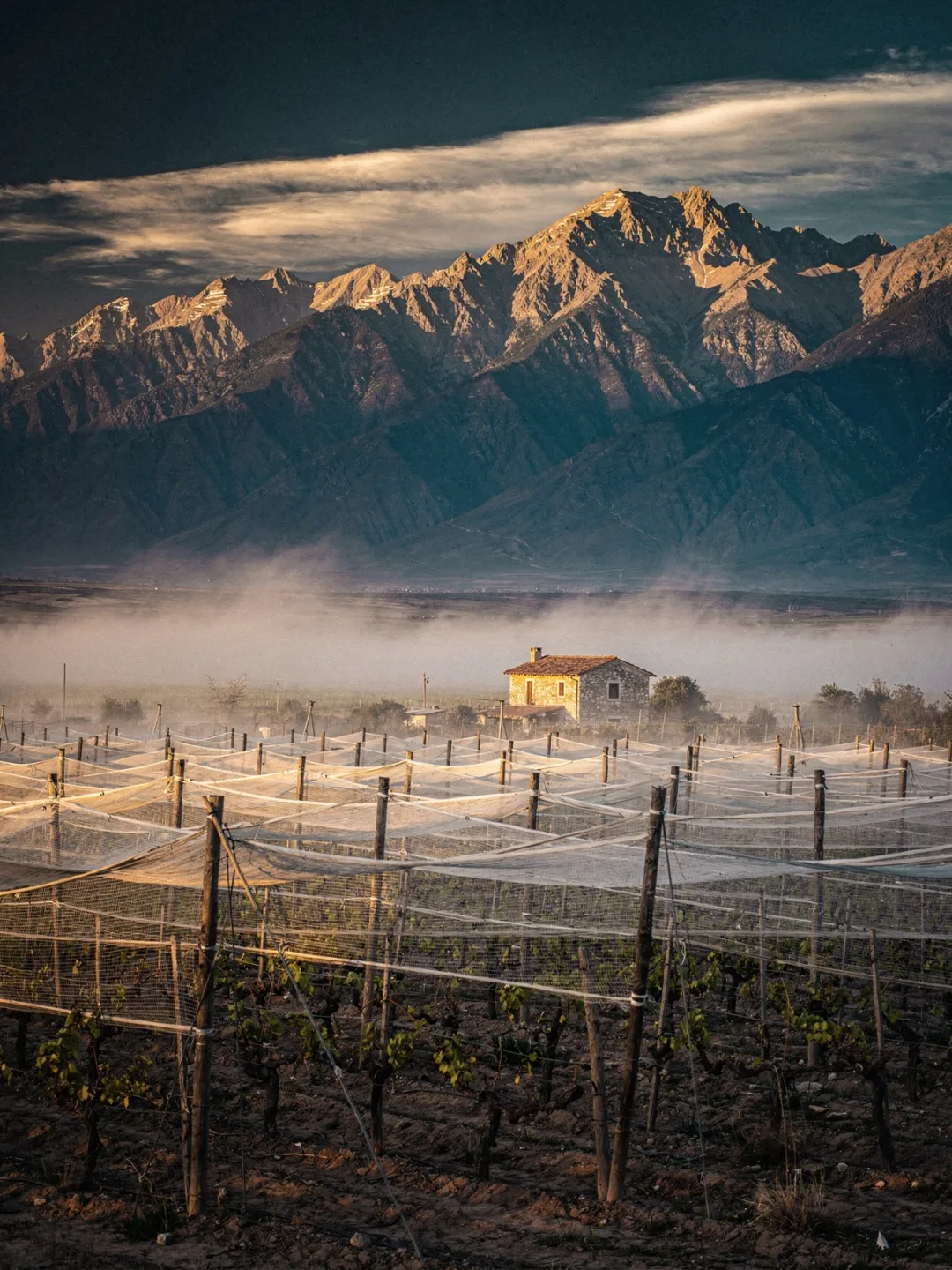
Desert, Altitude, Zonda
Climate
Mendoza lies in a desert, and that's no exaggeration. About two hundred millimeters of rain a year is nowhere near enough for a vineyard, so here every vine lives on artificial irrigation. Without the canals from the mountains, there would be nothing but rubble in their place.
Altitude determines the style. Vineyards in Luján de Cuyo sit between eight hundred twenty-five and just over a thousand meters, while in Gualtallary, the coolest corner of the Valle de Uco, some climb above fifteen hundred. With every hundred meters of altitude, the temperature drops, UV radiation increases, and thicker skins form. The wine becomes tighter, cooler, less dominated by alcohol.
Even more important is the difference between day and night. In summer, the thermometer climbs above thirty degrees Celsius during the day and often drops by fifteen degrees or more at night. During the day, the berry ripens in blazing sun; at night, the cold locks in the acidity instead of letting it evaporate. Without this swing, Malbec would taste flat and tired.
Then there's the Zonda. A warm, dry downslope wind that rushes down from the Andes and can raise the temperature by ten degrees or more within hours. It dries the grapes quickly after rain, preventing fungal infection, but can also scorch young shoots in spring.
Still, the greatest danger comes from above. Hailstorms hit Mendoza almost every year. They cost the province an average of about fourteen percent of the harvest, and far more in individual unprotected sites, which is why many estates stretch tight hail nets over their rows — a sight as much a part of Mendoza as the mountains in the background.