Andean Water and Pouget
Region & History
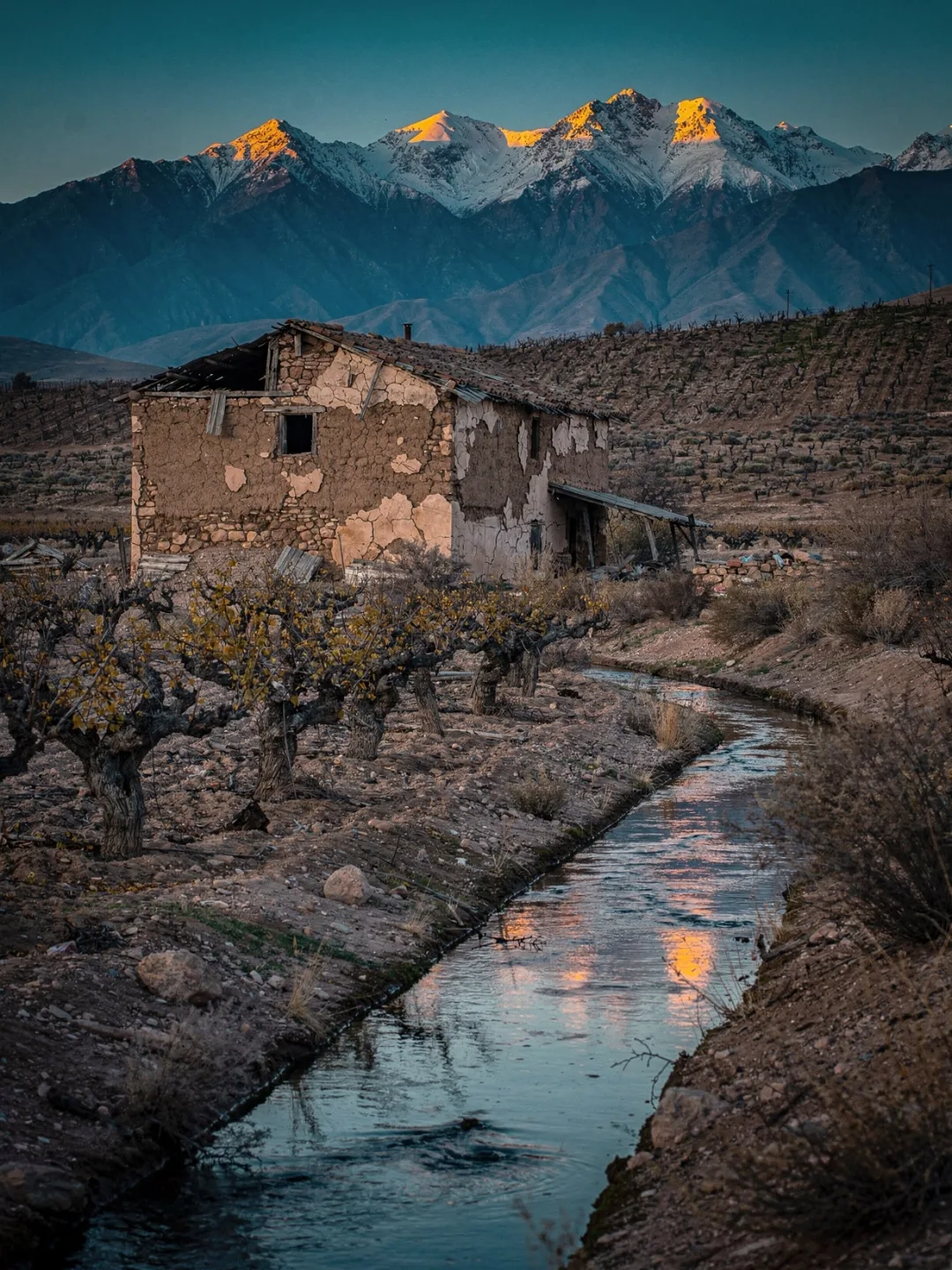
Anyone driving through Mendoza today sees endless green rows in the middle of a brown desert, and that very contrast tells the whole story of the city. Without the Andes, there would be no vineyard here. On average, only about two hundred millimeters of rain fall each year, barely more than in some steppe, and yet every vine drinks its fill of water — from the snow of the mountains.
Long before the Spanish arrived, the Huarpes had already solved the problem. They dug acequias, narrow canals that channeled meltwater from the mountain rivers into the dry plain, laying the groundwork for everything that came later. When Captain Pedro del Castillo founded the city in 1561, he placed it exactly where these canals already flowed. A borrowed system. It still supplies every vineyard in the province today.
Jesuits and Spanish settlers planted the first vines early on, but the great leap came only in 1853. The politician Domingo Faustino Sarmiento brought the French agronomist Michel Aimé Pouget to Mendoza to set up an agricultural school. Pouget brought cuttings from his homeland — Cabernet, Semillon, and a then-insignificant grape from Cahors in southwestern France: Malbec. No one suspected what it would become.
At the end of the nineteenth century, Italian and Spanish immigrants arrived in droves. They brought the Bonarda grape variety with them and further expanded the irrigation oases, so that a desert fringe gradually became one of the largest contiguous growing areas in the world. Even so, for over a hundred years Malbec remained just bulk wine for the domestic market.
It was Nicolás Catena Zapata who turned things around. In the nineties, he planted vines at an altitude where, according to experts, no grape could ripen — in Gualtallary, high up in the Valle de Uco. With a wine that later earned a hundred points, he proved the opposite. Mendoza went from being a supplier of table wine to a world address for Malbec. None of these steps would have worked without the Andes.