Altitude Meets Cellar
Winemaking
In Gualtallary and much of the Valle de Uco, vineyards sit so steep and high that machines barely reach them. The grapes are picked by hand, usually early in the morning while the night's coolness still keeps them fresh. Only afterward does the real work in the cellar begin.
For color and tannin, Malbec stays on the skins for a few days to about two weeks, notably shorter than a robust Cabernet. Longer skin contact means more structure. But it also risks masking the variety's signature violet and plum notes — a balancing act each bodega resolves differently.
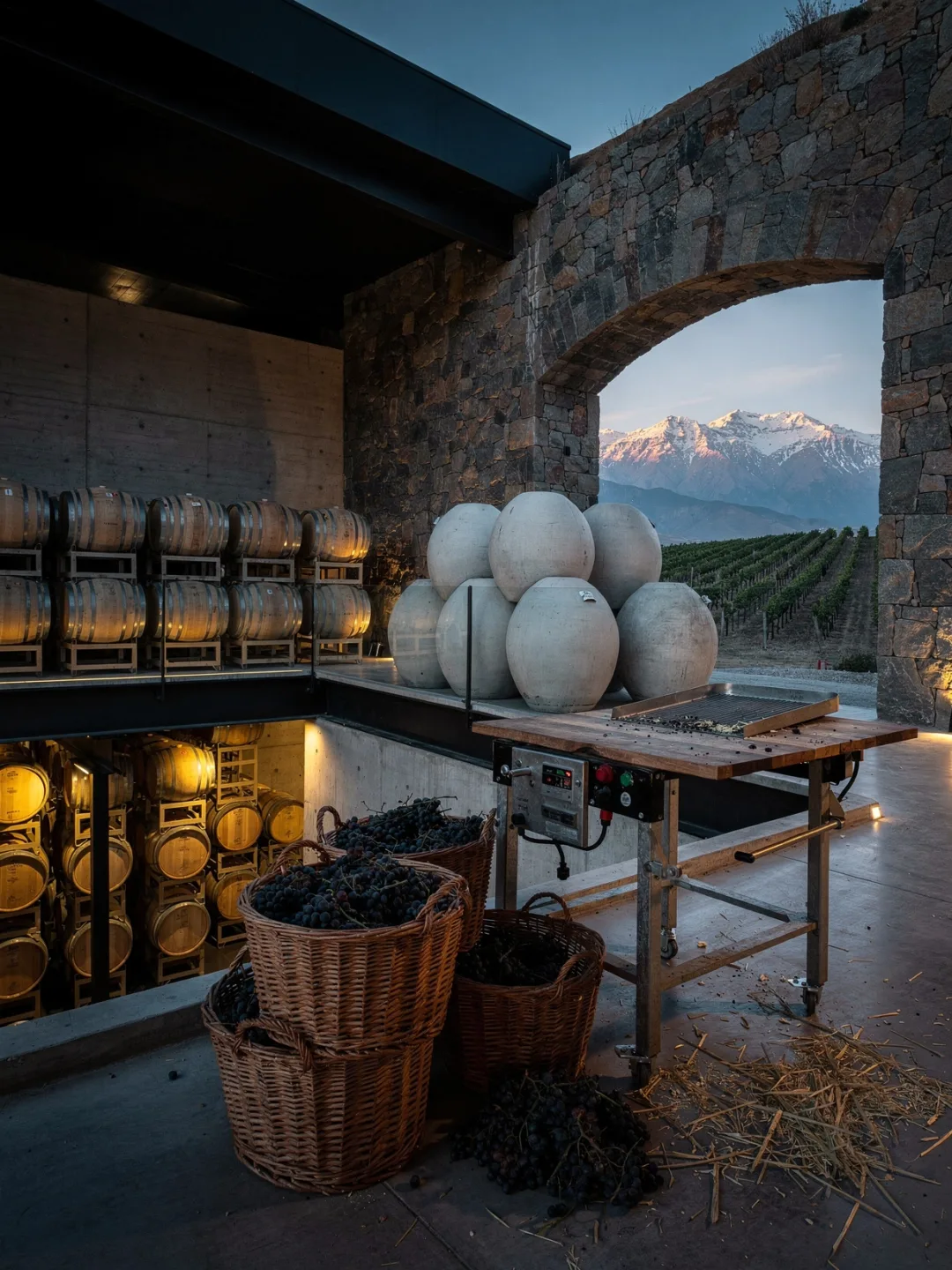
Oak usually follows. French barriques, at two hundred twenty-five liters, lend fine toasty notes, while large old casks let the wine breathe only slowly. In recent years, more and more estates have also been experimenting with concrete eggs and tanks, which impart almost no flavor but round out the texture — Mendoza uses oak more variedly than most wine regions.
Anyone wanting to carry the Luján de Cuyo label must follow strict rules under the DOC, Argentina's highest quality tier. At least eighty-five percent of the wine must be Malbec, from vines at least ten years old. Vines are trained on trellises, with over five thousand plants per hectare. At least eighteen months must pass between harvest and release, with a minimum of six months in oak. Each bottle also carries a numbered official seal.
Argentina's second DOC is San Rafael, in the south of the same province, with similarly strict requirements. Both seals are rare to find on the label, since most bodegas prefer to sell their Malbec under their own name rather than the appellation rule — the variety's reputation now carries itself.