Terraces & Fragipan
Soils
Dig a hole in the Alto Valle. In the first twenty to thirty centimeters, you'll find a fine, silty soil, deposited over millennia by the repeated overflowing of the Río Negro and Río Neuquén. Organic matter is almost nowhere to be found, because in this dryness almost nothing left on the ground ever rots.
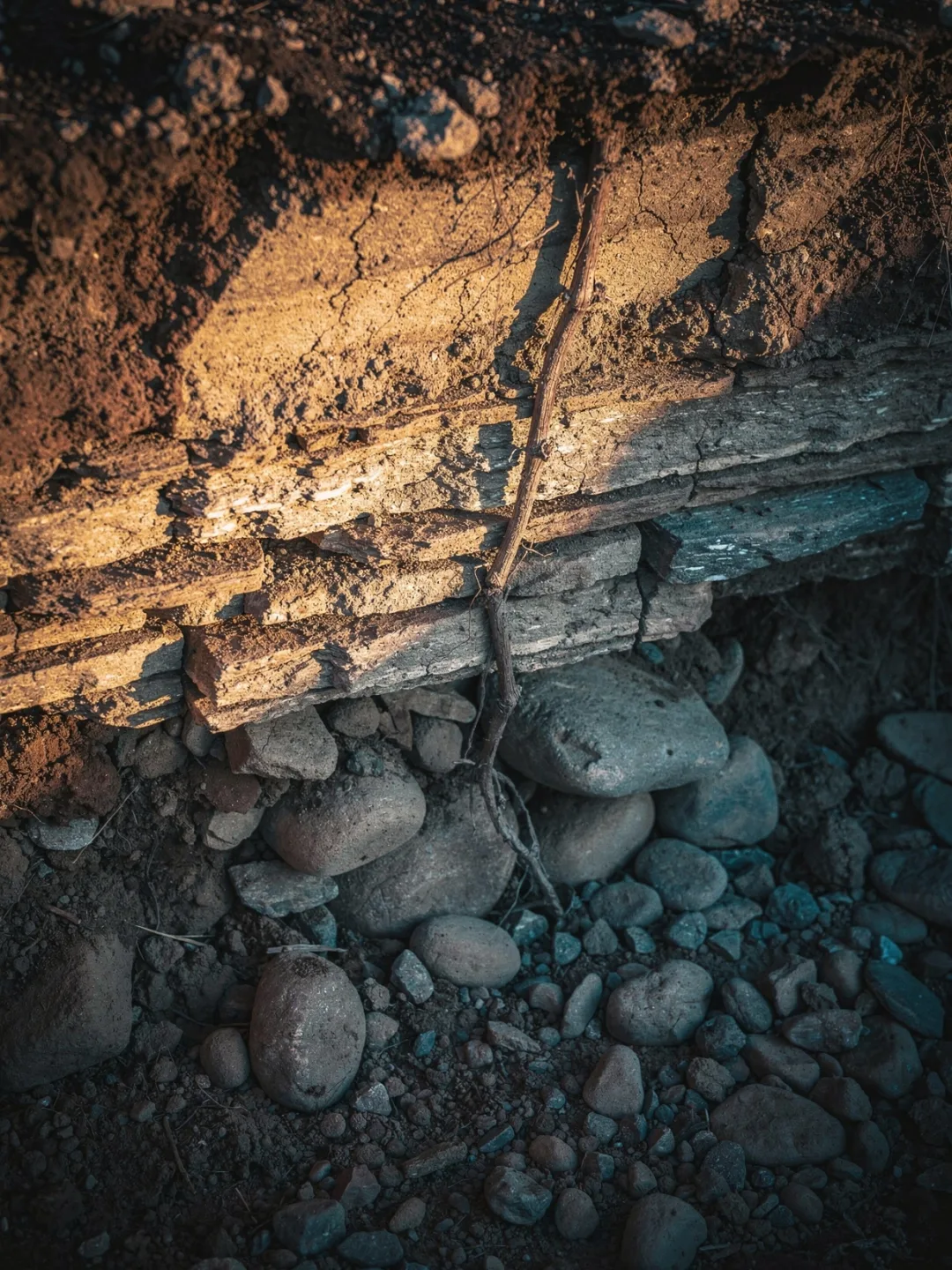
Below that, things get complicated. Soil scientists call the region an Aridisol, a desert soil. In many plots there lies a hardened layer, a so-called fragipan: dry, it's almost like concrete, but wet, it turns brittle and platy, as if someone had stacked thin tiles on top of each other. A study at sixty-one measurement points across the Alto Valle found a clear correlation for Merlot, Malbec, and Cabernet Sauvignon. Where this layer sat higher than thirty centimeters and offered more than three megapascals of resistance, the vines had less leaf area and lower yield.
For the root, this is a wall it must grow along rather than through. Some manage it anyway, forcing their way through cracks and fine fissures. Below waits the reward: an old river terrace of coarse gravel, known locally as ripio, which holds the water that the irrigation canals replenish from above. Roots that reach this depth sustain the plant even through weeks without rain. Patagonia has plenty of those.
In the vineyards of San Patricio del Chañar, across the Río Neuquén in the neighboring province, the same principle looks different. There, the vines sit on the slopes of the bardas, eroded plateaus of clay-limestone sediment interspersed with rubble. The rock is younger and looser than in the Alto Valle, but demands the same adaptation from the roots. Two provinces, two kinds of rock, one rule: whatever has to fight its way through ends up concentrating more aroma in the berry than what has it easy.
Fine, silty alluvial soil from the flooding of the Río Negro and Río Neuquén. Almost no humus, because in this dryness almost nothing rots.
The root: Here lie the fine roots, waiting for the next canal irrigation — rain almost never comes on its own.