Limestone & Flint
Soils
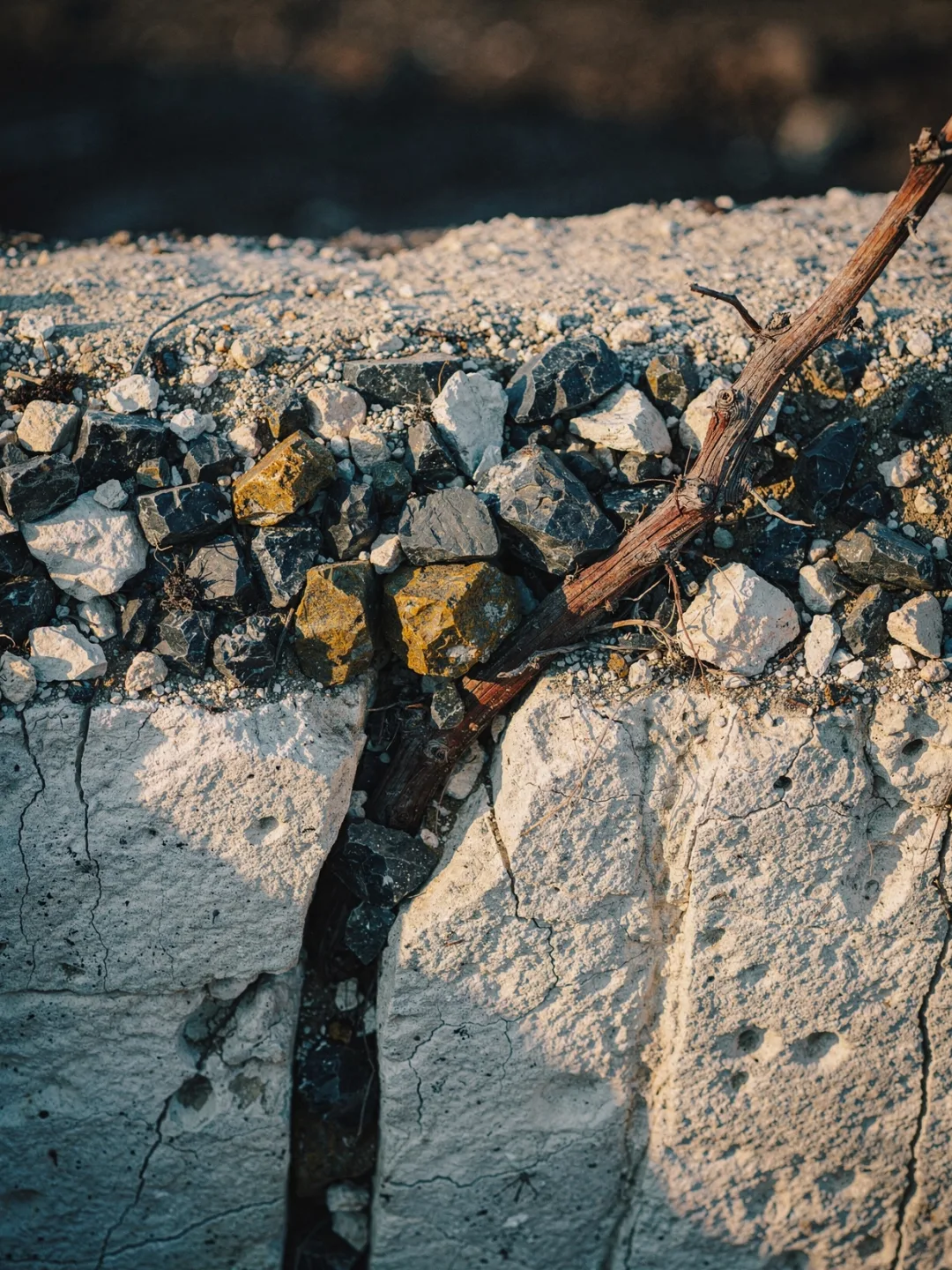
Dig a hole in the Valle de Pedernal, and after just a few shovelfuls, the first pale pebble jams between the teeth of the tool. This is pedernal itself, Spanish for flint. The region earns its name: limestone and flint nodules lie so densely here that you can barely dig twenty centimeters without hitting stone.
This limestone is ancient. It formed roughly 485 million years ago on the floor of a sea long since vanished, and has since been pushed upward by the folding of the Andes. Such geologically marine limestone soils are a true rarity in Argentine winegrowing. Most of the country's growing areas instead sit on younger, alluvial material washed down from the mountains.
The effect in the vineyard works two ways. First, limestone retains water better than pure sand and releases it slowly, crucial in a region with barely a hundred millimeters of rain a year. Second, the hard rock forces the roots to push through cracks and fissures rather than spreading comfortably outward. This resistance is exactly what produces smaller berries with thicker skins.
Down in the Valle de Tulum, where most of the province's vines grow, things look very different. There, the Río San Juan has deposited sand, silt, and gravel over millennia — loose material with almost no limestone. Sand makes it hard for phylloxera to spread, which is why ungrafted, own-rooted vineyards still stand there today. That said, the pest has recently been detected in isolated cases in San Juan as well, including at one estate in the Departamento Caucete.
Between the two soils lies a difference you can taste in the glass without knowing the origin. Tulum wines taste richer and more open, since the vine finds little resistance in the soft sand. Pedernal wines feel tighter, with more acidity and a fine-grained tannin reminiscent of wet limestone dust.
A thin layer of fine sand and angular limestone rubble, barely darkened by plant matter — the aridity here leaves almost no room for humus to form.
The root: Only the fine roots stay near the surface. They take up whatever the drip irrigation just delivered, and are the first to dry out when it stops.