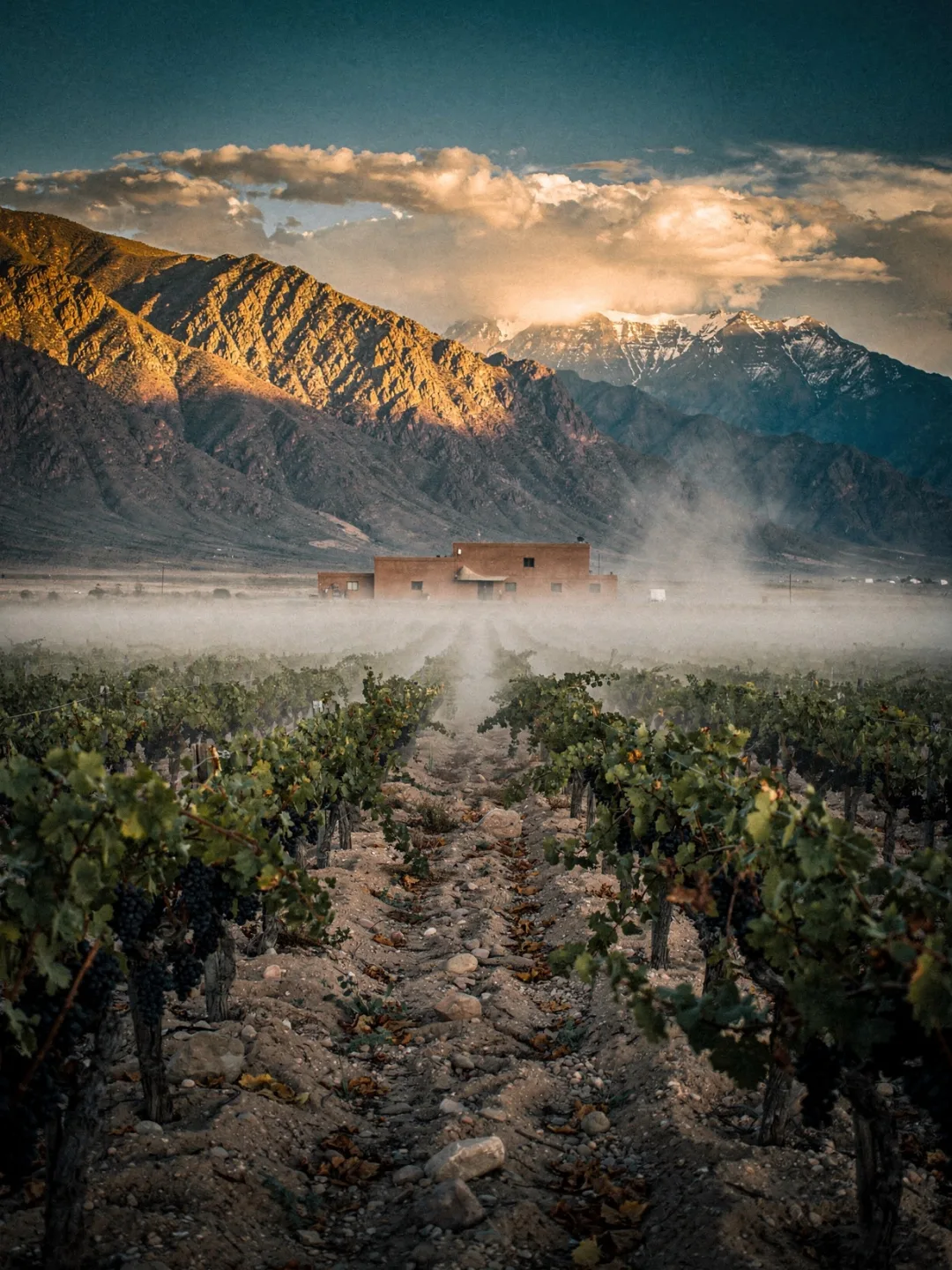
Desert & Zonda
Climate
San Juan lies in one of the driest wine regions in the world. Barely a hundred millimeters of rain fall each year, less than in some deserts. Without the snowmelt from the Andes, there wouldn't be a single vineyard here. Every drop counts. It arrives through a canal system older than the province itself.
What's lacking in rainfall is made up for by elevation. In the Valle de Tulum, the largest and lowest-lying growing area, the vines sit at around six hundred meters and ripen in blazing heat. In the Valle de Pedernal, further into the foothills, they stand between 1,300 and 1,600 meters, where temperatures swing by more than twenty degrees between day and night. This swing locks in the berry's acidity while the sun still delivers ripe aromas during the day.
Calingasta, further west and even higher, surpasses even that and ranks among the coolest zones in the entire province. Plant the same grape variety in Tulum and in Calingasta, and you get two different wines — more power below, more freshness above.
Then there's a wind that has lent the province one of its most famous names twice over: the Zonda. It forms as moist air over the Pacific, loses its moisture climbing over the Andes, and comes down the eastern side dry and superheated. It's a classic foehn wind, named after the Quebrada de Zonda, the gorge through which it breaks into the valley. Between May and November, it can drop humidity sharply within just a few hours.
For the vines, this is no marginal phenomenon. The Zonda typically hits the province during flowering, noticeably draining moisture from the shoots, and can shrink entire vintages. Winegrowers watch the weather forecast more closely here than almost anywhere else. Because against a downslope wind off the Andes, neither netting nor fencing offers any protection.