Sand over Ironstone
Soils
Dig a hole in an Adelaide Hills vineyard. First you'll hit a pale gray, sandy loam, loose and poor in nutrients, which dries out quickly in summer. That's exactly what the vine likes, because whoever finds nothing must search.
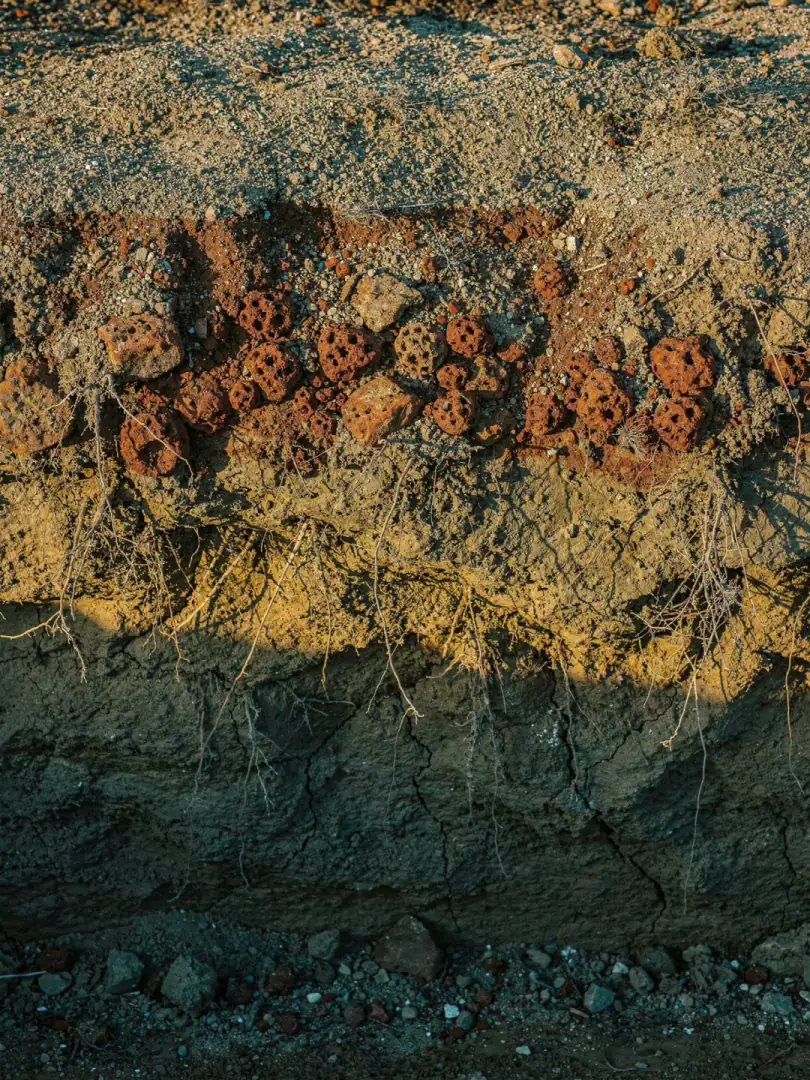
Just a few hand-widths down, the soil changes abruptly, not gradually. Such transitional soils are called duplex soils in Australia. The boundary here is often sharp enough to feel with your bare hand: loose sand on top, and suddenly, underneath, tough red clay with chunks of ironstone that look like small, rusty pebbles.
This ironstone is more than a curiosity. Where sand meets clay, water briefly pools after rain, and the root has to force its way through the hard layer instead of simply growing deeper. That takes effort. It curbs yield and concentrates more flavor into fewer berries.
Deeper down, beyond the root zone of most vines, dense, acidic clay awaits, holding water for a long time. It serves as the reserve for the dry weeks in February, when the Adelaide Hills' rain is long gone. How deep a root reaches determines the vine's entire summer.
Because South Australia was never reached by phylloxera, some vines in the Piccadilly Valley and Lenswood still stand on their own roots today, without American rootstock. These roots have known the transitional soil for decades. They have learned to live with its hard boundary — an advantage that many younger vineyards around the world no longer have.
McLaren Vale, barely an hour's drive south, is rooted instead in limestone and dark clay, almost at sea level. The duplex soil with its sharp transition from sand to clay belongs solely to the hills above Adelaide.
Pale, sandy loam, loose and low in nutrients. It's the first to dry out in summer.
The root: Fine roots search here for every last scrap of nutrient and are the first to suffer in drought.