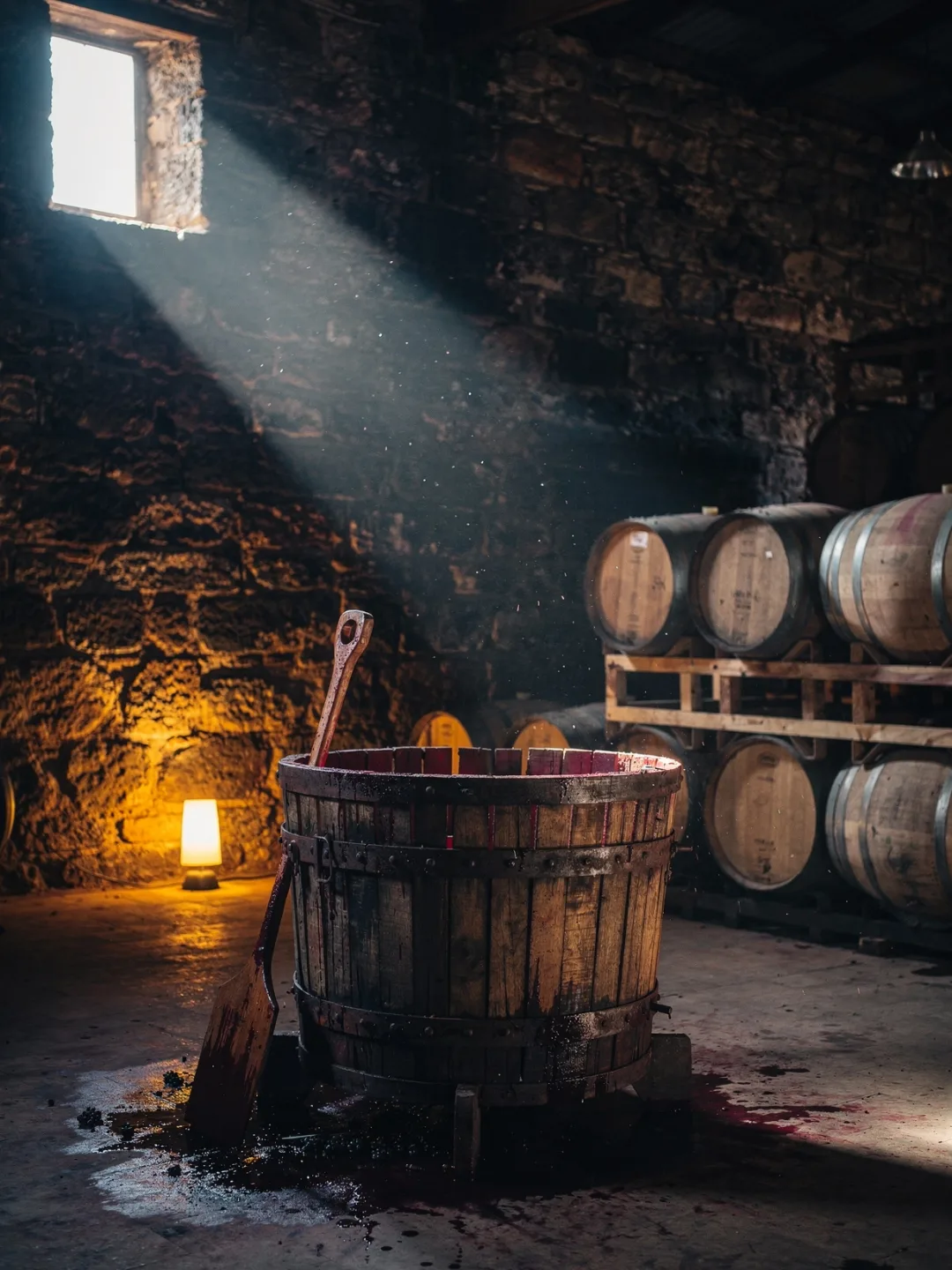
Basket press & bush vines
Winemaking
Many of the oldest vineyards in the valley grow as bush vines: no wire trellis, no espalier, just a single trunk spreading out in every direction. This is how the first settlers brought them from Europe. Without a trellis, every vine has to be pruned by hand. Often it's also harvested by hand, since a mechanical harvester can barely navigate between the unruly shoots.
Irrigation is kept to an absolute minimum. An old, unirrigated vineyard sends its roots deep into the clay, where residual moisture from winter still lingers. In return, it yields significantly less than an irrigated vineyard in the valley. Lower yield means smaller berries, and smaller berries mean more color and tannin relative to juice.
In the cellar, a producer like Rockford in Tanunda deliberately sticks to old techniques. An oak basket press weighs down the must from above, and the juice is pressed out from the sides rather than through a modern pneumatic press. The process is slower and yields less juice per grape. In exchange, the juice comes out of the skin more gently, pressing out fewer bitter seeds along with it.
Because most old vines stand on their own, ungrafted roots, the character of an individual vineyard changes little over the decades, and a winemaker harvesting grapes from the same block today as his grandfather did is working with genetically identical vines. This is something few other wine regions in the world can still claim since the phylloxera catastrophe.
With the GSM blend, much is decided only in the cellar. The three varieties, Grenache, Shiraz, and Mataro, ripen at different rates. They're often fermented separately and only brought together in barrel months later. This lets the winemaker fine-tune the ratio by taste, rather than fixing it in the vineyard. Every vintage remains a fresh decision, not a set recipe.
Some producers filter such wines minimally or not at all, to avoid losing aroma and structure. As a result, tartrate crystals sometimes settle at the bottom of the bottle: small, harmless crystals of tartaric acid that precipitate out when chilled. Anyone who lets the bottle stand for a moment before pouring won't find any in the glass.