Slate & Ironstone
Soils
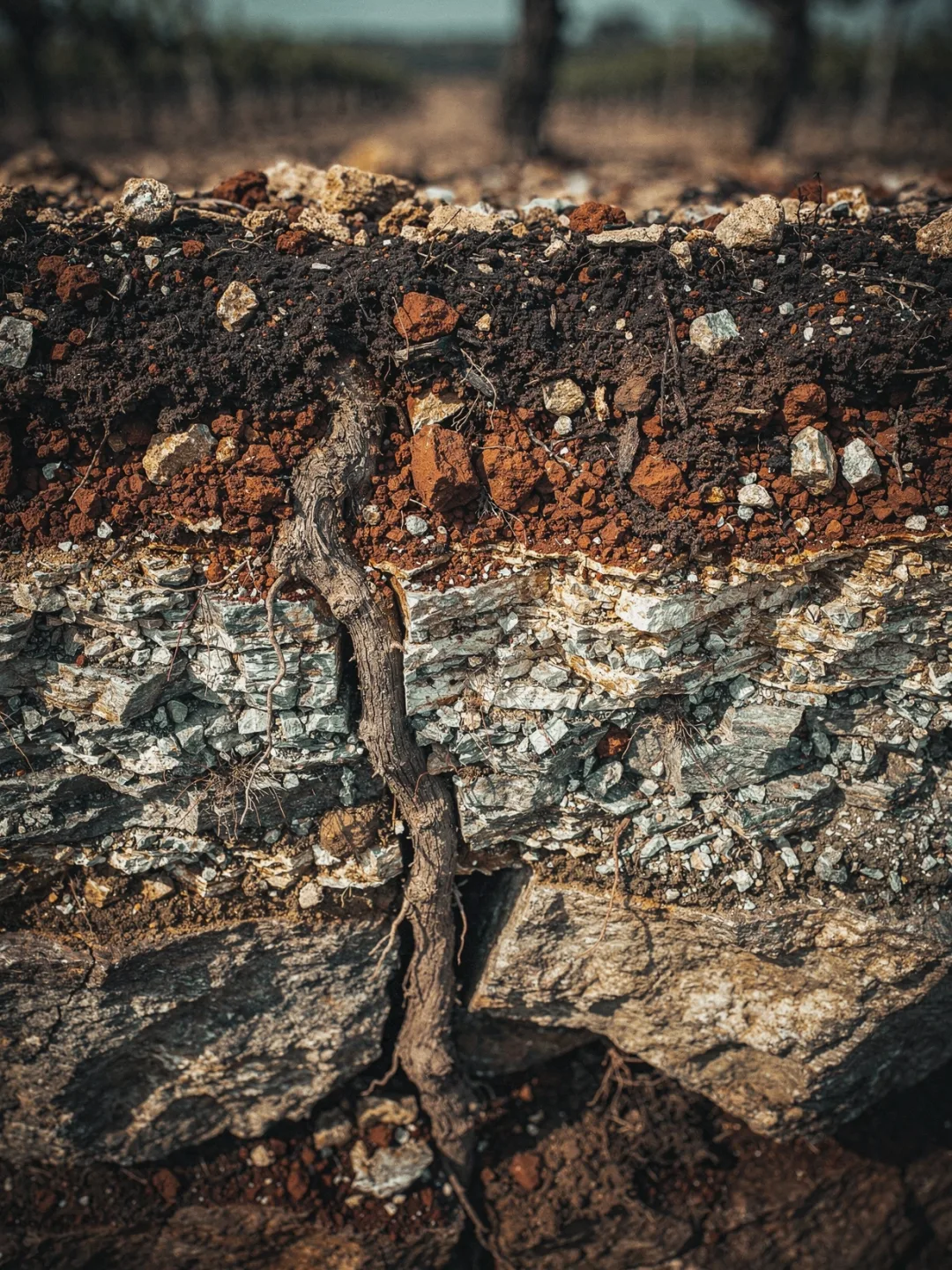
Take a close look at a handful of soil from a vineyard in the Eden Valley. Among the grey-brown clay lie angular fragments of ironstone and quartz. Mixed in is slate that crumbles almost into splinters when you rub it between your fingers. This ground is ancient: the rock beneath the Barossa Ranges formed around five hundred million years ago, long before land plants even existed.
On many slopes, weathered mica schist lies beneath the thin layer of clay — a rock that breaks into thin, glittering plates. It holds almost no water, forcing the vine's roots to squeeze through the cracks. They grow deep in search of moisture that has long since evaporated at the surface.
This very leanness of the soil is what keeps the berries small. A small berry has proportionally more skin than juice. The skin is where color, tannin — that furry sensation on the gums after a sip of red wine — and most of the aromas reside. That's why Shiraz and Riesling from these lean hillside sites often taste more concentrated than wines from the deeper, richer soils at the region's edges.
The ground isn't uniformly hard everywhere. In flatter, low-lying spots, deeper sandy clays appear, mixed with fragments of sandstone and broken slate. These hold more water and yield fuller, but less concentrated, grapes. Two vineyards just a few hundred meters apart can therefore produce entirely different wines, without anything being done differently in the cellar.
One misconception persists here as much as anywhere: that minerals from the rock supposedly travel through the roots straight into the glass, producing that so-called "mineral" taste. That's simply not how it works. What the roots actually absorb are dissolved ions in vanishingly tiny amounts — far too little to taste. The soil works indirectly instead, through the warmth the stones store and through the water it holds, or fails to hold.
Grey-brown clay with angular fragments of ironstone and quartz, often only a hand's depth.
The root: This is where the fine roots sit. They're the first to come up empty in a drought.