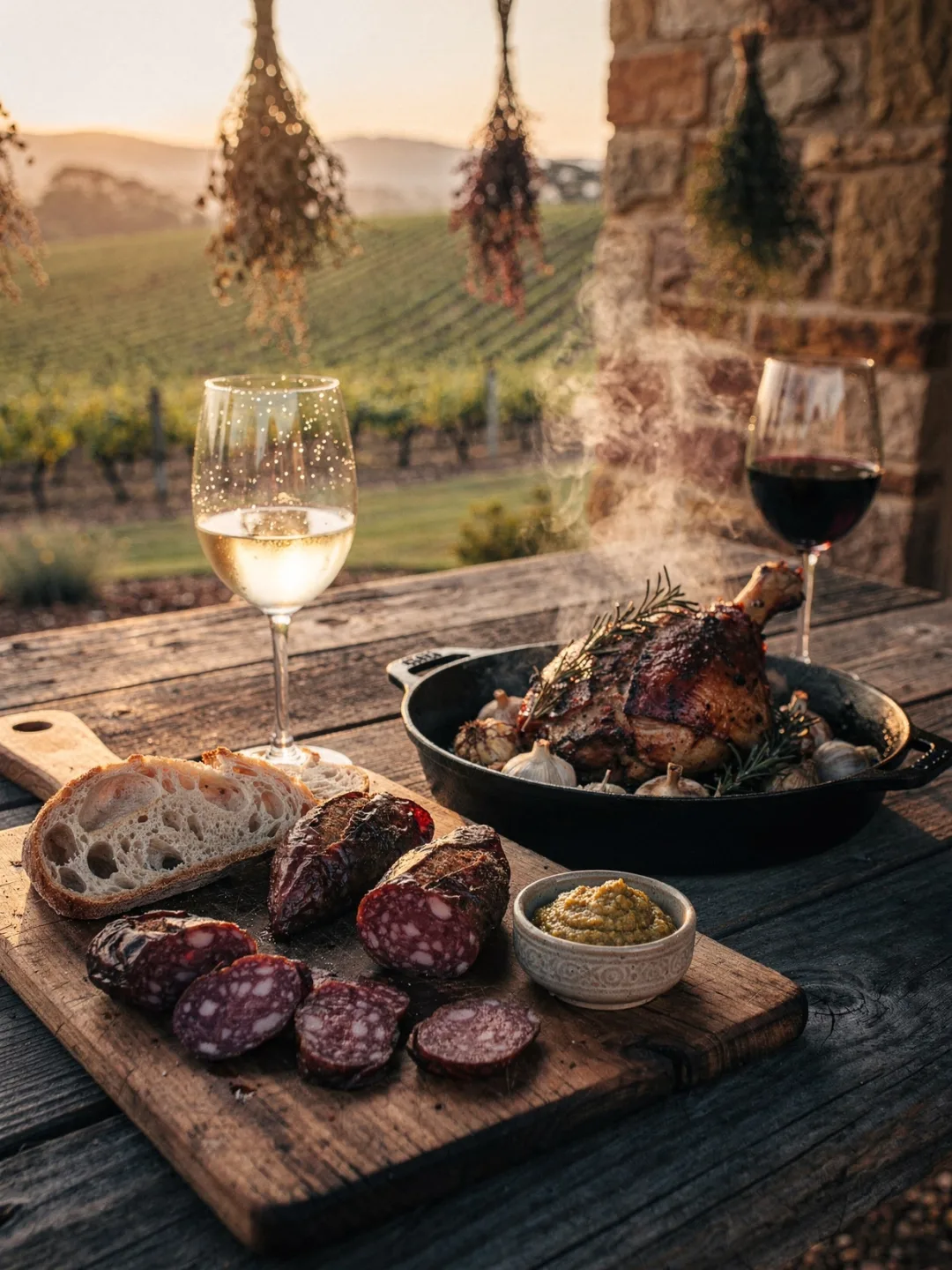
Mettwurst & Lamb
Wine & Food
At the table in the Eden Valley, you often encounter the same story as in the vineyard: German immigrants who brought their recipes along and adapted them to their new home. Lutherans from Silesia and Brandenburg arrived in Springton in the nineteenth century, bringing with them the skill of smoking meat — a skill that mattered even more in the dry Australian heat than it had back in the old country.
This tradition gave rise to mettwurst, a smoked, lightly spiced raw sausage still made today in the region's family butcheries. Once a year, at the so-called Schweineschlachten, or pig slaughter, entire families would spend two days turning a slaughtered pig into sausages, bacon, and ham. This work brought neighbors together long before refrigerators existed.
Hardly anything pairs as well with a smoky, spicy mettwurst as a dry Riesling from the Eden Valley. Its acidity cuts through the sausage's fat without drowning out the smoky flavor. The citrus note works like a squeeze of lemon over a hearty plate. A warmer, softer white wine, by contrast, would make the same sausage feel heavy and flat.
The more powerful Shiraz calls for meat with more heft. Slow-grilled or braised South Australian lamb, seasoned with rosemary and garlic, stands up to the wine's dark fruit and firm tannin without being overwhelmed by it. The peppery note in the wine echoes, almost casually, the spice on the plate.
This closes a circle that begins in the vineyard and ends at the table. In the nineteenth century, the same families built vines and smokehouses side by side, laying the foundation for two things that still belong together in the Eden Valley: a wine with edges, and food that has something to hold against them.