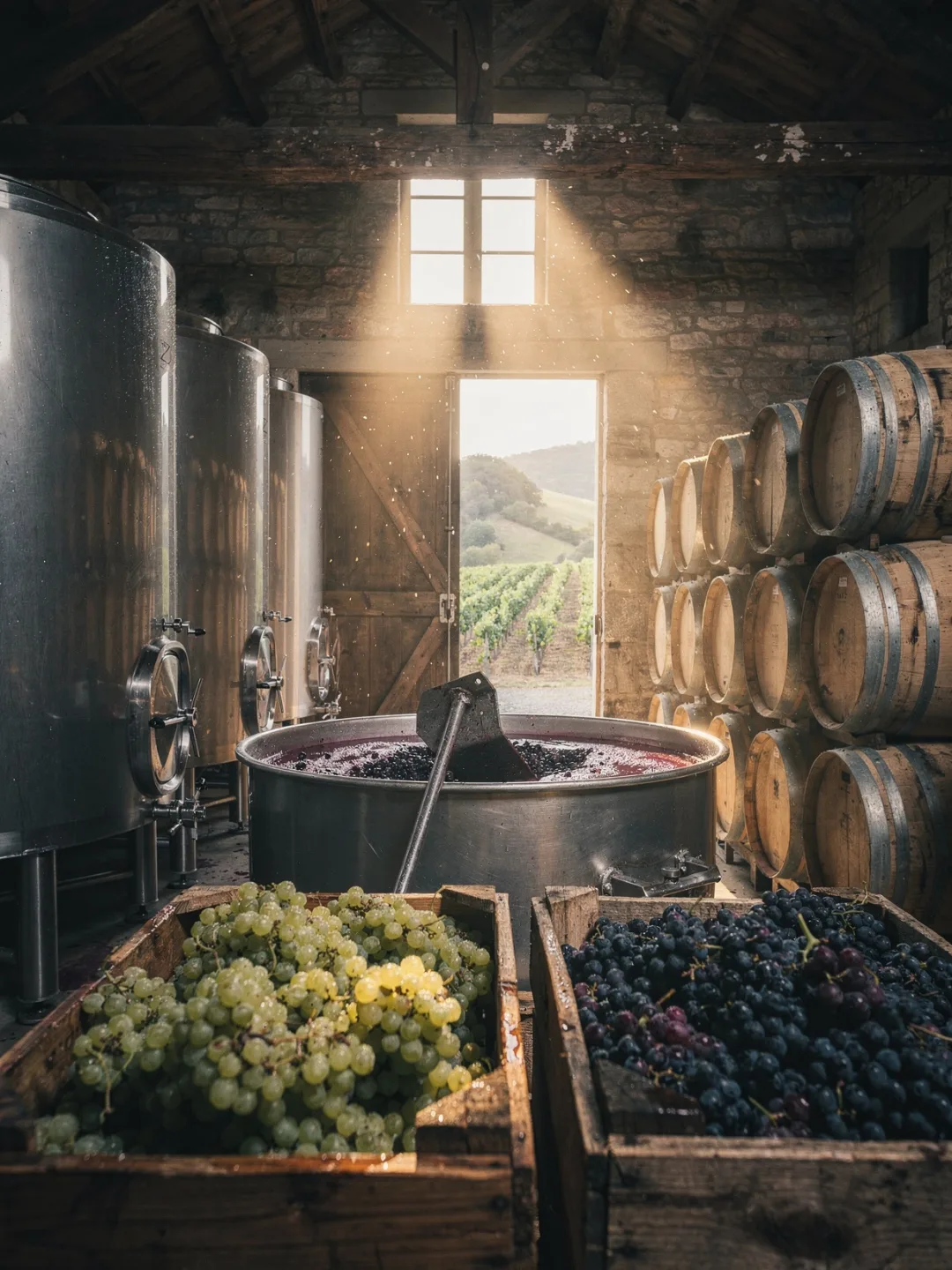
Steel Tank & Foudre
Winemaking
Riesling and Shiraz take almost opposite paths through the cellar in the Eden Valley. For Riesling, speed is everything. The grapes come in early in the morning, still cool from the night, are pressed gently, and ferment at low temperature in stainless steel. No oak, no malolactic fermentation — just what the grape brings, carried into the glass as unchanged as possible.
This restraint has a reason: any extra step in the cellar risks masking the fine citrus and floral aromas that define the wine. The naturally high acidity of grapes from the cool elevated sites makes malolactic fermentation unnecessary anyway. Many producers bottle the finished wine just a few months after harvest, often under screw cap, which preserves freshness longer than cork.
Shiraz demands exactly the opposite patience. After harvest, the must stays on the skins for several days so that color and tannin from the small, thick-skinned berries of the high-elevation sites can fully transfer into the wine. Handwork is standard practice here; cellar hands punch down the cap of skins several times a day so it doesn't dry out and lose its aromas.
Afterward, the wine often ages one to two years in oak, mostly American oak, which lends the robust Shiraz notes of vanilla and coconut without overwhelming the dark fruit. Some producers, not far from Pewsey Vale, blend in a small proportion of Cabernet Sauvignon, adding extra structure and firmer acidity.
At the end of the chain, for the Eden Valley's best-known wines, one more rule applies on the label. A wine may only carry the "Eden Valley" designation if at least eighty-five percent of the grapes genuinely come from there. This is Australia's general rule for region, variety, and vintage, not a special regulation limited to this area.