Riesling & Shiraz
Grape Varieties
Two varieties divide up the Eden Valley almost entirely between them. Shiraz covers a good third of the vineyard area, Riesling just under a quarter, which already accounts for more than half the region. The rest is mostly Cabernet Sauvignon and a little Chardonnay. Yet it's the two main varieties that give the place its character: a cool, austere white wine and a dark, spicy red from the same range of hills.
Riesling took a roundabout path to its current reputation. For decades, almost any white wine in Australia could be called "Riesling." The real thing was therefore sold as "Rhine Riesling," while in Sydney even Semillon was bottled as "Hunter River Riesling." The Eden Valley never really had this problem, though, since actual Riesling had been in the ground here from the very start, ever since Joseph Gilbert's first planting. Dry, with high acidity and a scent of lime and jasmine blossom — this is exactly the style making the variety famous again today.
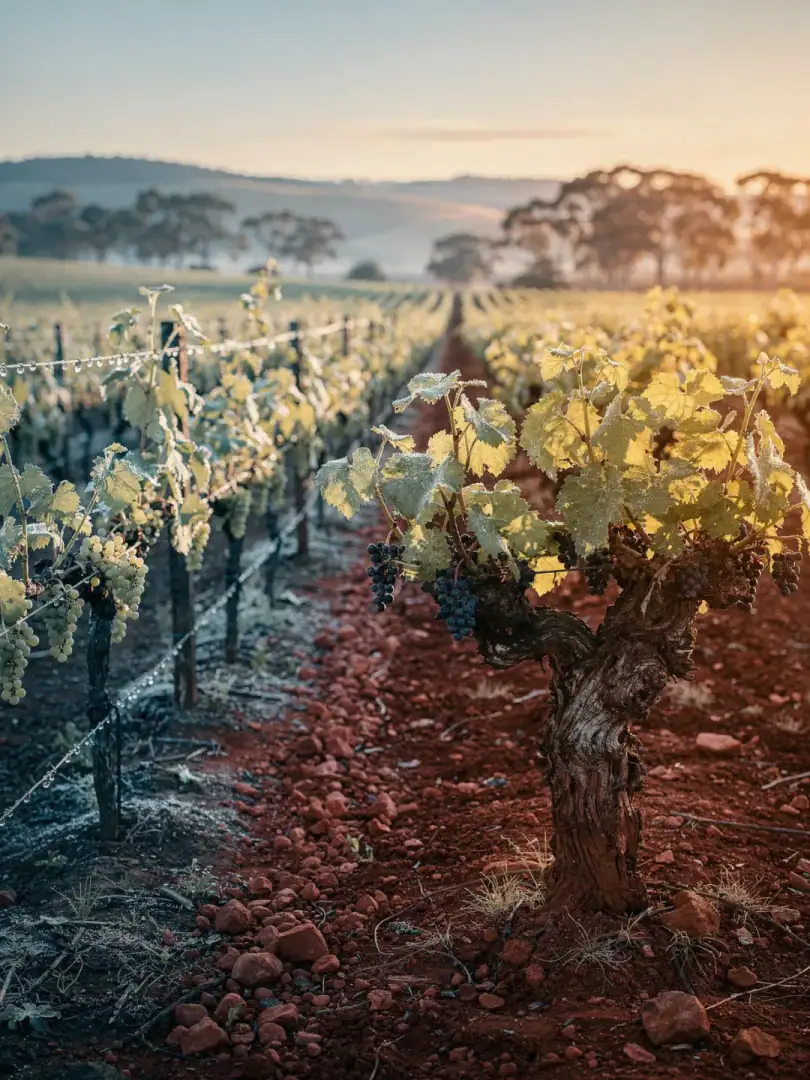
Shiraz grows here under different conditions than in the warmer Barossa Valley just a few kilometers downhill. The grapes ripen more slowly and stay smaller. At Henschke, some Shiraz vines have stood ungrafted on their own roots since the 1860s. Phylloxera never reached South Australia, so these vines never had to be grafted onto resistant American rootstock, as has long been standard practice elsewhere in the world. They now rank among the oldest Shiraz vines anywhere still producing fruit.
Cabernet Sauvignon arrived later and benefits from the same cool nights as Riesling, though it tends to stay leaner than in warmer sites, with more herbal character and less jammy fruit. It's often blended with Shiraz to add structure. Chardonnay is the smallest of the four main varieties, growing in the highest, coolest spots in the region — exactly where Riesling also thrives best.