Cabernet & the Gingin Clone
Grape Varieties
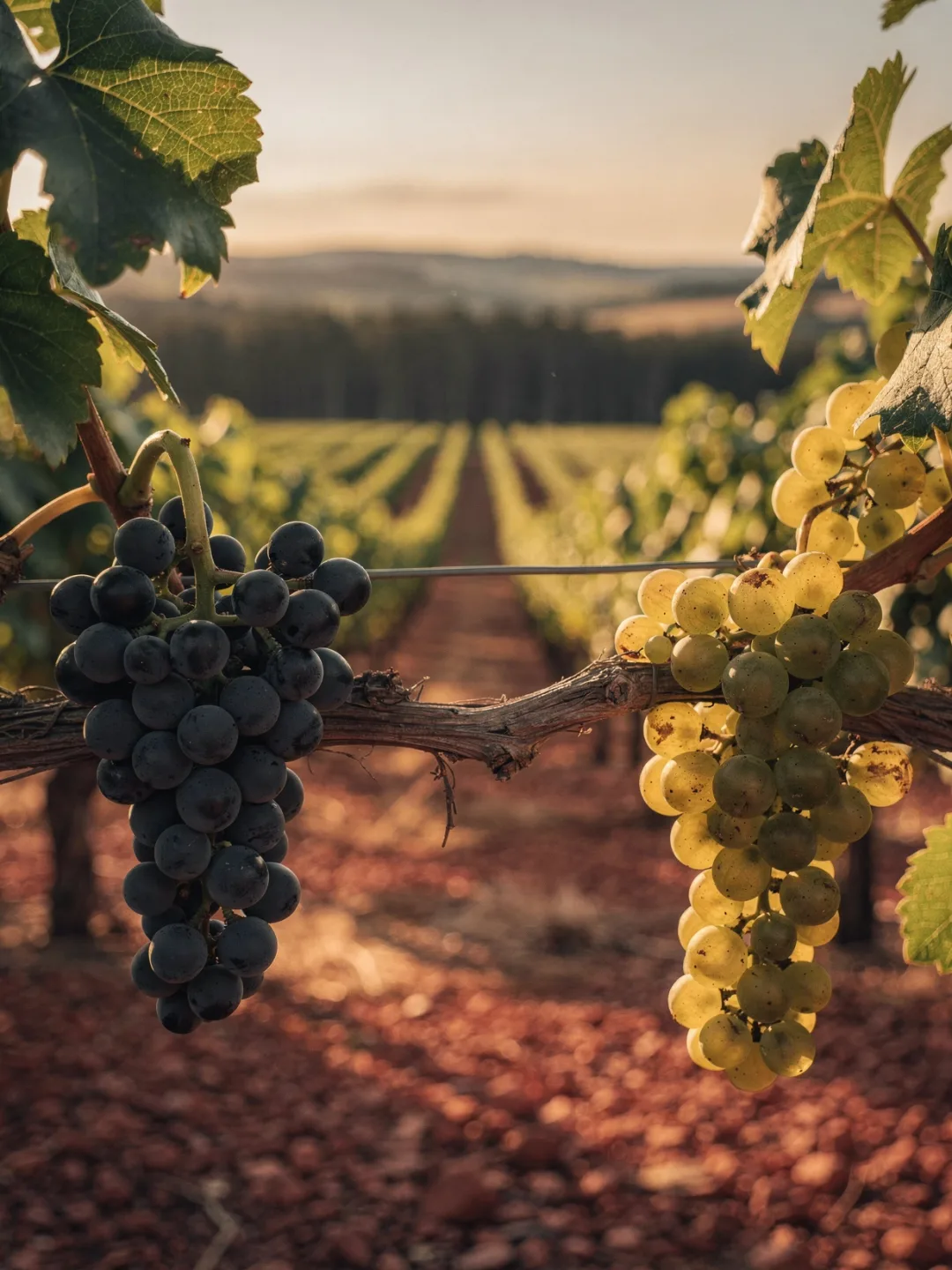
The region splits roughly forty-sixty between red and white. Even so, most people think first of a single red wine when they hear the name Margaret River. Cabernet Sauvignon supplies a good half of the red harvest and forms the backbone of the Bordeaux-style blends that made the region internationally famous.
Cabernet Sauvignon rarely appears as a single varietal in the glass. Winemakers blend it with Merlot for more body, with Cabernet Franc for herbal notes, and in small amounts with Malbec or Petit Verdot for color and spice. It's the same idea as in the Médoc, just with considerably more sunshine and an ocean acting as the refrigerator. Shiraz follows as the second red variety, with around thirty percent of the red harvest, though it comes across as noticeably less austere than the Cabernet.
Among the white varieties, the larger acreage belongs to Semillon and Sauvignon Blanc, which are almost always co-fermented here rather than kept separate. The blend is known locally simply as SSB and tastes of gooseberry and freshly cut grass. It's usually drunk the year after harvest, while that freshness is still intact.
More famous than either, though, is Chardonnay, even though it covers less land. Its reputation rests on a single mother plant: the Gingin clone. American vine researcher Harold Olmo brought it to Western Australia in 1957, originally just to help detect vine diseases, not to make wine from it. From this plant, Denis and Trish Horgan propagated vines for Leeuwin Estate, Moss Wood, and Cullen in 1976 and 1978.
The Gingin clone is famously temperamental. Its berries set unevenly, so a single bunch can carry tiny and normal-sized berries side by side. Winemakers call this 'hen and chicken.' It's bad news for yield. For concentration in the glass, though, it's exactly right, since the tiny berries are made up of almost nothing but skin.